Three Days After My Husband’s Funeral, His Adult Sons Told Me That “Bloodline” Meant They Deserved the House and Family Business, Gave Me 30 Days to Move Out, and Said $200,000 Was More Than Enough for Me to Start Over—Even Though I Had Spent 22 Years Helping Their Father Build That Company and Cared for Him Alone Through His Final Illness
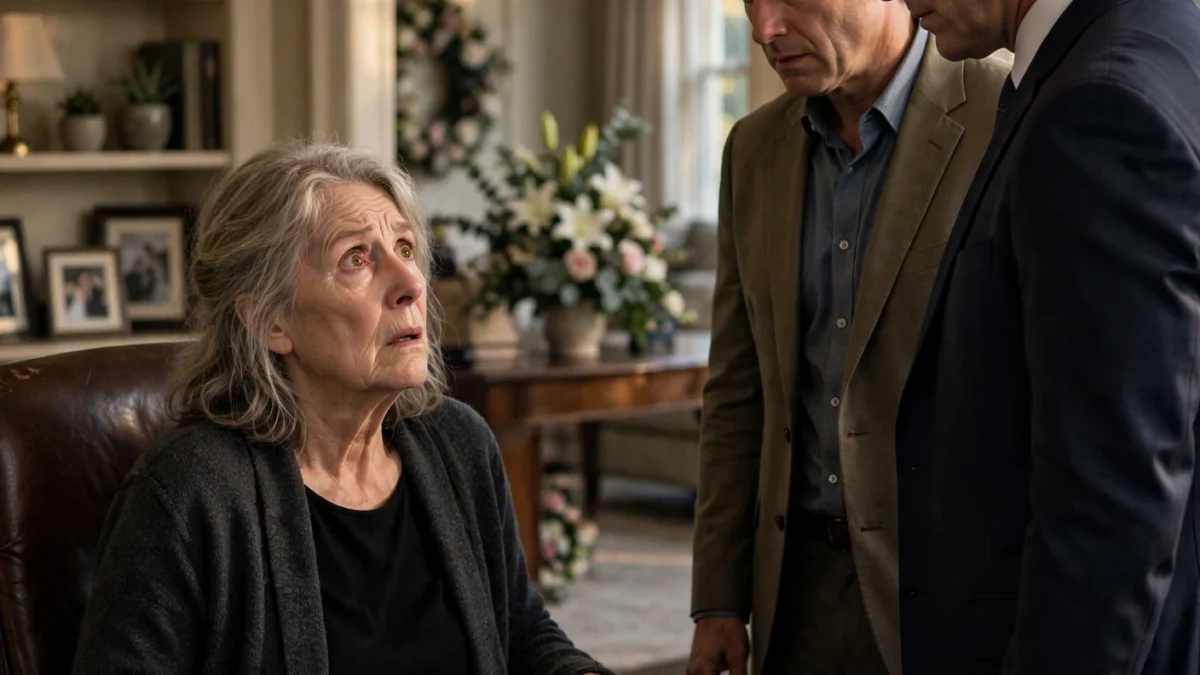
The funeral flowers were still fresh when Sydney and Edwin came to discuss my eviction.
That sounds harsher than what they actually said.
They used phrases like transition.
Estate administration.
Practical arrangements.
Family continuity.
People can make almost anything sound civilized when they put enough business language around it.
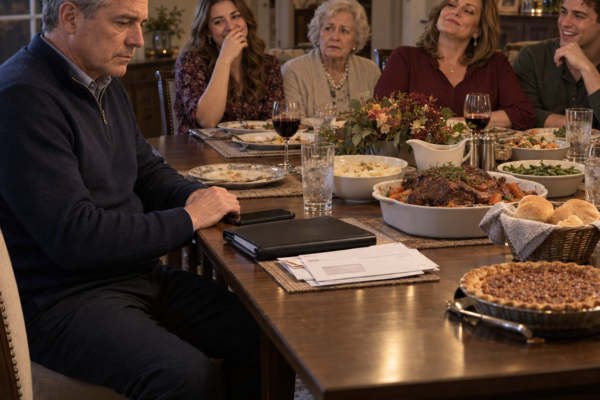
Floyd had been dead for three days.
I was sixty-three years old.
We had been married for twenty-two years.
And his two adult sons had decided the most urgent matter after burying their father was explaining where I would live next.
We met in Floyd’s home office.
I sat in his old leather chair.
Sydney remained standing.
He was forty-five, a corporate attorney in San Francisco, polished in the way men become when they learn early that looking certain is almost as useful as being right.
Edwin sat beside the desk.
Forty-two.
Less aggressive than his brother but somehow more irritating because everything he said arrived wrapped in concern.
“We know this is difficult,” Edwin began.
I looked at him.
During Floyd’s final three months, neither son had spent more than a handful of nights in Sacramento.
Sydney had court.
Edwin had clients.
Flights were inconvenient.
Traffic from Los Angeles was terrible.
There was always an explanation.
I had been the one measuring medication.
Speaking with doctors.
Helping Floyd walk to the bathroom at two in the morning.
Listening when he was afraid.
Holding his hand when he died.
Now Edwin was telling me how difficult things had been for all of us.
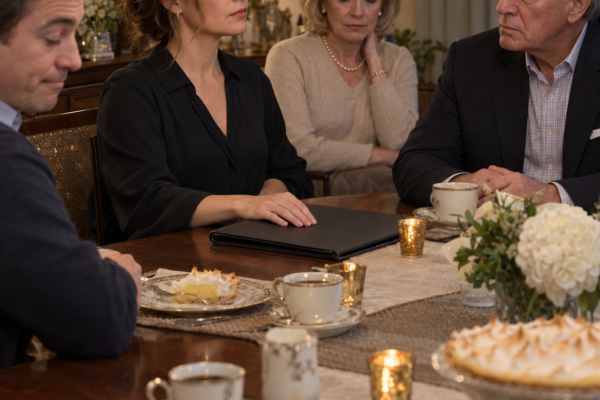
Sydney opened the folder.
He went through the estate structure.
The house passed to the sons.
So did Floyd’s controlling interest in Whitaker Contract Furnishings.
The Lake Tahoe property would eventually be sold and divided between them.
I received a life-insurance payout of roughly two hundred thousand dollars and my personal belongings.
I listened.
The numbers were not the part that hurt.
The house was.
Floyd and I had chosen the kitchen tile together.
I had planted the roses.
We had hosted Christmas dinners there.
The little dent in the hallway wall came from the year he tried carrying a new bookcase upstairs without asking for help.
But even the house wasn’t the deepest cut.
It was the company.
Whitaker Contract Furnishings had existed before I married Floyd.
But the company Sydney and Edwin knew was nothing like the one I first encountered.
When I met Floyd, he had twelve employees and a crowded warehouse supplying furniture to local offices and small hotels.
He was talented.
Ambitious.
Disorganized.
He could sell a client a vision in twenty minutes and then forget where he wrote down the delivery date.
I started helping almost accidentally.
One evening, I reorganized his project calendar.
Another time, I caught a purchasing mistake that would have delayed a hotel opening.
Eventually I was working there nearly every day.
I never became an owner.
That was partly my fault.
At the beginning, neither of us imagined it mattered.
Then the company grew.
Sacramento.
Tahoe.
Napa.
Regional hotel groups.
Senior-living projects.
Boutique resorts.
Floyd handled sales and strategy.
I handled what came after promises were made.
People.
Schedules.
Relationships.
Details.
By our fifteenth anniversary, employees joked that Floyd sold the company and I delivered it.
I liked that.
I didn’t need my name on the building.
At least, I didn’t think I did.
Sydney closed the folder.
“The company should remain in the Whitaker bloodline.”
I looked at him.
Twenty-two years.
And suddenly I was outside the bloodline.
“What happens to me?”
Edwin gave me the answer gently.
The insurance proceeds should be enough for a comfortable transition.
Then Sydney added that I could remain in the house for thirty days.
“Thirty?”
“We think that’s fair.”
Fair.
I looked toward the photograph on Floyd’s desk.
Our wedding day.
Both of us laughing.
Floyd’s hand around my waist.
The woman in that photograph had believed marriage meant belonging.
Maybe she had been naive.
Maybe belonging is something the living renegotiate once the person connecting everyone is gone.
I asked when they wanted me out of the business.
Sydney hesitated only briefly.
“It would probably be less confusing for everyone if the transition happened immediately.”
That answer clarified more than he intended.
They didn’t merely want ownership.
They wanted the company without me in it.
I stood.
“All right.”
Sydney frowned.
“All right?”
“Yes.”
“You’re not going to contest anything?”
“I didn’t say that.”
But I already knew I wouldn’t.
My lawyer, Ellen Price, thought I had lost my mind.
She had represented me personally for years.
When I showed her the estate paperwork, she read it twice.
“You contributed to the growth of that company for two decades.”
“I know.”
“There may be grounds to challenge how these interests are being classified.”
“I know.”
“You have leverage.”
“I don’t want leverage.”
Ellen removed her glasses.
“Colleen, grief is a terrible time to make permanent decisions.”
“That’s exactly why I don’t want to spend the next three years in court.”
“What do you want?”
The question stopped me.
For twenty-two years, most of my answers had included Floyd.
What restaurant do you want?
Whatever Floyd likes.
Where do you want to spend Christmas?
Wherever the boys are coming.
What do you want to do next year?
Depends on the company.
Now I was being asked what I wanted with no husband, no business role and no house automatically attached to the answer.
“I want to find out who I am when nobody needs me to manage their life.”
Ellen studied me.
Then nodded.
We made sure the release protected the life-insurance proceeds and my personal property.
Nothing dramatic.
No secret clause.
No hidden account.
I signed.
Sydney and Edwin were almost embarrassingly relieved.
The company transfer happened quickly.
I returned my keys.
Removed my personal belongings.
Said goodbye to employees one department at a time.
That was harder than leaving the house.
Maria in accounts payable cried.
Andre from installations hugged me.
Our operations manager, Leah, stood in my old office holding a box of files.
“What are we supposed to do without you?”
“You’ll figure it out.”
She shook her head.
“That’s not what I asked.”
I smiled.
“Give them a chance.”
Maybe I said it because I still wanted to be fair.
Maybe because I didn’t want anyone accusing me of undermining Floyd’s sons.
Probably both.
I did something else carefully.
I took no customer list.
No pricing information.
No vendor contracts.
No company files.
If I walked away, I wanted the line to be clean.
On my final day, I sent a simple note from my company email.
After twenty-two years with Whitaker Contract Furnishings, I am leaving the business following Floyd’s death. Thank you for the trust, patience and friendship you have shown me over the years. Sydney and Edwin Whitaker will be leading the company going forward, and I wish them well.
Nothing more.
Then I logged out.
I moved into a two-bedroom apartment near East Sacramento.
It was the smallest place I had lived since my thirties.
I loved it almost immediately.
The first morning, I made coffee and realized I had no schedule.
No contractor calling at seven.
No breakfast meeting.
No medication chart.
No son arriving with an estate folder.
Just coffee.
For about ten days, I believed retirement might suit me.
Then Frank Delaney called.
Frank’s family owned eleven hotels across Northern California.
Floyd had won the first Delaney project.
I had managed every one after that.
“Where are you?”
“At home.”
“I mean at Whitaker.”
“I left.”
“You what?”
I explained.
Frank swore.
“Who is handling Monterey?”
“I assume Sydney or Edwin.”
“They haven’t returned three calls.”
“I’m sorry.”
He paused.
“Are you?”
“No.”
That made him laugh.
Then his voice changed.
“If you go somewhere else, I want to know.”
“I’m not going anywhere.”
“Then start something.”
I dismissed it.
Frank did not.
Two days later, a supplier called.
Then a project manager from a resort group.
Then another client.
Not one asked me to take business away from Whitaker.
They asked whether I was still working.
That distinction mattered.
A week later, Leah called.
“Sydney changed the installation schedule without telling purchasing.”
I closed my eyes.
“I don’t work there anymore.”
“I know.”
“So why are you calling me?”
“Habit.”
I smiled despite myself.
“Call Sydney.”
“He told me schedules are operational details.”
“They are.”
“He said executives shouldn’t be buried in details.”
That sounded like Sydney.
Floyd had occasionally said similar things.
Then he learned that hotels do not open on time because executives consider delivery dates beneath them.
Still, I refused to intervene.
“They own the company now.”
Leah went quiet.
“Yes.”
“Give them the chance to run it.”
I kept repeating that sentence to everyone.
For another month.
Then something changed.
The calls stopped being questions about Whitaker.
They became questions about me.
Could I advise on one renovation independently?
Could I help a hotel owner reorganize vendor coordination?
Would I review a project schedule for a fee?
At first, I said no.
Then Frank Delaney called for the fourth time.
“I have a renovation in Davis.”
“Frank.”
“I’m not asking you to sell me furniture.”
That got my attention.
“I need someone to coordinate four vendors who currently hate each other.”
“That sounds terrible.”
“Exactly why I thought of you.”
I laughed.
Then he told me the fee.
I stopped laughing.
“You’re serious?”
“Completely.”
I accepted.
Not because I wanted to compete with Sydney and Edwin.
Because I was bored.
That is less noble, but it is true.
I created a simple consulting agreement.
No furniture sales.
No use of Whitaker information.
Project coordination only.
The job lasted six weeks.
The hotel opened on schedule.
Frank introduced me to another owner.
Then another.
Within three months, I had more consulting work than I could comfortably manage alone.
Ellen helped me form a company.
I named it Harbor Lane Operations.
No Whitaker.
No Floyd.
Just mine.
I rented a small office above a bakery.
Two rooms.
One conference table.
A receptionist worked mornings.
I hired a young project coordinator named Nina.
Then Leah resigned from Whitaker.
She called before applying.
“I want to work for you.”
“I’m not recruiting from them.”
“You didn’t.”
She sounded irritated.
“I’m an adult.”
“I know.”
“Then stop protecting people who gave you thirty days to leave your house.”
That ended the argument.
I hired her after a proper interview.
Andre joined six months later.
Not because I asked.
Because Sydney had reduced installation staff and outsourced too much work.
Other employees stayed with Whitaker.
That was fine.
I did not need everyone to choose me.
The first time Sydney contacted me after I left was through an attorney.
The letter accused Harbor Lane of unfairly interfering with Whitaker Contract Furnishings.
Ellen reviewed it.
“You’re fine.”
“I’m not contacting their clients.”
“I know.”
“They’re contacting me.”
“I know.”
“And I’m not selling furniture.”
“I know, Colleen.”
She smiled.
“That’s why the letter is mostly theater.”
We answered professionally.
Then returned to work.
The business landscape shifted gradually.
Whitaker still had inventory.
Warehouses.
Vehicles.
A recognizable name.
What it struggled with was coordination.
Clients complained that calls went unanswered.
Delivery promises changed.
Long-standing vendors stopped extending favors.
The company did not collapse.
Real businesses rarely disappear overnight.
It simply became harder to run.
Harder still when the people running it believed the relationships came attached to the furniture inventory.
Nine months after Floyd’s death, Harbor Lane received an invitation to bid on a regional hotel-renovation program.
Six properties.
Large enough to change the size of my business.
Whitaker Contract Furnishings was bidding on the furniture package separately.
That meant all of us attended the same vendor meeting at a Sacramento hotel.
It was the first time I had seen Sydney and Edwin in months.
Sydney approached during coffee.
“You look well.”
“So do you.”
He glanced at the Harbor Lane badge clipped to my jacket.
“You’ve been busy.”
“A little.”
Edwin joined us.
His smile was strained.
“We hear your name everywhere.”
I said nothing.
Sydney lowered his voice.
“You realize some of these were Dad’s relationships.”
“No.”
He looked surprised.
“They were relationships with people.”
“That’s what I mean.”
“It isn’t.”
He stiffened.
“We inherited the business.”
“Yes.”
“And yet clients we’ve had for twenty years suddenly want you involved.”
“I haven’t asked a single one to leave Whitaker.”
Sydney knew that.
That was probably what irritated him most.
If I had stolen a list, he could sue.
If I had sabotaged operations, he could blame me.
Instead, people simply had choices.
Edwin tried another approach.
“You could come back.”
I actually thought I had misheard.
“As what?”
“Senior advisor.”
Sydney added quickly:
“It would help stabilize things.”
There it was.
Nine months earlier, my immediate departure had been best for everyone.
Now stability required my return.
“I’m happy where I am.”
“Colleen.”
Sydney lowered his voice further.
“This is Dad’s company.”
“Yes.”
“And you’re hurting it.”
That surprised me.
Not because it was true.
Because he genuinely believed it.
“I left when you asked me to leave.”
“You knew what would happen.”
“No.”
I looked at him.
“I knew what might happen if I stayed.”
“What does that mean?”
“It means you would own everything and I would continue doing the work that made ownership valuable.”
Neither man answered.
I continued.
“You wanted the business.”
“You got it.”
“The building.”
“The trucks.”
“The warehouse.”
“The name.”
I pointed gently toward his badge.
“You got every asset listed in the estate.”
Sydney’s jaw tightened.
“Then what exactly did we miss?”
That was the first honest question he had ever asked me.
I looked around the hotel ballroom.
Frank Delaney was speaking with Nina near the entrance.
Leah was laughing with a supplier.
Two general managers I had known for years waved when they saw me.
“You thought trust was part of the inventory.”
Sydney’s face changed.
I continued.
“It isn’t.”
I left them standing by the coffee.
Harbor Lane won the coordination contract.
Whitaker won part of the furniture work.
For the next year, our companies occasionally worked on the same projects.
It was awkward at first.
Then practical necessity created rules.
Communication in writing.
Defined responsibilities.
No family conversations on job sites.
Nobody liked it.
It worked.
Something else happened too.
Sydney improved.
Not dramatically.
He still had an ego large enough to need its own office.
But he started learning operations.
He began answering client calls personally.
Edwin spent more time at the warehouse.
They hired a strong general manager.
The company stabilized at a smaller size.
That surprised me.
I had expected them either to fail or prove they never needed me.
Reality was less satisfying and more useful.
They were capable of learning.
They simply had never had to learn while I was carrying the details for them.
Two years after Floyd died, Sydney asked me to lunch.
I almost declined.
Curiosity won.
We met at a quiet restaurant near Capitol Park.
He looked older.
Less polished somehow.
Or maybe simply more human.
“I owe you an apology.”
I waited.
He did not make excuses.
That helped.
“We thought you were Dad’s wife.”
I raised an eyebrow.
“I was.”
“You know what I mean.”
Unfortunately, I did.
“We thought the company was his and you helped him.”
“And?”
Sydney looked embarrassed.
“We didn’t understand that in a lot of ways he was the face and you were the structure.”
I let that sentence sit.
Then he surprised me again.
“We also thought you’d fight us.”
“I considered it.”
“When you didn’t, Edwin and I thought it meant we were right.”
I almost laughed.
“Of course you did.”
He smiled faintly.
“Then everyone started asking where you were.”
I took a sip of tea.
“I didn’t leave to teach you a lesson.”
“I know that now.”
“I left because I was tired.”
Sydney nodded.
“So what happens with us?”
It was a complicated question.
Not business.
Family.
I did not suddenly feel maternal toward him.
He was forty-seven years old.
I was not interested in pretending his behavior after Floyd’s death had been a misunderstanding.
But I also no longer needed permanent anger.
“We stop pretending.”
“About what?”
“That twenty-two years automatically made me your mother.”
He absorbed that.
“And we stop pretending those same twenty-two years made me a stranger.”
That was harder for him.
He nodded anyway.
It was not reconciliation.
It was accuracy.
Sometimes that is a better foundation.
Harbor Lane continued growing.
Not into an empire.
I did not need another life dominated by a company.
We capped our client list.
I gave employees actual vacation time.
I worked four days most weeks.
On Fridays I painted badly.
Floyd would have laughed at my landscapes.
I could almost hear him.
Three years after his death, I moved Harbor Lane into a larger office.
Still modest.
Still mine.
On the morning we opened, Nina handed me a small brass plaque.
I thought it was for the conference room.
It wasn’t.
It read:
COLLEEN WHITAKER
FOUNDER
For several seconds, I just looked at it.
For most of my adult life, my name had followed someone else’s.
Floyd’s wife.
The boys’ stepmother.
The woman behind Whitaker Contract Furnishings.
Even when I had been indispensable, I had been described through my relationship to somebody else.
Nina handed me a screwdriver.
“You’re hanging it.”
I did.
The plaque went beside the glass door.
No inheritance.
No secret account.
No trap.
Just my name on something I had built after everyone assumed my useful years were behind me.
Sydney sent flowers that afternoon.
Edwin sent a bottle of champagne.
The card read:
DAD WOULD HAVE BEEN PROUD.
I stood in the doorway holding it for a long time.
Then I laughed.
Not because they were wrong.
Because three years earlier I would have needed that sentence.
Now I didn’t.
I placed the flowers on the reception desk.
Then walked into the conference room where my team was waiting.
The meeting started at nine.
For once, nobody in the room needed to know whose wife I had been.
They already knew who I was.