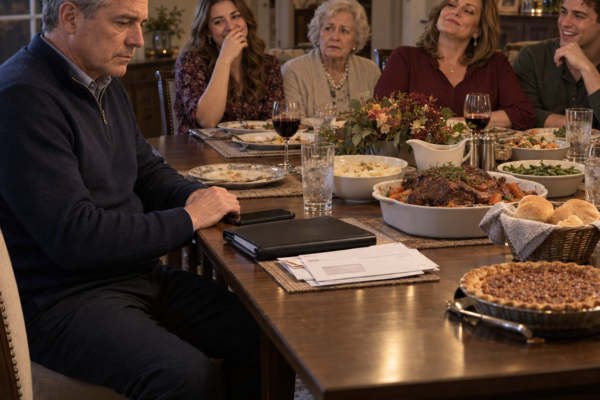
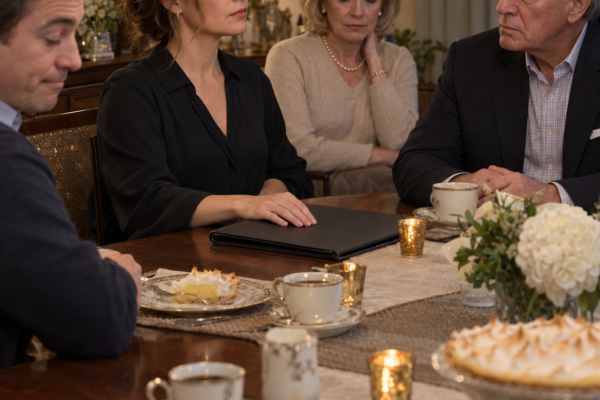
At my graduation dinner, my sister clinked her glass, announced she was pregnant, then leaned over and whispered, “Try topping that,” while my family forgot the night was supposed to celebrate me

My sister had always understood timing better than anyone in our family.
Not clocks.
Attention.
She knew exactly when a room belonged to somebody else, and she had a talent for stepping into the middle of that moment with news large enough that objecting would make the original person look petty.
My graduation dinner was supposed to be mine.
I had spent years finishing that degree.
Late nights.
Weekends sacrificed.
Money saved one careful month at a time.
There had been no shortcut.
That evening, my father had arranged a family dinner at a nice restaurant. He even ordered a small cake with a congratulations message across the top.
For a few minutes, I allowed myself to enjoy it.
Then my sister lifted her glass.
She held it high enough to draw every eye at the table.
“I’m pregnant.”
The reaction was immediate.
Mom’s hands flew toward her face.
Dad started asking about dates.
Relatives talked over one another.
Someone wanted to know whether they already had names.
Someone else asked if the news could be shared in the family group chat.
The waiter appeared carrying my graduation cake.
Almost nobody noticed.
I felt the old drop in my stomach.
I knew that feeling.
It was the physical recognition of a familiar pattern.
A moment I had earned disappearing while I was still sitting inside it.
My sister leaned toward me.
She wore the bright, satisfied smile she used whenever she felt the room swing in her direction.
“Try topping that.”
She whispered it so softly that nobody else heard.
Then she leaned back and accepted another round of congratulations.
I could have confronted her.
Years earlier, I probably would have.
Then my reaction would have become the story.
Not what she had done.
My reaction.
So I remained still.
I listened.
My parents asked the same questions several times because repeating them gave everyone more time to enjoy the announcement.
The graduation cake sat on the table.
I remembered other moments.
A birthday brunch that became an engagement-planning session after my sister hinted a proposal might be coming.
A dinner celebrating one of my job offers that turned into an extended discussion of her wedding binder.
Holidays that somehow reorganized themselves around whatever she was doing.
She did not steal every moment.
That would have been too obvious.
She simply knew which moments mattered most to me.
Then she placed something brighter on top of them.
After the pregnancy excitement softened slightly, she leaned toward me again.
“Are you mad?”
Her eyes were wide.
Innocent.
She had always been good at asking provocative questions in a voice that made answering honestly sound aggressive.
“No.”
I smiled.
“I’m happy for you.”
Her shoulders relaxed.
“And I’m happy for me.”
She ignored the second sentence.
Then she addressed me loudly enough for the whole table.
“So what are you doing next now that you’ve graduated?”
Everybody looked toward me.
The question sounded generous.
It wasn’t.
Anything I said now had to follow a pregnancy announcement.
That was the point.
I took a breath.
Then I decided I would not compete.
I thanked everyone who had come to celebrate me.
I talked about the degree.
Not dramatically.
I described what it had actually required.
Late nights.
Missed weekends.
Saved dollars.
The satisfaction of finishing something difficult without cutting corners.
Then I said, “I know tonight was supposed to celebrate that.”
Mom looked down.
Dad cleared his throat.
My sister watched me closely.
I continued.
“I’m also happy about the baby.”
That was true.
Her child had done nothing wrong.
“I think families should be able to hold space for two good things at once.”
Nobody argued.
Then I added one more thing.
“In the past, I’ve sometimes held back my own news because I didn’t want to compete.”
My sister’s expression changed.
“I’m not going to do that anymore.”
The table went very quiet.
“I have something of my own to share soon. Something I earned without asking anyone for money or introductions.”
I paused.
“But I’m choosing the timing.”
That was the sentence that mattered.
I raised my glass.
“To a healthy baby.”
Everyone followed.
“And to my future too.”
The waiter placed the cake directly in front of me.
I cut the first slice for my grandmother.
She had spent years watching our family dynamic with the careful expression of a woman who noticed more than she said.
Then I cut another piece and handed it to my sister.
“Big news deserves kindness.”
She took it.
“And I’m glad we can celebrate both of us without stepping on each other.”
Her smile tightened.
Then my phone buzzed.
I looked down.
A message I had been waiting on for weeks.
Only one word appeared in the preview.
I felt something inside me click into place.
My sister noticed.
“What?”
I locked the screen.
“Nothing for tonight.”
I asked Dad if he wanted to say a few words about my graduation.
For the first time all evening, he seemed to remember that there had been another reason for the dinner.
He stood.
He spoke about how proud he was that I had finished what I started.
The room softened.
My sister did not.
When the check came, Mom reached for it.
I told the waiter that my portion was already handled and that the dean had covered the cake.
That surprised my sister.
Someone important had invested in my night intentionally.
I could see her processing it.
As we left, she leaned close.
“So your big thing. Is that actually real?”
“In a few weeks, you’ll know.”
She stared at me.
“I hope you chew carefully until then.”
It was sharper than I usually spoke.
But I didn’t regret it.
In the parking lot, I opened the message.
I sent one word back.
Then I drove home.
For years, I had dealt with my sister’s behavior in the same way.
I vented privately.
Recovered.
Then showed up at the next event pretending nothing had happened.
That night, I decided the pattern would not repeat.
I sat at my kitchen table and looked at the last several years as though they were receipts.
My sister’s grand moments had always required invisible support.
Often mine.
At one birthday brunch that became an engagement discussion, I had handled the reservations and the family seating problems.
When she believed she was receiving a promotion during my job-celebration dinner, I was the one who drove our parents home and then comforted them later when she discovered there had been no promotion.
Her spotlight always came with logistics.
I had been providing them.
The more I examined the pattern, the simpler it became.
She used timing as leverage.
She placed her moment directly on top of somebody else’s.
Then she relied on everyone else being too polite to object.
Especially me.
I called my friend Renee.
Renee sold houses and approached emotional situations like a lawyer approaches evidence.
Then I called my cousin Mia, one of the few relatives who cared about me without requiring me to shrink first.
Neither said I was overreacting.
Neither said pregnancy automatically excused the timing.
Renee said something simple.
“If you want the machine to stop, stop powering it.”
That became my plan.
The first change looked almost boring.
I proposed a family rule.
Nobody should announce a major personal milestone at an event specifically organized to celebrate someone else.
Wait until the next day.
Give each person one evening that actually belongs to them.
I sent the suggestion to Aunt Carol, who hosted most holidays, and to my grandmother, who still had more influence over family etiquette than anybody wanted to admit.
I deliberately framed it around kindness.
Our family was growing.
There would be more milestones.
More weddings.
Pregnancies.
Promotions.
Graduations.
People deserved room for their moments.
Aunt Carol replied yes almost immediately.
Grandmother agreed.
Several cousins added approving messages.
Even Mom wrote that she wished we had thought of the rule years ago.
My sister contacted me privately.
She accused me of trying to control her.
I told her I had no problem with her pregnancy.
I had toasted it.
I meant it.
The rule simply applied to everybody.
Including me.
I reminded her that I had my own news coming.
That stopped the conversation.
The second change had nothing to do with etiquette.
I stopped subsidizing her.
Years earlier, when her credit had been messy, I had become a backup payer on her phone line.
Several small autopay arrangements had remained active long after they were supposed to be temporary.
I removed myself.
I also told the family I was stepping back from planning logistics.
Future events would be organized by whoever hosted them.
It sounded administrative.
It felt enormous.
A few days later, Mom called asking why my sister’s phone bill suddenly had late fees.
“Nothing’s wrong,” I said.
“I’m just living like an adult who doesn’t subsidize disrespect.”
Mom went quiet.
That week I also learned more about my sister’s situation.
Her husband’s employment had become less stable.
They were counting on our parents to help them with a down payment on a house.
Not just any house.
There was one property my sister had obsessed over for months.
She had posted it in the family chat.
Talked about the porch.
The rooms.
The neighborhood.
The previous buyers had backed out, and the house was suddenly available again.
By coincidence, I knew the listing agent.
And I had my own plans.
The message that arrived during my graduation dinner had confirmed an opening I had been pursuing quietly.
I scheduled a private showing.
I told no one.
My sister remained suspicious about my “big thing,” but she was also happy to accept my help when it benefited her.
She asked me to attend one of her prenatal appointments.
I went.
I took notes.
I asked how she felt.
I also asked practical questions about housing, money, parental leave and the first few months with a baby.
Eventually she told me almost everything.
Their plan depended heavily on parental assistance.
Her husband’s job situation could complicate financing.
They wanted to move quickly before lenders became more cautious.
Then she mentioned the house.
The previous buyers had been concerned about language in the foundation report.
The seller had resisted giving a credit.
My sister thought the issue sounded worse than it probably was.
I listened.
Then I offered to help her build a budget.
That was the kind of thing I had always done.
I also suggested looking at several lender options.
Within forty-eight hours, I understood their finances more clearly than she did.
Not because she was unintelligent.
Because she preferred momentum.
I preferred numbers.
Then I called the listing agent.
I requested a private showing.
I brought a preapproval letter.
The house was exactly the property my sister had been talking about.
I walked through it with a notepad.
I reviewed the foundation report.
I asked for the actual repair estimate.
The cost was manageable.
More importantly, the house fit my own budget.
Not a fantasy budget.
Not one dependent on my parents.
Mine.
I went home and made two sets of numbers.
One for my sister, because I had promised.
One for myself.
When I finished, there was no ambiguity.
I could buy the house.
I did not need help.
The next morning, I submitted an offer.
Clean terms.
Reasonable inspection period.
A modest credit related to the known foundation issue.
And one additional request.
Confidentiality regarding the buyer’s identity until closing.
The seller accepted with a small timing adjustment.
I wired the earnest money.
That evening, my sister posted the same listing in the family chat.
She wrote that they were preparing to make an offer soon “if the stars aligned.”
I typed:
Good luck.
Then I closed the laptop.
The following days were paperwork.
Inspection.
Appraisal.
Insurance.
Bank transfer.
Closing preparations.
None of it felt dramatic.
That was what I liked about it.
Contracts did not care who had stolen whose spotlight at dinner.
Numbers did not need applause.
Meanwhile, Aunt Carol organized a dinner celebrating the end of my sister’s first trimester.
Mom began discussing flowers and favors.
In an earlier version of myself, I would have taken over logistics.
I stayed out of it.
Then my grandmother called.
She asked me to attend.
“I want to look you in the eye and tell you I’m proud of what you’ve done.”
She did not know about the house.
She meant something else.
She had noticed I was no longer apologizing for occupying space.
I checked my calendar.
My closing date was the morning of the dinner.
I almost laughed.
I had made the no-hijacking rule.
So I would follow it.
My sister’s dinner would remain hers.
Two days before closing, she called asking if I could come review another lender email.
Habit almost made me say yes.
Instead, I told her to read the employment-verification requirements carefully and make sure any parental contribution was documented properly.
Then she asked about my announcement.
“Are you still planning to share it?”
“Yes.”
“When?”
“Not at your dinner.”
Silence.
“I respect the new rule.”
That seemed to worry her more.
Closing happened quietly.
I signed.
Initialed.
Transferred funds.
Shook hands.
Then I walked outside with the keys.
I drove past the house.
For a minute, I simply sat there.
My name was now attached to something I had chosen entirely for myself.
Then I put the keys in my bag and went to Aunt Carol’s dinner.
My sister received the attention.
Everyone asked about cravings and appointments.
I raised my glass when Aunt Carol toasted the baby.
I told my sister I was happy for her.
And I meant it.
I said nothing about the house.
After dinner, when most guests had left, I went into the kitchen with Aunt Carol, Grandma and Mom.
They were cleaning up.
I said I needed help coordinating a small delivery the next day.
Aunt Carol asked what was arriving.
“Locks. A toolbox. Some boxes.”
Then I gave the address.
The kitchen changed.
Mom turned toward me with a dish towel in her hand.
She knew the address.
Everyone did.
My sister had been talking about it for months.
“Starting tomorrow,” I said calmly, “the house is mine.”
Grandmother smiled.
Aunt Carol put down the towel.
From the doorway, my sister made a small sound.
I looked toward her.
She didn’t speak.
Not yet.
The following morning, I posted a simple message in the family group chat.
I thanked Aunt Carol for dinner.
Congratulated my sister again.
Then I invited anyone who wanted to stop by for ten minutes that afternoon for a small toast at my new address.
Nothing formal.
No gifts.
When the family arrived, I was already on the porch.
New keys in my hand.
The contractor had been there earlier.
The new locks were installed.
My parents came first.
I gave Dad two labeled emergency keys.
“Emergencies only. Text first. No drop-ins.”
He nodded.
Then my sister arrived.
Her expression was carefully controlled.
“I hope this is a joke.”
I opened the door.
Inside, on the kitchen counter, was the closing packet.
My name.
The address she knew by heart.
She looked at it.
Then at me.
“How could you do this to me?”
“I didn’t do anything to you.”
I kept my voice calm.
“I did something for myself.”
I reminded her that I had used my own money, my own financing and my own timeline.
I had not taken any money our parents intended to give her.
I had not announced anything during her dinner.
I had followed the family rule exactly.
“There are other houses.”
Her expression tightened.
“You stole my dream.”
“Dreams aren’t deeds.”
Mom tried to interrupt.
I told her I was breathing just fine.
Then I handed Dad another envelope.
Inside was documentation for a modest education fund I had started for my future niece or nephew.
It would remain under my control.
I wanted everyone to understand one thing.
I was not against my sister’s family.
I was simply finished sacrificing my own life to make hers easier.
A few minutes later, my sister’s phone rang.
She accidentally answered on speaker.
The loan officer explained that the property had gone under contract days earlier and had already closed.
Then he suggested they look at other homes and stabilize employment before submitting another offer.
The room became uncomfortable.
Once, I would have rushed to fix that discomfort.
I would have offered alternatives.
Called agents.
Opened spreadsheets.
Made myself useful.
I did none of it.
That machinery no longer ran on me.
Before my parents left, I told them I would host a small housewarming later.
Mom squeezed my hand.
“Can I bring dessert?”
“Yes.”
I smiled.
“As long as it’s for me.”
Grandmother whispered that every woman deserved at least one room in the world where her name could not be talked over.
My sister lingered after everyone else began leaving.
“Do you feel good about topping me?”
I looked at her.
“I didn’t top you.”
She waited.
“I stopped letting you set the height.”
Then I walked her to the door.
I did not hate my sister.
I hated the job I had performed for her.
The logistics.
The rescue.
The silence.
The constant shrinking.
I had quit.
When the door closed, I rested my forehead against the cool wood.
For a moment, I thought about the younger version of myself who had believed someday she would own something nobody could turn into somebody else’s celebration.
I looked toward the hook by the door.
My new keys hung there.
Quiet.
Ordinary.
Mine.
And I understood that the final victory was not the house.
It was that the next time somebody clinked a glass and tried to steal my moment, I would not need to fight for the room.
I would already know exactly where I belonged.