At My Granddaughter’s Wedding, My Name Tag Said “The Old Lady Who Will Pay for Everything,” and My Own Son Introduced Me to Guests as “Our Walking Bank Account”—After I Had Already Spent Years Funding Their Renovations, Cars, Vacations, Tuition, and Nearly the Entire Wedding
At sixty-five, I thought I understood my family.
I knew Richard could be impatient.
Pamela cared too much about appearances.
Jennifer was young and sometimes followed her mother’s lead.
Michael had always been quieter and more thoughtful.
What I did not understand was how completely money had changed the way some of them saw me after Robert died.
Jennifer’s wedding made that impossible to ignore.
That morning, I dressed carefully.
I chose the pale blue dress Robert had always loved.
My silver hair took longer than usual to arrange, and I added a little of the perfume he had given me for our final anniversary.
Three years without him had taught me that grief does not disappear.
It simply learns how to sit quietly beside you.
“You look beautiful, Alice.”
I said the words to my reflection because I could almost hear Robert saying them.
The wedding ceremony at St. Mark’s was beautiful.
Jennifer glowed walking down the aisle.
Richard looked proud escorting her.
Pamela cried.
For a brief time, the family looked exactly as it had in old photographs.
Whole.
Then I reached the reception at the Westbrook Hotel.
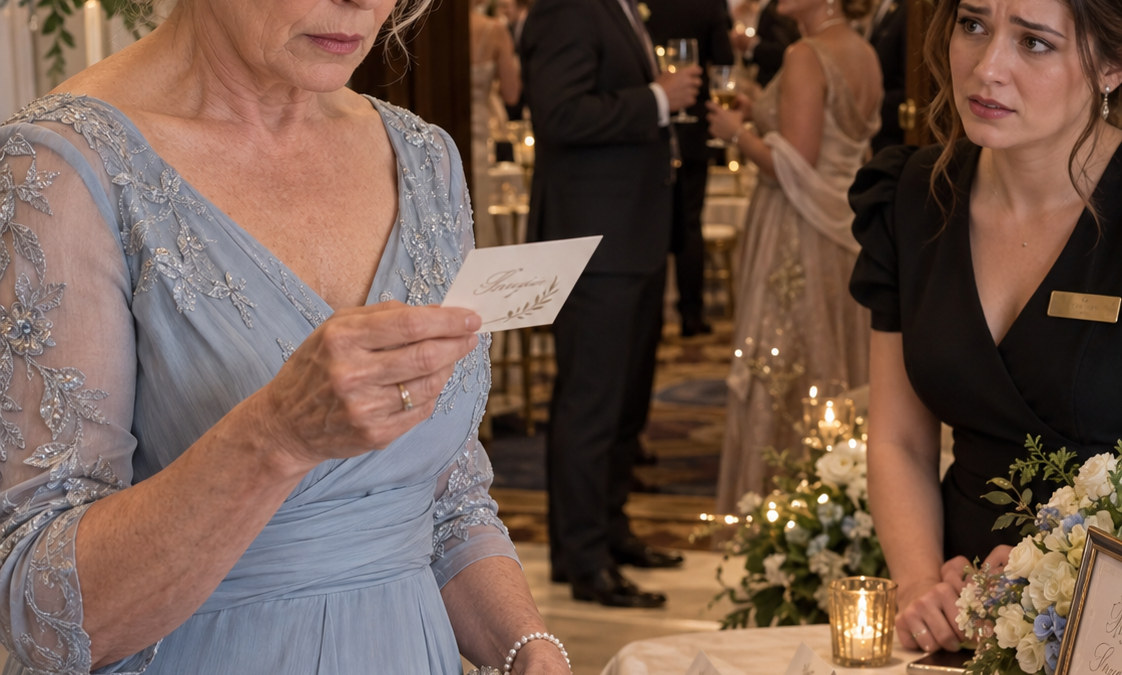
Guests collected name tags and table assignments near the ballroom entrance.
A young woman searched through the cards.
“Here you are, Mrs. Edwards.”
I looked down.
Instead of my name, someone had written:
The old lady who will pay for everything.
My hand froze.
I looked again.
Surely I had misunderstood.
The woman behind the table noticed my face.
“Is something wrong?”
“There seems to be a mistake.”
She leaned forward.
Her eyes widened.
“Oh my goodness. I’m so sorry. Let me find another one.”
“No.”
I stopped her.
“It’s all right.”
It wasn’t.
But this was Jennifer’s wedding.
I pinned the card to my dress and entered the ballroom.
During cocktail hour, I heard two guests whispering.
“Did you see the grandmother’s name tag?”
“Pamela said they thought it would be hilarious.”
Then:
“Apparently she’s their personal ATM.”
I moved away before they noticed me.
My hands were shaking.
Richard spotted me near a group of guests.
“Mom! Come meet the Andersons.”
Bill Anderson had known Robert through business.
Richard introduced me.
Then laughed.
“And this is Mom—our walking bank account.”
Martha Anderson’s expression changed.
Bill looked deeply uncomfortable.
I extended my hand.
“Alice Edwards. Robert’s widow.”
Bill immediately softened.
“Robert spoke about you often. He was very proud of you.”
That sentence followed me for the rest of the evening.
When the Andersons left, I pulled Richard aside.
“What is the meaning of this?”
I pointed at the tag.
He laughed.
“Oh, Mom. Don’t be so sensitive. It’s a joke.”
“It’s humiliating.”
“Lighten up.”
Then came the justification.
Everyone knew Robert had left me comfortable.
Pamela joined us.
She said they wanted everyone to know who was responsible for such a beautiful wedding.
They laughed again.
I walked away.
Inside the restroom, I dabbed at my eyes and tried to steady myself.
When I stepped back into the hallway, Martin Reynolds was there.
Robert’s attorney.
He looked at my name tag.
Then at me.
“What happened?”
“Apparently it’s a joke.”
His face hardened.
“Robert would have been furious.”
Then he lowered his voice.
“There’s something you need to know.”
From inside his jacket, he produced an envelope.
Robert had added a codicil to his will shortly before he died.
Martin had been instructed not to tell me unless circumstances made it necessary.
The legal wording was complicated, but the meaning was not.
Any descendant who publicly humiliated me could lose their inheritance.
The provision also covered attempts to control my finances against my wishes or pressure me out of my home.
I stared at Martin.
“Why didn’t Robert tell me?”
“He hoped you would never need to know.”
Martin spoke quietly.
“He wanted them to treat you properly because they loved you, not because they were afraid of losing money.”
I looked back toward the ballroom.
Richard and Pamela were laughing with guests.
Jennifer was dancing.
Nobody knew what Martin had just shown me.
Nobody knew how large Robert’s estate actually was.
Not even me.
“What do you want to do?” Martin asked.
“Nothing.”
He looked surprised.
“Not yet.”
I handed the document back.
“I need to see how far this goes.”
The next morning, I placed the name tag on my kitchen table.
Then I opened the hallway closet and pulled out financial records.
Six months after Robert’s funeral, Richard and Pamela had invited me to dinner.
They wanted to renovate their kitchen.
Money was tight.
College costs.
Other expenses.
Richard reminded me that Robert had left me comfortable.
I wrote a $30,000 check.
That was the beginning.
The kitchen remodel became a much larger renovation.
Then came cars for Jennifer and Michael.
Tuition help.
Trips.
Other requests.
I sorted through three years of bank statements and canceled checks.
The total approached $250,000.
Then Pamela called.
She thanked me for helping with Jennifer’s wedding.
I had already written a $45,000 check for the venue and catering.
Almost immediately, she moved to the real reason for the call.
Mark’s parents could no longer cover the honeymoon.
Jennifer had her heart set on Bali.
Would I help?
“I’ll think about it.”
Pamela went quiet.
She was used to yes.
Soon afterward, my grandson Michael arrived.
He was twenty-one, tall, thoughtful and so much like Robert around the eyes that looking at him sometimes hurt.
He apologized for the wedding.
“The name tag. The comments. It wasn’t right.”
“You noticed?”
“Of course.”
Then he told me something he had overheard.
Richard and Pamela had been discussing my house.
They said it was too large for one person.
They talked about helping me downsize.
My house was not simply property.
Robert and I had built a life there.
Every room contained a memory.
Now my son was apparently discussing its future without me.
Michael looked worried.
“I think they’ve changed since Grandpa died.”
I looked at the financial records stacked on my table.
“No,” I said slowly. “I think I’m finally seeing clearly.”
Three days after the wedding, Richard and Pamela hosted a post-wedding brunch at their country club.
I almost stayed home.
Instead, I went.
I wanted to know whether the wedding had been an exception.
Pamela stood and clinked her glass during brunch.
She thanked everyone for coming.
Then she announced:
“Grandma Alice will be funding Jennifer and Mark’s dream honeymoon to Bali.”
People applauded.
I sat still.
I had never agreed.
Richard leaned toward me.
“Mom, don’t make a scene. We already told them they could book it.”
That sentence did something to me.
“I have not agreed to pay for a honeymoon to Bali.”
The table became quiet.
Pamela reminded me that I had said I would think about it.
“Yes. I’m still thinking.”
Then I suggested Jennifer and Mark choose a honeymoon they could afford.
Pamela’s face changed.
“What about your means? Everyone knows Robert left you more than comfortable.”
“My financial situation is not a public discussion.”
Richard grabbed my arm.
“Stop. You’re embarrassing us.”
I pulled away.
“No, Richard. You’ve embarrassed yourselves.”
Michael walked me out.
That evening he came to my house for dinner.
I told him about the constant requests.
He told me the conversation about my house had gone further than I realized.
His parents were discussing Sunrise Acres.
A retirement community.
They wanted me to move.
Then they could sell my house.
I felt physically sick.
They did not merely want access to my money.
They had begun planning my life.
My doorbell rang.
Richard.
He came inside furious about the brunch.
Then saw Michael.
“What are you doing here?”
“Having dinner with Grandma.”
Michael’s voice remained calm.
“Something the rest of you might try sometime without asking her for money.”
Richard told him to stay out of it.
I refused.
“If we’re having this conversation, Michael stays.”
Then everything that had been happening finally came into the open.
The name tag.
The honeymoon.
The money.
The house.
Michael said what I had been afraid to admit.
“They treat you like a bank, Grandma. Not a person.”
Richard insisted they were only trying to help me manage things wisely.
“You’re not getting younger.”
“I’m sixty-five, Richard. Not ninety-five.”
He mentioned Robert’s money again.
I stopped him.
“Robert’s estate is not a family piggy bank.”
Richard stared at me.
“So you’re cutting us off over one joke?”
“No.”
I looked directly at him.
“I’m making my own decisions about my money and my home.”
He left angry.
Afterward, I sat in Robert’s old chair.
I thought about the codicil.
Martin could have exposed everything immediately.
But then Richard and Pamela would have changed because they feared losing money.
I wanted to know who they were when they believed no consequence existed.
So I waited.
Quietly.
The next morning, I called Martin.
This time, I wanted to understand the entire estate.
The numbers stunned me.
Robert had sold several companies at the right times.
His investments were conservative.
The wealth was far larger than I had understood.
Robert had kept money quiet because he hated people who measured worth through possessions and status.
Then Martin explained the codicil again.
Public humiliation.
Financial control.
Attempts to force me from my home.
Any of those could trigger forfeiture.
I asked about changing my own estate plans.
Martin leaned forward.
“What are you thinking?”
I left his office with a plan.
Not revenge.
A life.
I reconnected with friends.
Enrolled in painting classes.
I had always wanted to paint, and Robert had always encouraged me.
I also began helping Michael develop a business plan.
He wanted to open a bookstore.
Instead of simply handing him money, I treated the idea seriously.
We discussed costs.
Locations.
Revenue.
His plan was thoughtful.
That felt different from being treated like a wallet.
Meanwhile, I stopped answering every demand.
Pamela left messages.
Richard called.
Money eventually entered every conversation.
I simply said:
“I’m not discussing my finances.”
Six months later, I turned sixty-six.
Michael insisted on hosting a small dinner at my house.
For the first time in years, I wore red.
I had changed too.
I was painting.
Seeing friends.
Using my money according to my own values.
Richard and Pamela arrived with forced smiles.
Jennifer and Mark came too.
Martin was there.
So were some old friends.
During dinner, Michael mentioned his bookstore.
“Grandma is investing.”
Richard looked at me.
“With what money?”
“My money.”
He caught himself when he realized everyone was listening.
Later, Pamela cornered me in the kitchen.
She criticized the bookstore.
Then finally said what she and Richard had been planning.
I should move into Sunrise Acres.
The house could be sold.
“The money could help all of us.”
“This house isn’t for sale.”
Richard appeared in the doorway.
We returned to the living room for dessert.
Then he stood.
“There’s something Pamela and I need to discuss.”
I stopped cutting the cake.
Richard told the room they were concerned about my decision-making.
I was making “unwise financial choices.”
Refusing family guidance.
Investing in a bookstore.
Refusing to downsize.
Then he said they believed a power-of-attorney arrangement might be necessary for my own protection.
For a moment, nobody spoke.
Martin set down his cup.
“That is a serious step, Richard. Do you have evidence Alice lacks capacity?”
Richard pointed toward my financial choices as proof.
Martin replied calmly:
“Making decisions you disagree with is not evidence of incapacity.”
That was the moment I understood how far Richard was willing to go.
As long as I financed their lives, I was generous.
The moment I chose differently, I became incompetent.
“Enough.”
I put down the cake knife.
“I have paid for renovations, vacations, cars and a wedding. I have allowed you to treat me like a walking checkbook instead of your mother.”
Richard flushed.
“That stops now.”
He stood.
“You selfish old woman.”
Pamela grabbed his arm.
He kept going.
“Dad would be ashamed of you.”
Martin cleared his throat.
“Actually, Richard, your father anticipated this exact situation.”
Richard froze.
Martin removed the envelope.
Robert’s codicil.
He explained the conditions to everyone.
Anyone who publicly humiliated me, attempted to control my finances against my wishes or tried to remove me from my home could lose their inheritance.
Richard tried to object.
Martin had documented the incidents.
The wedding name tag.
The brunch.
The financial pressure.
The attempt to portray me as incompetent.
Then Martin looked at me.
“Alice, do you want to enforce the codicil?”
Everyone looked at me.
Richard.
Pamela.
Jennifer.
Michael.
I thought about Robert.
About three years of checks.
About the label pinned to my dress.
About my son discussing my house as though I were already gone.
“Yes.”
My voice was steady.
“I do.”
Richard dropped into his chair.
Martin confirmed the consequence.
Richard and Pamela’s inheritance was forfeited.
Jennifer asked whether that meant all of it.
Martin said yes.
Richard became furious.
“She tricked us!”
I looked at him.
“I never promised you anything.”
That was the truth.
They had assumed.
Taken.
Demanded.
But rarely asked what I wanted.
Jennifer began crying.
She apologized for not defending me at the wedding.
I took her hand.
“We all make mistakes. What matters is what we learn from them.”
The forfeited inheritance would be redistributed according to Robert’s instructions.
Part came directly to me.
The remainder went to descendants who had shown genuine care and respect.
Everyone looked toward Michael.
He seemed horrified.
“I didn’t know.”
“I know.”
And I did.
That mattered.
Richard threatened to challenge the arrangement.
Martin told him he was free to try.
The documentation was strong.
The evening ended soon afterward.
Richard and Pamela left furious.
Jennifer and Mark apologized.
Eventually, only Michael and I remained.
“Are you okay?”
He helped me clear dessert plates.
I realized something.
“I feel free.”
One year later, I stood inside Chapter 1, Michael’s bookstore.
He had opened it inside a converted Victorian house downtown.
Sunlight crossed shelves filled with books and reading chairs.
A coffee counter served pastries.
A mural I had painted covered one wall in the children’s section.
Michael had also created a small writer-in-residence apartment upstairs.
The bookstore was becoming more than a business.
It was a community.
Jennifer came in that morning pushing a stroller.
Her daughter was named Roberta, after Robert.
Over the previous year, Jennifer and I had rebuilt our relationship slowly.
Not through money.
Through effort.
Richard and Pamela had tried unsuccessfully to challenge the codicil.
Eventually, they moved to Florida.
Our contact became limited.
Christmas cards.
Occasional updates.
They still believed everything had been unfair.
I no longer needed them to see it differently.
My own life had expanded.
Painting.
Friends.
Travel.
I even took a two-week trip to Italy and met Claude, a widower from Boston who called me every Sunday.
Robert had tried to protect me through legal language.
But somewhere along the way, I learned the part he could never put into a will.
I had to protect myself too.
Michael joined Jennifer and me at a small table inside the bookstore.
He talked about literacy programs and writing workshops he wanted to add.
The baby made a happy sound.
I looked around the room.
This was family now.
Not perfect.
Not complete.
But based on trust instead of obligation.
Respect instead of access.
Love instead of entitlement.
Michael asked what I thought about his next idea.
I smiled.
“This is exactly where we’re supposed to be.”