On Christmas Morning, My Mother Gave My Sister Samantha a Brand-New MacBook, a Designer Bag, and $5,000 for Her “Bigger Dreams”—Then Handed Me a $3.99 Thrift-Store Cookbook Because I “Liked Food,” After Years of Treating Her Ambitions Like Investments and Mine Like Little Hobbies I’d Eventually Outgrow
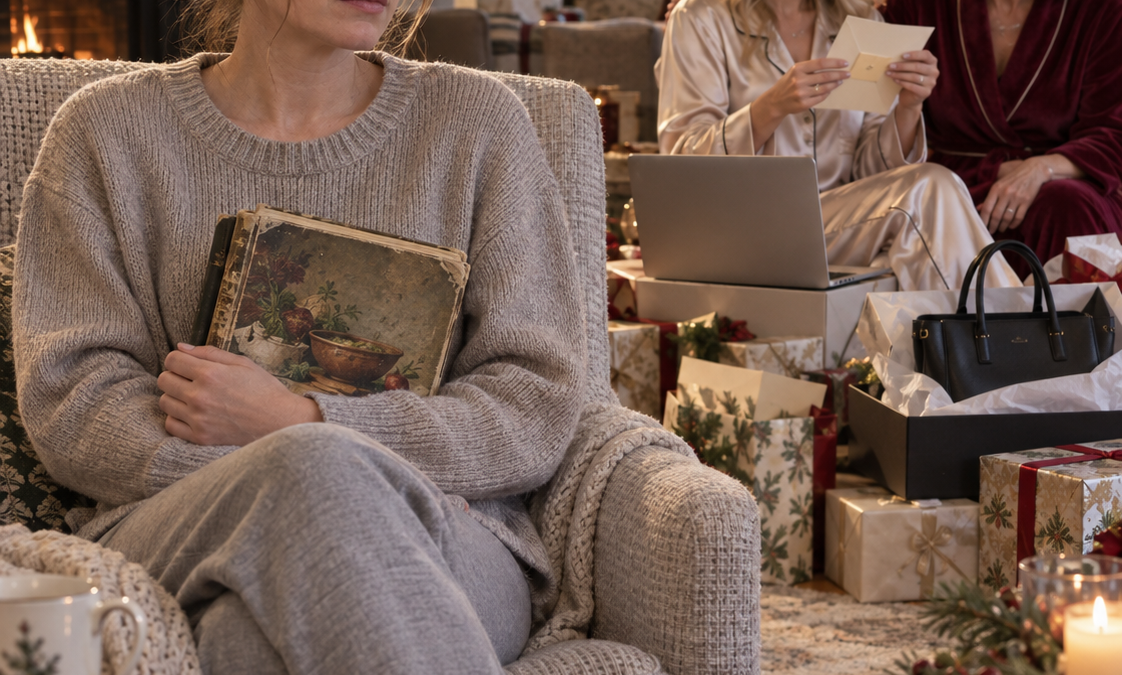
Christmas morning in my mother’s house always looked better than it felt.
The living room could have been photographed for a holiday catalog.
Garland hung above the fireplace.
Soft jazz versions of old Christmas songs played through the speakers.
Cinnamon candles burned on the mantel, sweet enough to cover almost anything nobody wanted to say out loud.
Mom sat curled into the corner of the couch in a burgundy robe, holding her coffee with both hands.
Samantha was already there.
Of course she was.
She had somehow managed perfect hair and full makeup before eight in the morning. Her blond curls bounced when she laughed at something Mom said, and her silk pajamas probably cost more than everything I was wearing.
I took the armchair across from them and pulled my oversized sweater tighter.
We started with stockings.
Samantha pulled out luxury lip balm, a jade roller and skin-care products that looked as though they’d come from a Beverly Hills spa.
I got socks.
Wool.
Itchy.
I smiled anyway.
That was something I had practiced for years.
Then came the real gifts.
Samantha opened the first large box.
A brand-new silver MacBook.
She gasped.
Mom smiled.
Next came a designer handbag inside a black dust cover.
Samantha held it up while Mom watched her face.
Then there was an envelope.
Samantha opened it slowly.
Her eyes widened.
“Five thousand?”
She sounded surprised, although something about the performance suggested she might already have known.
“Mom, you didn’t have to.”
“I wanted to.”
Mom’s smile tightened with satisfaction.
“You have big dreams, Sam. This will help with that seminar in Paris you’ve been talking about.”
Big dreams.
The phrase lodged itself somewhere inside me.
Then it was my turn.
There was one present.
A rectangular package wrapped in faded paper.
I already knew it wasn’t expensive.
The wrapping itself smelled faintly like something pulled from the back of a discount bin.
Still, I opened it carefully.
For one stupid second, I imagined there might be something hidden inside.
A gift card.
Cash.
A note.
Something personal.
Instead, I found a cookbook.
Country Casseroles and Midwest Magic.
The corners were bent.
The pages had yellowed.
There was a thrift-store sticker on the back.
$3.99.
I stared at it.
Then looked at Mom.
“That’s thoughtful.”
My voice barely made it across the room.
She took another drink of coffee.
“I thought of you when I saw it. You like food, right?”
That was her explanation.
Samantha looked uncomfortable for about half a second.
Then she leaned over and hugged me.
“You’ll do something amazing with it.”
She said it the way a teacher might praise a child for making art with broken crayons.
And then Christmas morning moved on.
No envelope for me.
No speech.
No discussion of my plans.
I was simply the extra body at the edge of someone else’s celebration.
The thing that hurt wasn’t the price difference.
At least, not only that.
The gifts were declarations.
Samantha’s said:
We believe in you.
We see where you’re going.
We want to help you get there.
Mine said:
We saw this random object and remembered you exist.
After breakfast, Mom and Samantha moved into the kitchen.
I stayed behind.
The Christmas lights blinked against the window.
The cookbook sat across my knees.
There was an old coffee stain on the back cover.
I ran my thumb over it.
Then I took out my phone.
On the coffee table were Samantha’s gifts.
The MacBook.
The designer bag.
The envelope, with the edge of a hundred-dollar bill still visible.
I placed the cookbook beside them.
Took a picture.
The contrast looked almost ridiculous.
I didn’t post it.
I just stared.
Because there was something they didn’t know.
Something none of them had bothered to ask about.
I had a book deal.
A real one.
Signed.
Not enormous.
Not glamorous.
But real.
For more than a year, I had been writing in secret.
Mostly late at night.
Laptop balanced across my knees while everyone assumed I was scrolling through dating apps or watching something mindless.
It hadn’t started as a book.
It had started as therapy.
Little stories.
Observations.
Things I couldn’t say at family dinners.
What it felt like to grow up as the easy child.
The one who didn’t ask for more.
The one who didn’t make scenes when somebody else received everything.
The one who became “independent” partly because there was no reward for needing anything.
Eventually the pieces began connecting.
They weren’t all literally about my family.
But they circled the same feeling.
Being second.
Being nearby while someone else occupied the center.
Watching affection behave like a spotlight that always seemed to swing toward the same person.
I sent the manuscript to a small publisher that had opened submissions for personal essays.
I expected nothing.
Then Carrie emailed me.
She was an editor with a matter-of-fact style and a strange warmth underneath it.
She said the writing felt personal but universal.
She told me one section made her cry on the subway and laugh three pages later.
Then came the sentence I read until I almost stopped believing it.
They wanted to publish the book.
The final manuscript had been approved shortly before Christmas.
A tentative publication date was set for spring.
My family knew none of this.
Because I hadn’t told them.
And I hadn’t told them because they never asked.
That realization settled differently after Christmas morning.
Mom said Samantha had bigger dreams.
Maybe.
Or maybe Samantha simply announced hers more loudly.
Maybe hers photographed better.
Maybe mine were the kind that grew in silence.
Between Christmas and New Year’s, I kept acting normal.
I helped with dishes.
Listened while Samantha talked about how exhausting success could be.
Watched Mom organize the kitchen with the same precision she brought to everything she wanted the family to see.
They assumed I was fine.
They had always mistaken silence for contentment.
Meanwhile, Carrie sent publishing updates.
There were deadlines.
Edits.
Production notes.
Every message made the book more real.
By January 2, I knew what I wanted to do.
I put the thrift-store cookbook back on the same coffee table.
Samantha’s new laptop was still near the tree.
The designer bag’s dust cover had been left behind.
Then I placed a printed copy of my publishing offer beside the cookbook.
I took another photo.
The contract details weren’t readable.
They didn’t need to be.
I opened Instagram.
My caption was simple.
“This year I got a secondhand cookbook and a book deal. Funny how dreams work out.”
Then I tagged Mom.
Samantha.
A few relatives.
And I posted it.
I put my phone away for five hours.
When I finally checked, the comments were multiplying.
Old classmates congratulated me.
People I barely remembered said they always knew I would do something like this.
Other comments focused on the Christmas gifts.
“Wait. Your sister got $5,000 and you got a cookbook?”
“She had bigger dreams?”
“Apparently not.”
There were laughing reactions.
Eye rolls.
Long discussions from strangers analyzing a family dynamic they had only seen in one photograph.
But the most noticeable reactions came from two people who didn’t react at all.
Mom.
Samantha.
No likes.
No comments.
Nothing.
I knew they had seen it.
My cousin Lexi messaged before midnight.
“Girl. I screamed when I saw that post. FINALLY.”
Then messages came from people I barely knew.
Congratulations.
Questions about the book.
Stories about their own families.
Two days later, Samantha stopped posting.
For four straight days, there were no yoga pictures.
No travel updates.
No perfectly staged brunches.
She disappeared from the online world she normally documented constantly.
For once, the silence wasn’t mine.
Mom called two days after my post.
She skipped hello.
“Well,” she said, drawing the word out. “That was a choice.”
I leaned back.
“Which part?”
“What do you mean?”
“The part where I wrote a book, or the part where I told the truth?”
Silence.
Then she said my name.
“Rachel.”
She made it sound like a warning.
“You humiliated your sister. And frankly, you humiliated me. Putting family matters online where everyone can speculate—”
“Speculate about what?”
My voice stayed calm.
“That Samantha received a MacBook, a designer bag and five thousand dollars while I got a thrift-store cookbook? That you told her she had bigger dreams?”
“You’re twisting everything.”
“No. People are seeing it.”
Mom insisted she had always tried to give both daughters what they needed.
That word bothered me.
Needed.
Samantha had always needed everything.
Private school.
Tutors.
Internships.
Travel.
Professional opportunities.
Mom funded them.
I wanted to write.
That was merely something I liked.
Samantha needed encouragement.
I was expected to be grateful I wasn’t actively ignored.
“I didn’t humiliate her,” I said. “She’s thirty-two years old. She can handle people knowing I exist too.”
Mom scoffed.
“This isn’t about your existence. It’s about respect. You don’t discuss family business online.”
“It isn’t family business if I’m the only one who gets treated like a footnote every Christmas.”
She hung up not long after.
That was when the response grew larger.
Cousins reached out.
Old classmates.
Readers.
Some supported me.
Some called the post tasteless.
Some said I was airing grievances for attention.
Oddly, those comments barely bothered me.
The book moved forward.
Early digital copies went to reviewers.
The responses were stronger than I expected.
One reader said the writing felt like a scalpel under the skin.
Another wrote that it reminded her of the moment she realized her mother would never love her the way she loved her sister.
I read that sentence three times.
The manuscript never used Samantha’s name.
I hadn’t described her face.
I hadn’t included identifying information.
But people who knew us could recognize certain emotional patterns.
Eventually, a friend of Samantha’s messaged.
“I hope this isn’t about Sam.”
Then Samantha emailed me herself.
The subject line read:
Request to Remove Identifiable Content.
The email was carefully written.
Polite.
Almost legal in tone.
She said readers were making “unfair connections.”
She worried about how that might affect her professionally.
She suggested there was still time to change things.
I did not reply.
Instead, I wrote another essay.
I called it The Cost of Silence.
It wasn’t part of the book.
I published it under my own name.
I wrote about favoritism.
About the strange ways families can disguise it as fairness.
About how one child becomes “the driven one” while another becomes “the steady one,” and how those labels can determine who receives investment and who receives leftovers.
I wrote about what it feels like to be managed through kindness.
At the end, I included Samantha’s email in anonymized form.
No names.
No identifying details.
The essay spread quickly.
Hundreds of women commented.
Some described sisters who received everything.
Some described mothers who insisted unequal treatment was simply giving each child what she “needed.”
Others criticized me.
I expected that.
What surprised me was Mom’s silence.
Nothing.
No call.
No text.
Not even a passive-aggressive social-media comment.
This was the same woman who once called to criticize me for not wearing mascara at a cousin’s wedding.
Now her daughter had a book coming out, an essay spreading online and strangers discussing the family dynamic she had spent decades controlling.
Mom said nothing.
Then, just before midnight one evening, I received a message from Aunt Marian, Dad’s sister.
I hadn’t seen her in almost five years.
“I read your book. Your father would have understood.”
I stared at those words.
For the first time, the absence underneath everything became visible.
My father wasn’t there to read it.
Whatever he might have understood now existed only as a possibility.
I didn’t cry.
I simply sat with the message.
For most of my life, I had wanted to be seen by the people closest to me.
Now strangers were seeing pieces of me with uncomfortable accuracy.
The irony wasn’t lost on me.
Eventually Mom invited me to Sunday dinner.
Her message acted as though almost nothing had happened.
No apology.
No mention of the book.
No discussion of the essay.
Just:
Family dinner Sunday. Hope you can come.
I almost declined.
Curiosity changed my mind.
I wanted to see what they would say when we were in the same room with no captions and no screens between us.
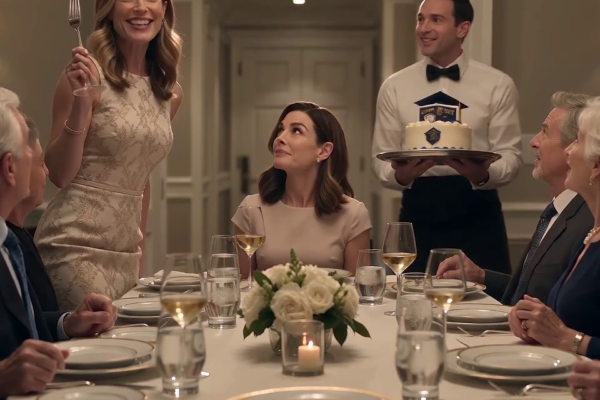
The driveway was full when I arrived.
Extended family had been invited too.
Of course.
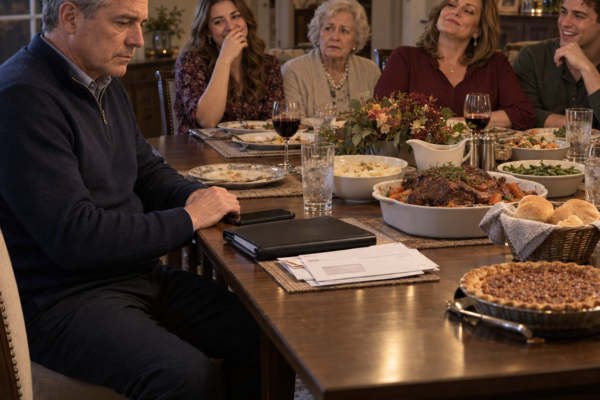
Mom had set the table perfectly.
Crystal glasses.
Linen napkins.
White roses.
Samantha was already seated in beige cashmere and subtle gold jewelry.
Her eyes met mine briefly.
For the first time, she looked uncertain.
Dinner began with meaningless conversation.
Weather.
Work.
Small family updates.
The real subject sat at the table with us even when nobody named it.
Eventually Mom passed the bread basket.
“I read your book.”
I looked at her.
“Some parts were very creative.”
“That isn’t fiction.”
Her smile tightened.
“Well, you certainly have an imagination. But I think it was unfair to write things that could harm your sister’s reputation. Or mine.”
The room went still.
Samantha said nothing.
I looked at Mom.
“Do you think I wasn’t hurt?”
Her expression hardened.
I continued.
“Growing up invisible. Watching her dreams treated like something worth investing in while mine were treated like hobbies. Getting scraps while she got everything. None of that mattered because it didn’t make anyone else uncomfortable.”
Mom’s smile remained.
“You always make everything about you.”
There it was.
Even now.
She started to say that perhaps I could have had more if I had learned to be more like Samantha.
I turned toward my sister.
Samantha finally looked at me.
She looked tired.
Not annoyed.
Not smug.
Just tired.
“You read an early draft,” I said.
Her face changed.
“You told Mom it wasn’t worth publishing.”
Silence.
No denial.
No excuse.
Nothing.
I turned back to Mom.
“So don’t tell me I distorted anything.”
I reached into my bag.
Pulled out a copy of the finished book.
First edition.
New paper.
My name on the cover.
I placed it on the table beside the white roses.
The gesture wasn’t really for Mom.
It wasn’t even for Samantha.
It was for everyone who had watched the pattern for years and decided silence was easier.
I stood.
Put on my coat.
And left.
I didn’t shout.
Didn’t slam the door.
I stepped into the cold air and breathed more deeply than I had in years.
People like to describe moments like that as revenge.
I don’t think that’s what it was.
I didn’t write the book to punish them.
I wrote because silence had become heavier than truth.
I wrote because I had spent too long standing beside someone who always had the light turned toward her while everyone expected me to learn how to grow in the dark.
For once, I wasn’t asking Mom to believe in me.
I wasn’t asking Samantha to make room.
I wasn’t asking the rest of the family to admit what they had seen.
The book existed.
The words existed.
So did I.
And no one could rewrite that page for me anymore.