During dessert, my father announced that they were done supporting me and told me to “grow up”—while my mother looked away and my brother smirked, after years of everyone assuming I would always be the one who showed up
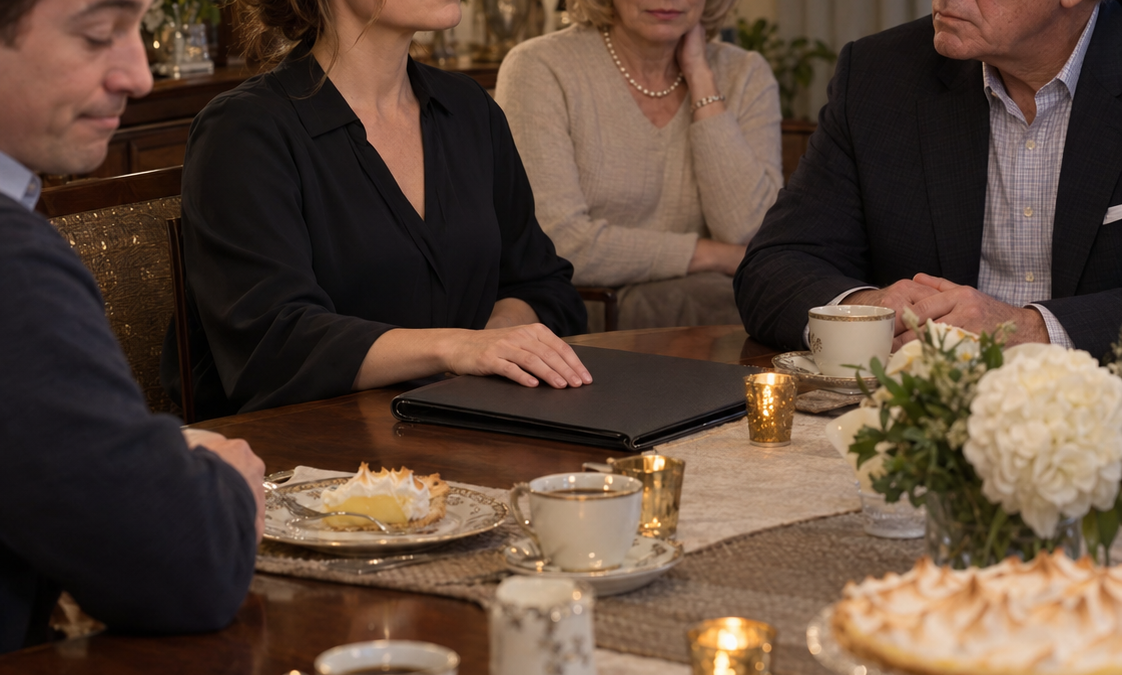
The evening looked perfect from the outside.
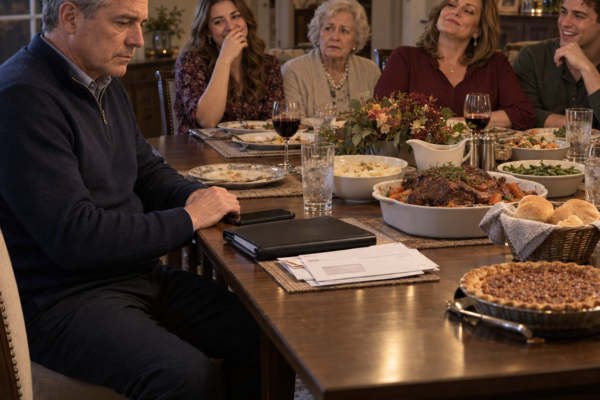
Mom had set the table with her wedding china. Small gold candles glowed between serving dishes. The roast was dry, the green beans were overcooked, and Tommy was already halfway through another drink he hadn’t brought and wouldn’t offer to replace.
My parents looked at him as though he’d returned from some heroic expedition.
In reality, my older brother had just completed another stretch of couch surfing disguised as “starting over.”
I had brought dessert.
Two lemon meringue pies from a bakery near my office because Mom loved them and because I had long ago stopped trusting Tommy to remember the things he volunteered to bring.
Everything was arranged for a peaceful dinner.
In my family, that usually meant trouble was close.
I was exhausted before Dad even spoke.
Not only from work.
From years of being the person who showed up.
I handled bills before anyone asked.
I answered phone calls when Tommy couldn’t face our parents.
I rewrote resumes.
Helped untangle financial problems.
Covered expenses.
When Dad once had a serious health scare, I drove six hours because I couldn’t stand the idea of him waking up alone.
No one forced me.
I did those things because I thought that was what family meant.
What I hadn’t noticed was how gradually love had become habit.
And habit had become obligation.
We were finishing dessert when Dad cleared his throat.
“We’ve been talking.”
That sentence had introduced almost every uncomfortable family announcement I could remember.
I set down my fork.
Dad looked at his plate.
“We’ve decided it’s time for you to stand on your own two feet.”
I waited.
“You’re almost forty. We’re not supporting you anymore.”
Then he looked at me.
“Grow up.”
I blinked.
Mom gave me an embarrassed smile.
Tommy grinned.
For several seconds, I genuinely wondered whether this was some kind of joke.
“Excuse me?”
“You heard me,” Dad said. “You’ve had our help long enough. It’s time you learned what adulthood looks like without leaning on your parents.”
The absurdity was so complete that laughter almost escaped me.
Instead, something inside me simply shifted.
I reached into my purse.
There was a folder inside.
I had brought it mostly because some part of me had grown tired of relying on memory whenever my family rewrote history.
I placed the folder on the table.
“Good.”
Dad frowned.
“Because starting tomorrow, I’m no longer paying for your retirement condo.”
The room stopped.
Mom’s spoon clicked against her cup.
Tommy’s smile vanished.
Dad stared at me.
“You what?”
“The Brook Hollow condo.”
I kept my voice calm.
“The mortgage and maintenance fees I’ve been covering for eighteen months. The place you said you’d handle after selling the lake house.”
No one interrupted.
“The lake house is still unsold. The payments are still coming from me. Starting tomorrow, that stops.”
Dad’s face tightened.
“You’re lying.”
“No.”
I had receipts.
Account statements.
Payment histories.
Dad had given me access to the finances years earlier when he needed help managing them.
He had apparently forgotten how much I could see.
He stood slowly.
His voice dropped.
After everything they’d done for me, he said, how could I behave like this?
I stood too.
I wasn’t yelling.
“What exactly have you done for me?”
That question opened years of buried accounting.
I had paid for roof repairs.
Covered utilities while they told other people I lived on their generosity.
Helped keep up appearances when their income didn’t stretch far enough.
Stepped in whenever Tommy created another problem.
My parents had built a public story in which they supported me.
Behind closed doors, the direction of support was often the opposite.
And they had repeated their version for so long that I think they actually believed it.
Mom cried quietly.
She had always been the person who avoided choosing sides by defaulting to Dad’s version.
Tommy tried to interrupt.
I didn’t let him.
“I am not your safety net anymore.”
I picked up the folder.
“And I’m done pretending.”
Then I walked out.
No slammed door.
No dramatic exit.
I left the remaining pie on the table and drove away.
In my car, I finally opened the folder.
One document listed Dad and me together in connection with the Brook Hollow property.
I was a financial guarantor.
That fact had once made me feel responsible.
That night, it made something else clear.
Responsibility did not have to mean endless rescue.
For almost two days, nobody contacted me.
On the third morning, Tommy left a voicemail.
He said I had gone too far.
Mom was crying.
Dad was furious.
I should have talked things through first.
He never once asked how I felt.
That was the part I replayed.
Tommy wasn’t worried because the family had hurt me.
He was worried because I had destabilized a system that had always protected him.
Tommy was two years older than me and had spent much of adulthood moving between short-lived plans.
Different careers.
Different ventures.
Different explanations for why each one failed.
And every time he landed badly, someone caught him.
Mom softened the consequences.
Dad complained while opening his wallet.
I helped quietly.
I had been the invisible parachute.
I didn’t call him back.
Instead, I opened the spreadsheet I’d kept for years.
Every time I sent money or covered an expense, I had recorded it.
Mostly for budgeting.
Now I totaled everything.
More than $82,000 over eight years.
Housing assistance.
Medical expenses.
Utilities.
Repairs.
Credit-card problems connected to Tommy.
Emergency expenses.
The total made me stare.
But the amount itself wasn’t what bothered me most.
It was how similar every request had been.
“We wouldn’t ask if it wasn’t important.”
Then came silence.
Until the next emergency.
That afternoon, I contacted my bank.
I stopped the remaining automatic payments connected to my parents.
The Brook Hollow payment.
Utility top-ups.
The emergency reserve I had quietly maintained.
One by one, the recurring obligations disappeared.
I expected guilt.
Instead, I felt like someone correcting an accounting error that had gone unnoticed for years.
Later, while putting away old paperwork, I pulled a box from the back of my closet.
Inside were college documents.
Old journals.
Letters.
And an envelope from my grandmother.
She had been the one adult in my childhood who seemed to notice things nobody else wanted to discuss.
When I left for college, she gave me the envelope.
I had never opened it.
I assumed it contained sentimental advice.
I was wrong.
Her note was short.
If I ever became confused about what my parents had done, she wrote, I should ask about my college fund.
And ask what really happened when I was seventeen.
I read the line repeatedly.
For years, I’d believed the college money had been lost in a market downturn.
That was the story my parents told me.
Bad economy.
Bad timing.
Nothing anyone could have prevented.
I had accepted it.
I had taken scholarships.
Worked.
Borrowed what I needed.
Pushed through.
Mom praised me for being independent.
Dad said I always landed on my feet.
Now those compliments suddenly sounded different.
I began searching through old financial files.
Emails.
Statements.
Archived documents.
By midnight, the story had changed.
When I was seventeen, almost thirty thousand dollars had been removed from the education account.
Not because of the market.
The money had been redirected toward Tommy during a serious period when he needed treatment and help after a dangerous incident linked to medication misuse.
My parents had made the transfer quietly.
Then they had allowed me to believe the account had disappeared because of economic conditions.
That was the part I couldn’t forgive in that moment.
Not that Tommy had needed help.
Not even that my parents had been afraid.
It was the lie.
They had watched me scramble for scholarships.
Watched me work.
Watched me become proud of my “independence.”
All while knowing that the financial difficulty I thought life had handed me had actually been a decision they made.
And that wasn’t the end.
More records suggested money had continued flowing toward Tommy afterward.
Living expenses.
Utilities.
Groceries.
Fuel.
The supposed emergency had become a pattern.
The next morning, I looked at Mom’s old goodbye from when I left for school differently.
She had hugged me and said she was proud of how strong I was.
At the time, I heard love.
Now I also heard relief.
I hadn’t asked them for money they no longer had.
I closed the laptop.
The anger wasn’t explosive.
It was clarity.
Dad wanted me to grow up.
Fine.
Growing up meant understanding that I was allowed to stop participating in a financial story built around my silence.
I wanted more proof.
Not because I needed revenge.
Because I knew how easily my family turned uncomfortable facts into emotional explanations.
Numbers didn’t care who felt guilty.
A few days later, I returned to my parents’ house while I knew they were out.
I still had the door code.
In Dad’s home office, I found the old ledger I remembered him using before he became comfortable with spreadsheets.
It was meticulous.
Dates.
Transfers.
Account notes.
Withdrawals.
And there it was.
A specific transfer from education savings connected to Tommy’s treatment.
Other entries followed.
Smaller amounts.
Recurring support.
The evidence stretched for years.
Then I found something recent.
A record involving Brook Hollow.
My money.
Their housing.
And a note implying they never intended to raise the subject because I had sufficient assets.
That sentence told me exactly how they’d come to view me.
Not as their daughter making a generous choice.
As available capacity.
If I had money, they believed they could use it.
I copied the relevant pages.
Then I left.
That night, I opened the Brook Hollow payment portal.
I turned off the recurring payment.
A cheerful confirmation appeared.
Recurring payments canceled.
It took seconds.
The next Saturday, Mom appeared at my apartment.
She almost never came unannounced.
She carried a reusable shopping bag and looked exhausted.
“Your father doesn’t know I’m here.”
I let her inside.
She sat down.
Then she removed a folder from the bag.
Brook Hollow documents.
The condo agreement.
A co-ownership clause I had signed years earlier.
At the time, Dad had described the paperwork as a temporary formality.
They would sell the lake house.
Everything would resolve itself.
I signed because saying no to my parents had always felt like betrayal.
Mom showed me a paragraph I hadn’t paid attention to.
As primary co-owner, I had options if payments stopped, including initiating resale instead of continuing to carry the obligation.
But the legal clause wasn’t what stayed with me.
It was Mom’s handwritten note tucked inside the folder.
She admitted Dad had always believed I owed them because of what they’d sacrificed as parents.
She said she hadn’t agreed completely.
But she hadn’t stopped him.
“You let me believe I was helping you,” I said.
She wiped her eyes.
“We thought we were helping Tommy.”
I laughed once.
“You already lost both of us.”
She flinched.
I almost softened.
Then I remembered how many years I’d spent signing away pieces of my time, money and peace because everybody else’s discomfort was treated as more urgent than mine.
“I’m not fixing this.”
Mom nodded.
“You and Dad can sell something, refinance, ask Tommy, change your plans. But I’m done.”
Before leaving, Mom asked:
“Do you hate us?”
I thought about it.
“No.”
Then I opened the door.
“But I don’t trust you. And right now, that matters more.”
After she left, I contacted Brook Hollow directly.
I confirmed my authority under the ownership structure.
A resale process could be initiated.
So I scheduled the walkthrough.
The following week, I entered the condo not as the daughter paying for her parents’ comfort, but as a legal co-owner of a property I no longer wanted to carry.
The unit was beautiful.
Bright hallways.
Quiet courtyards.
Dad’s recliner still by the window.
Mom’s favorite blanket on the sofa.
A photograph of their anniversary hung above the bed.
They were smiling in a banquet hall.
I remembered that event.
I had paid for the cake.
Booked the room.
Handled details.
So many memories I once thought proved how close we were now looked different.
Not false.
Just incomplete.
The resale coordinator, Julia, walked me through the documents.
When we finished, she handed me the extra keys.
Then she gave me another envelope.
My name was written on it in Mom’s handwriting.
Mom had left instructions that I receive it only if I came in person.
I waited until I reached my car to open it.
The letter wasn’t a dramatic apology.
It was a confession.
Mom wrote that she had spent years allowing Dad to turn my loyalty into obligation.
Every time she considered standing up for me, she feared breaking the version of family she had worked so hard to preserve.
She said my strength frightened her because it reminded her of the parts of herself she had given up.
The final sentence stayed with me.
She wrote that I had not merely been holding the family up.
I had been carrying everything they refused to face.
I folded the letter.
For years, I had imagined receiving words like that.
Now that I had them, I realized I didn’t need them as much as I once had.
Later, I met my friend Rachel.
We ate cupcakes on her porch while her dog chased a squirrel across the yard.
I told her everything.
Rachel didn’t interrupt.
Didn’t offer a solution.
She listened.
When I finished, she shook her head.
“It’s about time.”
That night, Tommy texted me.
He said he couldn’t believe what I had done.
He reminded me that our parents weren’t perfect.
As proof of something, he attached a blurry photograph of a checkbook page.
I opened my own gallery.
Found the photograph I’d taken of Dad’s ledger.
The page showing the transfer from my college savings toward Tommy’s crisis.
I sent it back.
One sentence.
“You already cost me more than you know.”
He didn’t reply.
For once, I didn’t care.
The next morning, Mom’s letter was still sitting beside my keys.
I considered saving it.
Then I took it outside.
I watched the paper curl and disappear.
Not because her words meant nothing.
Because I no longer needed to carry them.
My parents could tell whatever version of the story allowed them to sleep.
Tommy could continue believing someone else had always been responsible for catching him.
I could not control any of that.
What I could control was whether I kept paying for the role they’d assigned me.
I finally knew the truth.
I finally understood the price of the loyalty they expected.
And I had decided I wasn’t paying it anymore.