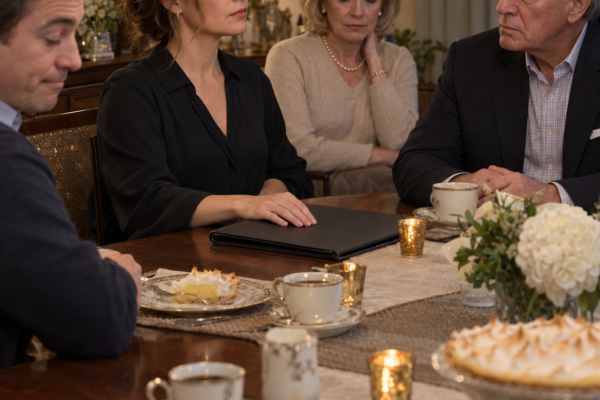
At a Family Dinner, I Raised My Glass to Thank Everyone Who Had Helped Me Through the Year—My Brother Cut Me Off and Joked That All I’d Done Was Chase a Rich Businessman for His Money, While Dad Sat There Knowing I Had Spent the Last Year Paying Off the $100,000 Debt That Had Been Keeping Him Awake at Night

I had barely raised my wineglass when my brother started laughing.
“To family,” I said. “And honestly, thank you for everything this year.”
“Everything?”
Marcus leaned back in his chair.
There were eight of us squeezed around my parents’ dining table that Sunday.
Mom had made pot roast because Aunt Susan was visiting from Pennsylvania.
My father sat at the head.
Marcus and his wife, Jenna, were across from me.
My cousin Trevor had taken the folding chair at the end.
Julian’s seat was empty.
My boyfriend had been invited, but an equipment failure at one of his company’s commercial sites had sent him to Pittsburgh that morning.
At the time, I was disappointed he couldn’t come.
Twenty seconds later, I was grateful.
Marcus lifted his glass.
“Come on, Claire. What exactly did you do this year besides chase some rich businessman around?”
Mom said, “Marcus.”
Not stop.
Not don’t speak about your sister that way.
Just his name.
He smiled.
“You know I’m kidding.”
Then he looked at everyone else.
“Our baby sister finally cracked the code. Forget working harder. Find yourself a guy who owns companies.”
Trevor laughed.
Aunt Susan made the short involuntary sound people make when they know a joke is inappropriate but do not want to be the first person to kill it.
Mom smiled too.
For half a second.
Then she looked at me and stopped.
I turned toward Dad.
He was staring at his plate.
That was the part that stayed with me.
Not Marcus.
My brother had always been loud.
He thought being funny gave him permission to say things other people would have to apologize for.
Growing up, he teased me for studying too much.
For buying my first car used.
For keeping spreadsheets.
For taking extra certifications after college.
According to Marcus, responsibility was only impressive if it produced something he could see.
Julian was visible.
That made Julian easier to understand than fifteen years of my work.
“I still have a job,” I said.
Marcus waved a fork.
“I know. I know. Construction something.”
“Senior estimator.”
“Exactly.”
He smiled.
“Julian probably spends more on lunch than you make in a day.”
“That isn’t how his company works.”
“You’ve become his accountant too?”
Jenna elbowed him.
“Enough.”
He laughed.
“Everybody relax.”
Then he reached for the serving bowl.
I wish I could say his words shocked me.
They didn’t.
The family had been building that story for almost eighteen months.
Julian Wells owned a regional commercial maintenance and facilities company.
Not a billionaire.
Not famous.
Not someone whose name appeared on magazine covers.
He was simply successful.
Twenty years earlier, he started with two vans and a business partner.
Now the company employed more than 160 people across four states.
He lived well.
Had money.
Did not pretend otherwise.
We met because his company bid on maintenance work for a commercial development my employer was estimating.
I was thirty-six.
He was forty-one.
I disliked him during our first meeting because he arrived seven minutes late and somehow still looked relaxed.
He later told me I was the only person in the room who told him his pricing assumptions were unrealistic.
Apparently that was attractive.
We started dating six months later.
My family loved him immediately.
Or rather, they loved what they thought he represented.
Mom became fascinated by where he traveled.
Marcus asked about his revenue before asking where Julian grew up.
Dad was quieter.
Julian noticed.
“Your father doesn’t care what I do,” he said after their second meeting.
“He cares.”
“He asked me whether I change my own oil.”
“That is Dad caring.”
Julian laughed.
For a while, I thought my family’s interest was harmless.
Then comments began.
Mom told relatives I was “seeing someone very successful.”
Aunt Susan asked whether I would keep working if we married.
Marcus called him “Mr. Moneybags” even after I asked him not to.
The assumption underneath all of it was simple.
My life had become easier because Julian entered it.
In some ways, it had.
He was emotionally steady.
Generous.
Good at turning his phone off during dinner.
But financially?
My life remained mine.
I worked as a senior estimator for a construction management firm.
My salary was $148,000 plus bonus.
I had been there nine years.
Before that I worked for a subcontractor.
I owned a small townhouse with twelve years left on the mortgage.
I had savings.
Retirement accounts.
Company shares that had vested over time.
Julian knew my finances because adults in serious relationships eventually talk about them.
He also knew I was stubborn about paying my way.
Once, when he booked a weekend at a resort for my birthday, I told him I was not splitting it because I hadn’t chosen a resort at that price.
He laughed and said:
“Good. Because it’s a gift.”
That was our system.
Clear.
If he invited, he paid.
If we planned together, we divided things.
If I invited, I paid.
Nobody was keeping score.
We simply never confused generosity with entitlement.
My family did not see that.
They saw photographs.
Restaurants.
Trips.
Julian’s car.
The company logo on his jacket.
Then they filled in everything else.
Under ordinary circumstances, I might have corrected Marcus and moved on.
That Sunday was not ordinary.
Eleven months earlier, my father had called me at 10:47 at night.
Dad did not call after nine.
Ever.
His name on the screen immediately frightened me.
“Dad?”
“Claire.”
His voice was low.
“Is Mom okay?”
“She’s asleep.”
“Are you okay?”
A pause.
“Can you come over tomorrow?”
I drove there before work.
Dad was already at the kitchen table.
A yellow legal pad sat beside his coffee.
Three envelopes were spread in front of him.
He looked tired.
Not physically sick.
Defeated.
“Sit.”
I did.
He pushed one envelope toward me.
First County Financial.
Another.
Business credit card.
Another.
Vendor financing.
I read numbers.
Then looked at him.
“What is this?”
“Everything.”
My father had owned Grant Monroe Printing for thirty-seven years.
The shop produced menus, brochures, local advertising pieces, business cards and specialty signage.
It had survived recessions.
Digital advertising.
A pandemic.
Dad was proud of that.
Maybe too proud.
Two of his largest commercial clients failed within fourteen months.
One owed him almost $46,000.
Another disputed invoices and dragged payment out until its own bankruptcy filing made recovery unlikely.
Dad had kept employees working.
Kept ordering paper.
Kept paying equipment leases.
He used credit to bridge gaps.
Then used more credit to service the first credit.
By the time he admitted the problem, the shop had already closed.
“How much?”
He slid the yellow pad toward me.
$103,614.
I looked at him.
“Does Mom know?”
“She knows I have debt.”
“How much does she think?”
“Maybe twenty.”
I leaned back.
“Marcus?”
“No.”
“Why are you telling me?”
He looked toward the window.
“Because you understand numbers.”
That was true.
Also incomplete.
“What do you need?”
“I don’t know.”
For the first time in my life, my father looked like he genuinely did not know.
We spent three hours reviewing everything.
Not all of the debt was equally urgent.
Some carried manageable rates.
Some did not.
One line of credit was eating through his remaining cash.
Dad could pay everything from retirement.
If he did, retirement would become something very different.
Mom was sixty-six.
Dad sixty-eight.
Starting over was not impossible.
It was expensive.
I went home with copies.
That evening, I called Denise, my accountant.
Then a financial counselor she recommended.
Not a lawyer.
Not a secret fixer.
A woman named Renee who specialized in debt repayment plans for small-business owners.
We built options.
Dad could sell a remaining delivery van.
He could liquidate one small investment.
He could negotiate a vendor balance.
There was still a gap.
About ninety thousand after everything realistic.
I had money.
Not ninety thousand lying around casually.
But resources.
I had $42,000 in a savings account intended for a larger house.
I had vested shares through my employer worth about $30,000 after taxes.
I had income high enough to handle the remaining balance over the next year if I stopped doing several things.
Travel.
Kitchen renovation.
Aggressive retirement contributions.
I could do it.
The question was whether I should.
I called Julian.
We had been dating seven months.
I told him everything.
He listened.
Then asked:
“What does your father want?”
“To solve it without Mom losing retirement security.”
“No. What does he want from you?”
That question annoyed me.
“I don’t think he knows.”
“What do you want?”
“I want to help him.”
“Then help him.”
“You think it’s stupid?”
“I think ninety thousand dollars is a lot of money.”
“Yes.”
“I think you should decide it like ninety thousand dollars is a lot of money.”
That was Julian.
No romantic speech.
No offer to rescue everyone.
Just reality.
Two days later, he did make one offer.
“If the payment schedule stretches you too thin, I can loan you the difference.”
“No.”
“Okay.”
That was it.
No wounded ego.
No persuasion.
He never mentioned it again.
I told Dad I would help under three conditions.
He would close every remaining business account.
No new borrowing.
We would create a real budget with Mom.
And every payment would go directly to creditors.
Dad agreed.
Then he asked one thing from me.
“Can we not tell everyone?”
“Mom needs to know enough to live on the budget.”
“I’ll tell her.”
“What about Marcus?”
Dad shook his head.
“I can’t.”
“Why?”
He rubbed both hands over his face.
“I spent my entire life telling that boy to be responsible.”
There it was.
Shame.
I understood it.
Maybe too well.
“Until you’re ready,” I said.
Mom learned the broad truth.
Dad had more debt than she knew.
I was helping.
He never told her the total.
I think she assumed ten or fifteen thousand.
I did not correct her.
That became my first silence.
Then the payments began.
$42,000 from savings.
$27,600 after selling vested shares.
The rest monthly.
Some months $3,000.
Some $4,500.
The annual bonus I usually put into retirement went almost entirely to Dad’s debt.
I worked two freelance estimating projects through a former colleague.
Julian and I skipped a trip to Vancouver.
He didn’t complain.
He came over with takeout on nights I was working until midnight.
By summer, Dad’s situation looked different.
Not solved.
Controlled.
Then the family narrative about Julian intensified.
Marcus saw us leaving a hotel downtown after a charity dinner.
He joked that I had “graduated to the good life.”
Mom mentioned that I was traveling more.
Aunt Susan asked if Julian was “spoiling me.”
I could have told them.
I didn’t.
The secrecy had started as Dad’s.
I slowly adopted it.
That was my mistake.
When you hide generosity, people do not automatically invent a kinder explanation.
Sometimes they invent the easiest one.
By September, the remaining debt had fallen below twenty-five thousand.
Dad called me every time a balance hit zero.
There was relief in his voice.
And shame.
“Claire, I’m going to repay you.”
“No.”
“I mean it.”
“So do I.”
“I can’t take this from my daughter.”
“You already did.”
He laughed.
Then went quiet.
“I’m sorry.”
“I know.”
The final payment cleared twelve days before the family dinner.
$7,418.23.
First County Financial sent a confirmation.
Balance paid.
Account closed.
I forwarded it to Dad.
He called immediately.
“It’s done?”
“Yes.”
Silence.
Then I heard him exhale.
A long, shaky breath.
“It’s really over.”
“It is.”
“I don’t know how I ever repay you.”
“You don’t.”
“Claire.”
“Dad.”
“What?”
“Just breathe.”
The dinner twelve days later was meant to be ordinary.
Aunt Susan was visiting.
Mom cooked.
Julian got called away.
Before dinner, Dad hugged me longer than usual.
I assumed that was his quiet thank-you.
Maybe that was enough in private.
Then I made my toast.
“To family. And honestly, thank you for everything this year.”
Marcus laughed.
“Everything?”
Then came the joke.
The rich businessman.
Gold digging without using the exact term at first.
The laughter.
Dad’s silence.
I waited.
Maybe he would stop Marcus.
He didn’t.
Marcus went further.
“You have to admit, Claire, you timed this pretty well. Thirty-five years of being practical and suddenly Mr. Corporate walks in.”
“Thirty-seven,” I said.
“What?”
“I’m thirty-seven.”
“You know what I mean.”
I did.
I looked at Dad.
His fork stopped.
He knew what I was asking without words.
Tell them.
He didn’t.
Marcus said:
“Maybe Julian has a rich friend for me.”
That got another laugh.
I put my fork down.
Dad looked at me.
“Claire.”
I stood.
Mom frowned.
“What’s wrong?”
“Nothing.”
Marcus rolled his eyes.
“Oh God.”
“I’m not mad.”
He smirked.
“Sure.”
I turned toward Dad.
“Can you tell Marcus what First County Financial was?”
The table changed.
Mom looked at Dad.
“First County?”
Marcus frowned.
“What’s that?”
Dad’s face drained.
I could have answered.
I didn’t.
That mattered.
The secret belonged to him.
The insult had landed on me.
If the truth entered the room, Dad needed to carry some weight.
“Dad?”
Mom sounded worried.
He put down his knife.
For several seconds, he stared at his plate.
Then:
“Claire didn’t spend last year living off Julian.”
Marcus’s smile disappeared.
Dad swallowed.
“She spent it paying off my debt.”
Nobody spoke.
Mom looked at me.
“What debt?”
Dad closed his eyes briefly.
“All of it.”
“How much?”
He looked at me.
I shook my head.
His story.
His number.
“One hundred three thousand.”
Mom pushed back from the table.
“What?”
Aunt Susan whispered:
“Gordon.”
Marcus stared at Dad.
Then me.
“You paid a hundred grand?”
“Almost.”
Dad corrected me.
“Over a hundred before the asset sales.”
That was the accountant in him, still alive.
I almost smiled.
Mom looked hurt.
“You told me Claire was helping with a few bills.”
“I was ashamed.”
“And you let us sit here laughing at her?”
That question landed harder than anything Marcus said.
Dad looked down.
“Yes.”
Marcus leaned back.
His face had gone red.
“I didn’t know.”
“No,” I said.
He looked at me.
“But you didn’t ask either.”
“That’s not fair.”
“Isn’t it?”
He had no answer.
Mom started asking Dad questions.
How long?
Why had he hidden it?
What had happened to the business?
Dad answered.
Haltingly.
The conversation was no longer about me.
That felt strange.
For eleven months, Dad’s debt had occupied part of my life every day.
Now it belonged to the room.
Marcus finally said:
“So Julian didn’t pay any of it?”
I looked at him.
“No.”
“I thought—”
“I know.”
“What?”
“You thought the easiest version.”
He looked embarrassed.
“I was joking.”
That phrase again.
“I know.”
“I didn’t mean—”
“I know.”
He frowned.
My calmness bothered him more than anger would have.
Then he said:
“Why didn’t you tell me?”
I looked at Dad.
Because that was the real question.
Why had I protected one person so thoroughly that everyone else learned the wrong lesson?
“Because Dad asked me not to.”
Marcus looked at him.
Dad nodded.
“And because,” I added, “I thought helping someone quietly was more respectful.”
Aunt Susan said:
“It is.”
I shook my head.
“Sometimes.”
Everyone looked at me.
“Sometimes quiet help becomes invisible help. And invisible help is easy to rewrite.”
Dad’s face changed.
That was the sentence he remembered later.
Dinner ended early.
No dramatic exit.
No shouting.
Marcus and Jenna left first.
Aunt Susan hugged me in the hallway.
Mom went upstairs because she was angry with Dad.
I stayed.
Dad and I washed dishes.
For fifteen minutes, neither of us spoke.
Then he said:
“I should have stopped him.”
“Yes.”
“I froze.”
“I know.”
“That’s not an excuse.”
“No.”
He dried a plate.
“I was afraid if I said anything, everything would come out.”
“It did anyway.”
“Yes.”
He put the plate down.
“I made your silence pay for my dignity.”
I looked at him.
That was exactly what happened.
“Yes.”
His eyes filled.
“I’m sorry.”
“Thank you.”
I did not tell him it was fine.
It wasn’t.
The next morning, Marcus texted.
Can we talk?
I waited until after work.
He came to my townhouse.
No Jenna.
No audience.
He stood in my kitchen looking awkward.
“I was an ass.”
“Yes.”
He almost smiled.
“Not going to make me work for that one?”
“No.”
He looked at the floor.
“I really thought Julian was paying for everything.”
“Why?”
“I don’t know.”
“Yes, you do.”
He sighed.
“Because Mom kept talking about how successful he was.”
“That explains Julian.”
“Because you started doing nicer stuff.”
“I’ve always traveled.”
“Not like that.”
“I paid for Vancouver before Dad’s debt started. I canceled it.”
Marcus looked surprised.
“You canceled that?”
“Yes.”
He sat down.
“I never know anything about your life.”
That was unexpectedly honest.
“You mostly make jokes.”
“I know.”
We talked for almost two hours.
Not about $100,000.
About the years before it.
Marcus admitted he had thought of me as the sibling who had everything under control.
Stable career.
No children.
No financial disasters.
He assumed I did not need help.
That sounded familiar.
Strong people becoming infrastructure.
I told him being stable did not mean being untouched.
He listened.
Then asked:
“Are you staying with Julian?”
I laughed.
“Why wouldn’t I?”
“I don’t know. Because this got weird.”
“Julian didn’t do anything.”
“I know.”
That mattered too.
The rich boyfriend did not become the villain simply because my family misunderstood him.
He also did not become the hero.
He had stayed exactly what he was.
My partner.
When I told Julian about the dinner, he listened.
Then asked:
“How do you feel?”
“Exposed.”
“Do you regret it?”
“I regret Dad didn’t do it sooner.”
“That isn’t the same thing.”
“No.”
He never said:
I told you so.
Never offered to confront Marcus.
Never suggested replacing the $100,000.
That was why I trusted him.
Three months later, Dad began repaying me.
Not because I demanded it.
Because he wanted to.
We compromised.
Two hundred dollars a month.
Symbolic.
Manageable.
I deposited the first three checks.
Then called him.
“Dad, stop mailing checks.”
“No.”
“You’re seventy.”
“I know.”
“You need the money more.”
“That isn’t the point.”
I understood.
So we changed the arrangement.
He transferred $200 each month into a savings account for my niece, Marcus’s daughter.
Not repayment.
A new direction for the money.
Marcus did not know at first.
Eventually he did.
For once, nobody turned it into a joke.
My relationship with Dad changed most.
Not because he owed me.
Because we stopped keeping important truths hidden in the name of dignity.
He told Mom the full story of the business failure.
She was angry.
Then practical.
They downsized a vehicle.
Changed insurance.
Started planning retirement around real numbers instead of pride.
Dad seemed lighter.
I was too.
The following Thanksgiving, Marcus raised his glass.
I braced myself.
He looked directly at me.
“To Claire.”
I narrowed my eyes.
He laughed.
“No joke.”
Everyone smiled.
He continued.
“To the person in this family who somehow manages to do a lot without making sure everybody sees it.”
I could feel Dad looking at me.
Marcus added:
“And maybe we should all get better at asking before deciding we know someone’s story.”
No applause.
Thank God.
Just glasses lifted.
I raised mine too.
After dinner, Dad came beside me while I was packing leftovers.
“You okay?”
“Yes.”
“You sure?”
“Yes.”
He smiled.
A year earlier, he would have assumed.
Now he asked.
That was worth more than the checks.
Julian arrived later after visiting his own family.
Marcus handed him a beer.
“For the record, I no longer think you’re funding my sister’s life.”
Julian looked at me.
Then Marcus.
“Were you under that impression?”
Marcus winced.
“Long story.”
Julian took the beer.
“I’ve got time.”
I walked away before Marcus could blame me.
In the kitchen, Dad was washing a serving spoon.
Mom was arguing with Aunt Susan about pie containers.
My niece was stealing whipped cream.
Ordinary family noise.
Nothing had changed forever because I stood up at one dinner.
Real families do not transform that neatly.
What changed was smaller and more durable.
The next time someone tried to define me while knowing almost nothing about what I carried, I did not smile to protect the room.
And the next time my father needed help, he asked without requiring me to hide the truth afterward.
The $100,000 had been expensive.
The silence cost more.