My Wife Cut Our Family’s Grocery Budget to $90 a Week and Told Me to “Make Rice Stretch” While I Worked Nights—Even as Our 8-Year-Old Daughter Started Hiding the Hole in Her Sneakers So We Wouldn’t Have to Spend Money on Her
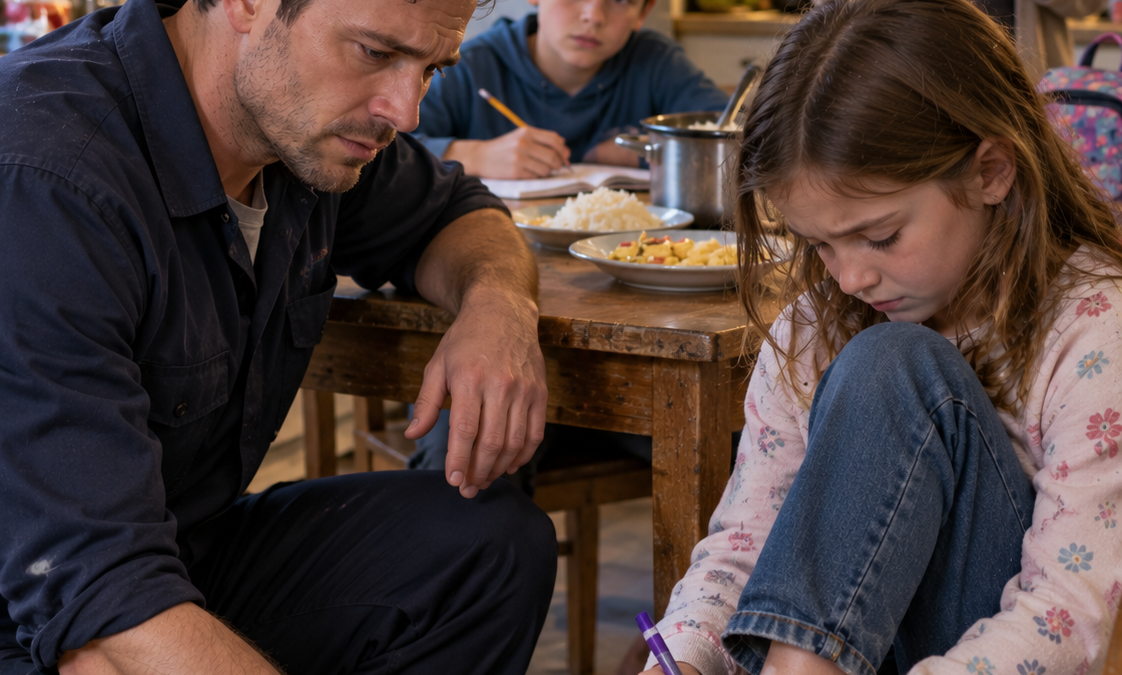
My daughter colored the hole in her sneaker with a purple marker because she did not want us to spend money replacing it.
She was eight.
That was the detail I could never make small afterward.
Not the apartment.
Not the missing savings.
Not even the marriage ending.
The purple flowers around the torn rubber.
My name is Aaron Hale.
I was forty years old, married to Melissa for thirteen years, with two children.
Owen was eleven.
Ruby was eight.
We lived in a rented three-bedroom duplex outside Columbus, Ohio.
Nothing fancy.
Quiet street.
Small fenced yard.
Good elementary school.
Seven minutes from Owen’s middle school if traffic cooperated.
I worked overnight facilities maintenance in a large downtown office tower.
My shift officially ran from ten at night to six in the morning.
Facilities work is one of those jobs people notice only when it stops happening.
Air-conditioning fails.
Toilets overflow.
Doors stop locking.
Lighting circuits trip.
Elevators make sounds nobody wants elevators making.
Then suddenly the person carrying the tool bag becomes important.
I liked that.
I had spent most of my adult life fixing things.
Melissa used to say that was one of the reasons she married me.
“You don’t panic,” she told me when our first apartment flooded from the upstairs unit.
“I absolutely panic.”
“Internally.”
“That still counts.”
Back then, she laughed easily.
So did I.
We married at twenty-seven.
Owen arrived two years later.
Ruby three years after him.
Melissa worked in accounts receivable for a regional medical supplier before eventually leaving to build a bookkeeping business from home.
For several years, it worked surprisingly well.
Small contractors.
A dentist.
Two real-estate agents.
A landscaping company.
She liked having control of her schedule.
I liked that one of us could usually be home when the children returned from school.
Our marriage was not perfect.
Whose is?
My night schedule made things harder.
I slept when other people lived.
Melissa resented taking the children to weekend activities alone whenever I had worked overtime.
I resented waking at four in the afternoon and discovering twenty decisions had already been made without me.
But we functioned.
At least that was what I thought.
Three weeks before everything changed, Melissa put ninety dollars on the kitchen counter.
Cash.
“Groceries.”
I stared at it.
“For what?”
“The week.”
“For four people?”
“Yes.”
I laughed.
She didn’t.
“We need to tighten up.”
“What happened?”
Her bookkeeping income had fallen.
One large client closed.
Our car insurance increased.
Electric bill had jumped during summer.
Ordinary explanations.
I asked if we were in actual trouble.
“No.”
“Then ninety?”
“It’s temporary.”
She opened the pantry.
“We have rice.”
That became the joke.
Except it was not funny.
Rice stretches.
Beans stretch.
Pasta stretches.
Melissa said women online fed families on less.
I said women online lied.
She did not laugh.
Still, I accepted the budget.
We had an emergency fund.
Around twenty-two thousand dollars.
Some came from tax refunds.
Some from my overtime.
Some from Melissa’s better months.
It existed so an unexpected problem would not become a crisis.
If she said we needed three frugal months to keep from touching it, fine.
I trusted her numbers.
That was the mistake.
Not trusting my wife.
Trusting without participating.
There is a difference.
I had gradually handed her the entire financial dashboard because she was good at it.
I knew what I earned.
I knew roughly what our bills were.
But she managed due dates.
Transfers.
Savings.
Insurance renewals.
I fixed the faucet.
She fixed the spreadsheet.
Marriage divides labor that way.
The danger begins when division becomes blindness.
For three weeks, we ate cheaply.
I stopped buying coffee at work.
Packed leftovers.
Picked up an extra Saturday shift.
Owen wanted to join a weekend robotics workshop.
We told him maybe next session.
He said okay.
Ruby needed shoes.
Melissa said next month.
Ruby said hers still worked.
I believed her.
Then one Wednesday, I came into the kitchen before work and saw her decorating the damage.
Purple marker.
Tiny flowers around a crack opening near the toe of her right sneaker.
“What are you doing?”
“Nothing.”
I crouched.
“Show me.”
She moved her foot away.
“Mom said we’re not buying extras.”
I looked at her.
“Shoes are not extras.”
Her eyes immediately filled.
“I can wait.”
That hurt more than it should have.
Or exactly as much as it should have.
I told her we would buy shoes Friday.
Melissa overheard.
“We said next month.”
“She needs them.”
“They’re not falling apart.”
“She’s coloring the hole.”
Melissa sighed.
“You always do this.”
“Do what?”
“Turn every little thing into an emergency because you hate saying no to the kids.”
I almost argued.
Then stopped.
I had to leave for work soon.
We could discuss it later.
Life is full of “later” conversations that turn out to be the last version of the life you thought you had.
At five-twelve that afternoon, before I left, Melissa called.
Her SUV had a flat tire downtown.
“Bring the spare key and jack.”
“Where’s your jack?”
“Garage.”
“Why is it in the garage?”
“I took it out when I cleaned the cargo area.”
“Call roadside.”
“I canceled it.”
“When?”
“A few months ago.”
“Why?”
“Saving money.”
Something about that bothered me.
Roadside assistance cost less than a restaurant meal for the entire year.
Still, I told her I would come.
I went to the drawer where we kept spare keys.
The family tablet was charging nearby.
It chimed.
Melissa’s phone had synced messages to the tablet since she had used it during a software update weeks earlier.
I was not snooping.
The message appeared across the screen.
YOUR MOVE-IN PAYMENT HAS CLEARED.
Harrison Park Leasing.
I stood still.
Then another notification appeared.
Dana:
Monday is officially freedom day?
The next:
Does Aaron still think the money is going toward the roof?
That was the moment I crossed from accidental discovery into deliberate looking.
I opened the conversation.
Dana was Melissa’s closest friend from college.
The messages went back four months.
Not every message concerned me.
Most were ordinary.
Then gradually:
Apartment tours.
Neighborhoods.
Furniture.
School custody questions.
A lawyer consultation Melissa had never mentioned.
She had been planning to leave.
That truth hurt.
But it did not make me angry yet.
People can leave marriages.
People are allowed to decide they no longer want the same life.
Then I saw the money.
Melissa needed enough cash before moving.
She did not want to tell me because, according to one message:
Aaron will immediately turn everything into a committee meeting and freeze me in place for six months.
I opened our bank.
Emergency savings balance:
$3,184.
I refreshed.
Same.
The largest transfer was $14,400 to Harrison Park Residential.
I later learned Melissa had prepaid several months because her freelance income looked inconsistent on paper.
Another $2,900 went toward furnishings.
Application fee.
Security deposit.
Utility deposit.
Everything added up.
Almost our entire emergency fund.
I called Melissa.
She was still beside her SUV.
“You coming?”
“Which apartment are you moving into Monday?”
Silence.
Not even fake confusion.
That hurt in its own way.
“What did you do?”
“I checked our account.”
“Aaron.”
“The emergency fund.”
“I was going to explain.”
“When?”
“After I moved.”
My hand tightened around the counter.
“What about Owen and Ruby?”
“We would work out custody.”
“After you moved?”
“I needed somewhere stable first.”
“You have a home.”
“Your home.”
That stopped me.
“Excuse me?”
“Everything there feels like yours.”
“We rent it together.”
“You make most of the money.”
“You manage all of it.”
“That’s different.”
Maybe to her it was.
“What does the ninety-dollar grocery budget have to do with your apartment?”
She went quiet.
I knew.
“You were trying to stop the checking account from showing how much money was leaving.”
“No.”
“Then why?”
“I needed enough cash.”
“For yourself.”
“For a transition.”
“What did Ruby’s shoes have to do with your transition?”
“Stop.”
“No.”
“Aaron, this is why I didn’t want to do this over the phone.”
“You let our daughter think we couldn’t afford shoes.”
“She can wear them another month.”
I had never felt such immediate clarity in my marriage.
Melissa wanting to leave did not feel unforgivable.
The financial deception did.
Making the children participate unknowingly in the deception changed everything.
“I’m not coming to fix your tire.”
“Aaron.”
“Call a tow truck.”
“You know I canceled roadside.”
“Then pay for a tow.”
“With what?”
I almost laughed.
“The apartment fund.”
She hung up.
I did not lock her out.
Did not remove her from joint accounts.
Did not stuff clothes into garbage bags.
I had enough sense to know anger and legal rights were not the same thing.
What I did was download every statement I could access.
Bank accounts.
Credit card.
Emergency savings.
Tax returns.
Then I redirected my future paycheck into a new individual account.
Not money already jointly owned.
Future wages.
I left enough in the joint checking account to cover upcoming household bills while we sorted things out.
Then I called an attorney.
Not because I had already decided on divorce.
Because Melissa had.
She simply had not told me yet.
The attorney’s name was Julia Chen.
She came recommended by a coworker who had gone through a divorce two years earlier.
I explained the money.
Her first advice was boring.
Do not hide assets.
Do not retaliate.
Do not empty accounts.
Document.
Protect credit.
Keep paying ordinary household and child expenses.
Do not involve the children in adult financial details.
Boring advice saved me from making several satisfying mistakes.
Melissa came home after eight.
Her SUV had been towed.
The kids were upstairs.
We sat in the kitchen.
Same ninety-dollar grocery kitchen.
She looked exhausted.
“I was going to tell you.”
“You keep saying that.”
“Because it’s true.”
“When?”
“Sunday.”
“The day before you moved?”
“Yes.”
“You thought that was enough notice?”
“I knew you’d argue.”
“About you leaving?”
“About everything.”
“Probably.”
She looked surprised.
I continued.
“If you want to leave, I’m not going to trap you here.”
Her eyes filled.
Maybe she had expected begging.
Or rage.
“That easy?”
“No.”
I looked around the kitchen.
“Not remotely easy.”
Then:
“But I am not going to beg somebody to remain married to me.”
For the first time, we were talking about the correct problem.
Melissa said she had been unhappy for almost two years.
My night work.
Our different schedules.
She felt like a single parent much of the week.
When I was awake, I was tired.
When she wanted to talk, I was preparing for work.
None of that was invented.
I had known we were disconnected.
I had not known she was finished.
“I tried telling you.”
“You told me you hated my schedule.”
“Yes.”
“That’s not the same as telling me you were planning an apartment.”
“I didn’t know how.”
So she created certainty privately.
Tour apartments.
Talk to lawyer.
Move money.
Buy furniture.
Then announce the decision once there was nothing left to negotiate.
I understood the emotional logic.
I still hated the method.
“What did you expect me to tell the kids Monday?”
She looked down.
“I was going to tell them Sunday too.”
Everything was Sunday.
The final day of the family they thought they had.
I said:
“We tell them together.”
Melissa nodded.
“And we do not tell them anything about the money.”
“Fine.”
“And tomorrow, Ruby gets shoes.”
She looked irritated again.
“Aaron.”
“No.”
My voice was calm.
“She gets shoes.”
Something about my tone ended that argument.
The conversation with the children was awful.
There is no beautiful version of telling kids their parents will no longer live together.
Owen became angry.
Ruby cried immediately.
Melissa explained that she had rented another place nearby.
Owen looked at her.
“You already have it?”
She hesitated.
“Yes.”
“How long?”
I stepped in.
“The adults have been discussing changes.”
Technically true.
Protective without lying completely.
He looked at me.
“Did you know?”
There it was.
“No.”
Melissa closed her eyes.
Owen stood up and left the room.
I let him.
Later I found him on his bed.
“Did Mom leave because of us?”
“No.”
“Because you work nights?”
“That’s between Mom and me.”
“But she always complains about it.”
I sat down.
“My schedule made our marriage harder.”
“So yes.”
“No.”
I waited until he looked at me.
“Adults are responsible for telling each other when something is broken badly enough that they want to leave. Your mom and I did not do that well. None of this is yours.”
He became quiet.
Then:
“Are we broke?”
I knew exactly where that came from.
The rice.
The robotics workshop.
Ruby’s shoes.
“No.”
“Mom said we needed to save.”
“We needed to make some different decisions.”
He stared.
Kids know when adults are choosing words carefully.
“Can I still do robotics next time?”
“Yes.”
He nodded.
That seemed to matter more than anything I could say about marriage.
Melissa moved Monday.
Exactly as planned.
The furniture arrived.
She had a clean two-bedroom apartment twelve minutes away.
The children remained with me that first week because school routines were already established and Melissa’s apartment was full of boxes.
Then we began temporary shared custody.
Nothing dramatic.
Wednesday nights.
Alternating weekends.
Then mediation.
The $14,400 apartment prepayment became part of the financial division.
Not because a judge punished her.
Because it was a joint marital asset she had already spent.
Her attorney understood.
Mine understood.
Numbers are less emotional once two professionals put them in columns.
What complicated things was the emergency fund.
Melissa believed she had been entitled to use half.
That was reasonable.
She had used far more than half.
The final settlement accounted for the difference.
No criminal case.
No forged signature.
No bank scandal.
Just consequences.
She had a right to leave.
She did not have a right to treat all joint savings as her private exit fund.
The grocery issue became harder for her to face.
At first she insisted I was exaggerating.
Then Ruby came home from school wearing new sneakers I had bought.
Melissa looked at them and cried.
Not because of the cost.
Because Ruby said:
“Dad says shoes aren’t extras.”
I did not tell Ruby that to attack her mother.
I had said it when she apologized for choosing the pair she liked instead of the cheapest pair.
Melissa called me that night.
“She said I made her feel guilty about shoes.”
“You did.”
“I didn’t mean to.”
“I know.”
There are apologies where intention matters.
And injuries where it does not undo the result.
Melissa told Ruby she was sorry.
No excuses.
That was one of the first things that made me believe we might someday become decent co-parents.
Our divorce took eight months.
By then, I had moved from overnight facilities technician to second-shift supervisor.
Three in the afternoon until eleven.
Still not perfect.
Better.
I took a certification my company had offered twice before.
I had always refused because the classes met during hours I normally slept.
Once my marriage ended, I stopped treating exhaustion as an unavoidable law of my life.
I took the class.
Passed.
Applied for a supervisor opening.
Got it.
Melissa’s bookkeeping business recovered somewhat.
She kept the apartment.
She learned exactly how expensive independence was once it no longer came prepaid by our shared savings.
I do not say that with pleasure.
Independence was expensive for me too.
Two rents.
Two sets of furniture.
Two insurance policies.
Two households trying to give two children one stable childhood.
Divorce is financially inefficient.
Still, we managed.
The children managed.
Owen eventually returned to robotics.
Ruby destroyed the new sneakers in seven months because apparently children consider shoes challenge objects.
I bought another pair.
She did not apologize.
Progress.
One year after the divorce, Melissa and I attended Owen’s school science night.
We stood beside the same display for almost twenty minutes.
Normal conversation.
Teachers.
Grades.
Ruby complaining.
Before leaving, Melissa said:
“I need to tell you something.”
I waited.
“I was afraid you’d stop me from leaving.”
“Why?”
“Because you fix everything.”
I almost laughed.
“That sounds complimentary.”
“It wasn’t.”
She looked embarrassed.
“I thought you’d turn it into a problem to solve. Counseling. Budget changes. Different schedule. Whatever.”
“I probably would have.”
“I know.”
“So you removed my ability to participate.”
“Yes.”
There it was.
Honest.
Then she said:
“I told myself I was protecting myself.”
I waited.
“But I made the kids pay for it too.”
I nodded.
“That’s the part I still hate.”
“Me too.”
That conversation gave me more closure than the divorce decree.
Not because Melissa became wrong and I became right.
Because she finally named the thing that had hurt.
Years later, people sometimes hear this story and focus on the bank account.
They ask whether I should have frozen her cards.
Changed passwords.
Thrown her out.
They want the satisfying move.
The money mattered.
The deception mattered.
But the image that stayed with me was still Ruby drawing purple flowers around a torn sneaker.
My wife wanted to leave me.
Painful.
Legal.
Human.
What she was not allowed to do was make two children believe their needs had suddenly become burdens because she wanted to leave quietly.
That became the line.
Melissa is remarried now.
I’m not.
Maybe eventually.
We share birthdays without pretending we’re friends.
Owen is sixteen.
Ruby thirteen.
The old grocery budget has become a family joke, though I try not to make it cruel when Melissa is around.
Ruby recently asked for seventy-dollar sneakers.
I said:
“You have lost your mind.”
She replied:
“I thought shoes weren’t extras.”
The child had been waiting five years to use that against me.
I bought the fifty-dollar pair.
She survived.
Our emergency fund exists again too.
Different account.
Mine.
Melissa has hers.
I check mine every month.
Not obsessively.
Just enough.
Because the lesson was not that you should never trust anyone with money.
The lesson was that partnership requires participation.
For years, I believed my contribution was earning.
Melissa’s was managing.
That arrangement became an excuse for me not to look and for her not to explain.
By the time I looked, she had already built a door out of our marriage.
I could not stop her from walking through it.
I shouldn’t have.
But I could make sure our children were not charged admission.