My Sister-in-Law Told Me to Wash Everyone’s Dishes With a Bandaged Burned Hand. When I Said No, My In-Laws Threw Me Out in Front of 11 People—and My Husband Said, “Stay With a Friend Until You’re Ready to Apologize.”

The argument that changed my marriage started with thirteen dirty dinner plates.
That sounds ridiculous when I say it now.
At the time, it felt almost ridiculous too.
My right hand was bandaged.
My sister-in-law wanted the dishes washed.
I said no.
An hour later I was standing in my best friend’s apartment with a duffel bag while my husband remained at his parents’ house.
The dishes were never really the problem.
My name is Rachel Morgan.
I was thirty-four when this happened.
Daniel and I had been married seven years.
Until that winter, I would have described our marriage as good.
Not perfect.
Good.
We paid our bills.
We laughed.
We fought about thermostat settings and whose turn it was to replace the toilet paper.
We had both made compromises.
The kind of ordinary marriage nobody writes stories about.
Then a pipe burst in the condo above ours.
Water came through our ceiling, walls, kitchen cabinets and part of the bedroom.
Nobody was hurt.
But the repairs were extensive.
Insurance covered temporary housing, but there was a delay over whether parts of the unit were habitable and how much the insurer would reimburse.
Daniel’s parents lived thirty minutes away in a large four-bedroom house.
His mother Patricia called immediately.
“You are not wasting money on a hotel. Come here.”
I resisted.
Daniel didn’t.
“It’ll be four weeks.”
The contractor said four to six.
That should have warned us.
We moved into the upstairs guest room.
At first, Patricia was generous.
Too generous.
Clean towels.
Empty drawers.
Space in the refrigerator.
His father George told us to treat the house like home.
For the first week, I was grateful.
Then “treat it like home” quietly became “act like you owe us.”
Not in one dramatic moment.
Little things.
Patricia would ask me to pick something up because I “was already out.”
George would leave dishes beside the sink instead of loading the dishwasher.
Daniel’s sister Megan came over constantly.
Megan was thirty-eight, married to Craig, with two children.
She had grown up in that house.
She never stopped behaving as though it were still partly hers.
She had a key.
Walked in without knocking.
Opened the refrigerator.
Criticized whatever Patricia cooked.
Then left.
What changed for me was that Megan began including me in the household staff she seemed to believe existed.
“Rachel, could you make coffee?”
“Can you grab Ava some juice?”
“Mom needs those serving bowls upstairs.”
“You’re heading to Target? Pick these up.”
At first I did it.
We were living there.
I wanted to contribute.
Daniel and I were already giving his parents money for groceries despite Patricia initially refusing.
I cleaned.
Cooked.
Ran errands.
It felt reasonable.
Then one Thursday, Megan arrived with her children while Patricia was out.
She handed me two coats and said:
“Can you hang these?”
I stared at her.
The coat closet was three feet away.
She had already walked past it.
Something about that moment bothered me.
I hung them anyway.
That night I told Daniel.
He laughed.
“She does that to everyone.”
“She hands everyone her coat?”
“You know what I mean.”
“No. I don’t.”
He sighed.
“Megan has always been bossy.”
“Then why does everybody do what she says?”
He looked at me like I was trying to solve a mystery he had accepted as weather.
“That’s just Megan.”
I heard that sentence often after that.
That’s just Megan.
As though personality excused impact.
1
The burn happened on Saturday morning.
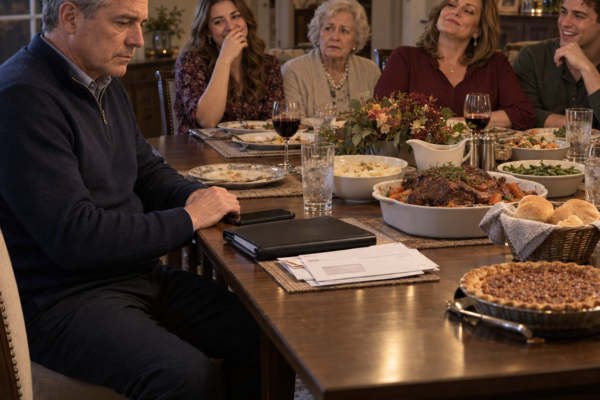
Patricia was hosting a dinner for George’s birthday.
Thirteen people total.
Daniel’s parents.
Us.
Megan and Craig.
Their two kids.
An aunt and uncle.
Two cousins.
Patricia had been cooking since seven.
I went downstairs around eight and found her trying to manage three things at once.
“Need help?”
“Could you take the rolls out?”
I did.
The oven rack caught the side of my palm when I reached awkwardly.
I jerked away.
Nothing dramatic.
No blood.
Just immediate pain.
Within half an hour, the area was red, blistered and uncomfortable enough that Daniel drove me to urgent care.
They cleaned it.
Wrapped it.
Told me to keep it dry and avoid friction for a few days.
We were home before lunch.
Patricia said:
“Oh, honey.”
Then immediately:
“Can you still help with the salad?”
That should probably have told me everything I needed.
I said yes.
With one hand.
Dinner started at six-thirty.
I carried what I could.
Set napkins.
Helped serve.
After dessert, people migrated toward the living room.
I stayed in the dining room gathering glasses with my left hand.
Then Megan appeared.
She glanced toward the kitchen.
“You doing dishes?”
I said:
“Not tonight.”
She laughed.
“You’re serious?”
That was where the Facebook version of the story starts.
In reality, there was a lot before it.
That matters.
Because I did not suddenly become unwilling to help over one sink.
I had spent six weeks helping.
This was simply the first time I gave a clear no.
Megan pointed at my hand.
“You’ve got one good hand.”
“I was specifically told to keep this dry.”
“There are gloves.”
“I’m not doing it.”
Her expression changed.
“Must be nice.”
“What?”
“Living in Mom and Dad’s house and deciding chores are optional.”
I felt my face get warm.
“We pay for groceries.”
“I didn’t say you don’t.”
“We clean.”
“Sometimes.”
That word irritated me.
“Sometimes?”
Megan shrugged.
“You know what I mean.”
“No. I don’t.”
Daniel was still sitting at the table.
He had heard enough.
“Megan.”
One word.
Not stop.
Not leave Rachel alone.
Just her name.
The family signal for don’t escalate.
Megan ignored it.
“You’re taking this way too personally.”
“I said I’m not washing dishes with a burned hand.”
Patricia walked in.
“What is happening?”
Megan told her.
Her version:
“Rachel says she’s too hurt to clean up.”
Patricia looked at the bandage.
Then at me.
“There are rubber gloves under the sink.”
That was when I understood this had stopped being about practicality.
If Patricia genuinely cared about the dishes, there were twelve other people in the house.
The issue was whether I was allowed to refuse.
“I’m not comfortable gripping wet dishes.”
Patricia sighed.
“We’ve all worked through little injuries.”
I looked toward Daniel.
He dropped his gaze.
That hurt more than anything else.
“I’m not washing them tonight.”
Patricia’s jaw tightened.
“If helping this family is that difficult for you, maybe you shouldn’t be staying here.”
George said:
“Patricia.”
But softly.
Too softly.
She kept going.
“We’ve opened our home for six weeks. Our routines are upside down. I don’t need attitude on top of it.”
There were eleven people watching.
I asked:
“Do you want me to leave?”
She should have stopped then.
Everyone expected her to.
Instead she said:
“If this is how you’re going to behave in my house, yes.”
I nodded.
Daniel followed me upstairs.
2
I packed one duffel bag.
Daniel shut the bedroom door.
“Rachel, don’t make this dramatic.”
I stopped folding a sweater.
“Your mother told me to leave.”
“She’s mad.”
“Am I supposed to wait until she becomes nicer?”
“Give everyone a couple days.”
“What does that mean?”
“Stay with Jenna.”
I thought he meant both of us.
Then he said:
“You come back when everybody cools down. You apologize. We finish the month here.”
I stared at him.
“Who apologizes to me?”
Daniel rubbed his face.
“Come on.”
“No. Answer.”
“Megan was rude.”
“Your mother threw me out.”
“She shouldn’t have done that.”
“That isn’t an apology.”
“You want me to force her?”
“I want my husband to recognize that I shouldn’t be the only person expected to repair this.”
He became frustrated.
“You said no in front of everybody.”
“I said no to dishes.”
“It was the way you said it.”
I almost laughed.
My marriage had suddenly become a courtroom trying the tone of the word no.
“I’m leaving.”
“Fine.”
That word stunned both of us.
Daniel immediately softened.
“I didn’t mean it like that.”
I zipped the bag.
He said:
“Text when you get to Jenna’s.”
I turned.
“You’re staying?”
“All our stuff is here.”
“So am I.”
He had no answer.
Downstairs, nobody looked at me as I left.
Jenna opened her apartment door twenty-five minutes later.
She saw the bag.
The bandage.
My face.
Then asked:
“Where’s Daniel?”
I said:
“At his parents’ house.”
She closed her eyes.
“Oh, Rachel.”
That was when I cried.
Not because of Patricia.
Because I finally heard the situation spoken plainly.
My husband had sent me out of his family’s house and stayed behind.
3
Daniel texted twice that night.
You okay?
Then:
Mom is still upset. Give it a day.
I did not answer the second message.
Sunday morning, he called.
“You coming back tonight?”
“No.”
Silence.
“Rachel.”
“What changed?”
“Mom is calmer.”
“That wasn’t my question.”
He sighed.
“What do you want?”
I hated that phrase.
As though respect were a demand I had invented after the fact.
“I want you to understand why I’m not coming back.”
“I do understand.”
“Tell me.”
A long pause.
“You felt ganged up on.”
Not:
My sister treated you badly.
My mother threw you out.
I failed to stand beside you.
You felt ganged up on.
He had converted what happened into my perception.
“No,” I said.
“What?”
“I didn’t feel ganged up on. I was.”
Daniel went quiet.
I told him I would stay at Jenna’s until we had somewhere else to live.
He became angry.
“That could be weeks.”
“Then we figure it out.”
“You’re seriously going to pay for another place when we can stay here for free?”
“We are not staying there for free.”
“You know what I mean.”
“I do.”
That was exactly the problem.
4
Our condo repairs were delayed another three weeks.
I found a furnished studio with a month-to-month lease.
The insurance company agreed to reimburse most of it after I sent documentation that our current temporary arrangement was no longer available to both policyholders.
Daniel hated that phrase.
“Not available?”
“Your mother told one policyholder to leave.”
“You’re making this legal.”
“No. I’m filling out a form.”
He stayed with his parents another four days.
Then he came to the studio.
Not to move in.
To talk.
We sat at the tiny kitchen table.
Daniel looked exhausted.
“Mom says you embarrassed her.”
“Of course.”
“She says you could have waited until people left.”
“To refuse dishes?”
He didn’t answer.
“What does Megan say?”
“She thinks you hate her.”
“I don’t.”
“She doesn’t believe that.”
“That’s her problem.”
Daniel looked annoyed.
“That attitude is exactly what they mean.”
I leaned back.
“Daniel, do you hear yourself?”
“What?”
“Every feeling in your family becomes my responsibility.”
He stared.
I continued.
“Megan orders me around. I’m supposed to understand she’s bossy. Your mom throws me out. I’m supposed to understand she was angry. Your dad says nothing. I’m supposed to understand he hates conflict. You stay behind. I’m supposed to understand our stuff was there.”
His expression changed.
“And when I say no once?”
I waited.
“Suddenly nobody is required to understand me.”
He looked down.
That was the first crack.
5
Daniel moved into the studio two days later.
Not because everything was fixed.
Because I told him living separately while pretending we were simply “cooling off” was becoming a decision of its own.
He brought two suitcases.
We slept badly.
Argued quietly.
Started marriage counseling.
The first session was almost unbearable.
Our counselor asked Daniel:
“What did you believe would happen if you sided with Rachel at dinner?”
He answered quickly.
“My mom would’ve exploded.”
The counselor asked:
“And what did happen when you didn’t?”
Daniel looked at me.
That question did more than three weeks of arguments.
His family had trained him to believe conflict with Patricia was dangerous.
So he moved the cost onto whoever was less likely to punish him.
Usually me.
Daniel admitted this slowly.
Not heroically.
He had spent his whole life doing it.
His father did too.
Megan pushed.
Patricia reacted.
Everyone else adjusted.
The family called that peace.
I called it what it was.
One person setting the rules through everybody else’s fear of discomfort.
6
Patricia invited Daniel to Sunday dinner the following week.
Only Daniel.
The message said:
Come home. We need to talk without outside pressure.
I was the outside pressure.
In my own marriage.
Daniel showed me the message.
“What are you going to do?” I asked.
He stared at the screen.
Then typed:
Rachel is my wife. If the conversation is about our marriage, there isn’t a version where she is outside it.
He showed me before sending.
“Too much?”
“No.”
His thumb hovered.
Then he sent it.
Patricia did not reply for six hours.
Daniel checked the phone about forty times.
That taught me something too.
He wasn’t choosing his mother over me because he didn’t care.
He was terrified of ceasing to be the easy son.
Understanding that did not excuse what happened.
It made change possible.
7
Megan made the next move.
She called me directly.
I almost didn’t answer.
“Rachel?”
“Yes.”
“I’m not calling to fight.”
“Okay.”
Long pause.
Then:
“I shouldn’t have told you to do the dishes.”
I waited.
“That’s it?”
She sounded irritated already.
“What else do you want?”
“The truth?”
“Yes.”
“You didn’t ask. You ordered.”
Silence.
“And when I said no, you made my living arrangement part of the argument.”
Megan exhaled.
“I was annoyed.”
“I know.”
“Mom took it too far.”
“Yes.”
Another pause.
Then Megan surprised me.
“I’m used to everybody doing things.”
“What does that mean?”
“At Mom’s.”
Her voice changed.
Softer.
“I walk in. Someone gets drinks. Someone watches the kids. Dad handles stuff. Daniel handles stuff.”
“And?”
“I didn’t notice how it sounded until Craig asked me why I was telling another adult to wash dishes.”
Craig.
The husband I had barely considered.
“He said that?”
“He said I sounded awful.”
I laughed despite myself.
Megan did too.
Barely.
It wasn’t reconciliation.
It was the first honest conversation we ever had.
8
Patricia was harder.
She wanted an apology from me first.
I refused.
Not dramatically.
Simply:
“No.”
Daniel supported that.
For the first time.
He told her:
“Rachel did nothing wrong by saying she couldn’t wash dishes.”
Patricia replied:
“She disrespected me in my own home.”
Daniel said:
“Mom, you threw my wife out because she wouldn’t do dishes with a burned hand.”
The sentence sounded almost absurd when reduced to facts.
That was useful.
Patricia stopped speaking to us for two weeks.
George called Daniel privately.
“You know how your mother gets.”
Daniel answered:
“Yes. That’s why this keeps happening.”
Another crack.
9
We moved back into our condo in May.
Fresh drywall.
New kitchen ceiling.
One cabinet door slightly darker than the others because the replacement batch didn’t match.
I loved it.
Our first night back, Daniel cooked pasta.
I set the table.
After dinner, he stood and gathered the plates.
I looked at him.
“What?”
He smiled.
“Nothing.”
“You’re making it weird.”
“I’m doing dishes.”
“Congratulations.”
He laughed.
It was a small moment.
But small moments were what our marriage needed.
Not some grand speech where Daniel chose me forever.
He had already chosen me when we married.
The problem was learning that marriage required choosing again when the old family system demanded otherwise.
10
Patricia finally came over six weeks later.
She stood in our living room.
Did not sit.
“I don’t like how everything happened.”
I said nothing.
Neither did Daniel.
She looked at my hand.
The burn had healed.
A faint mark remained.
Then she said:
“I should not have told you to leave.”
It was carefully worded.
Not:
You were right.
Not:
I treated you unfairly.
But it was real.
I said:
“Thank you.”
She waited.
Maybe for my apology.
None came.
Then she added:
“You do help a lot.”
That mattered more.
Because for weeks the family had acted as though one refusal erased six weeks of contribution.
“I don’t mind helping,” I said.
“I mind when helping becomes the price of being welcome.”
Patricia’s eyes moved toward Daniel.
Then back to me.
She nodded.
Once.
That was all we got.
It was enough for that day.
11
Months later, we attended George’s next birthday dinner.
Same dining room.
Same family.
Megan arrived late with the kids.
After dinner, Patricia started clearing plates.
I stood to help.
Megan said:
“Sit down. Craig and I have it.”
Craig looked shocked.
“You volunteered me?”
Megan grinned.
“Growth.”
People laughed.
I stayed seated.
Daniel reached under the table and squeezed my hand.
Nobody made a speech.
Nobody mentioned the night I was thrown out.
The dishes got washed anyway.
That turned out to be the simplest lesson in the entire mess.
Families do not collapse because one person says no.
Healthy families redistribute the work.
Unhealthy ones punish the person who finally stops carrying more than their share.
My hand healed quickly.
The marriage took longer.
But the burn left a thin pale mark near my palm.
For a while, I hated seeing it.
Now I don’t.
It reminds me of the first time I said one ordinary word and refused to explain it away.
No.
Not angry.
Not cruel.
Not selfish.
Just no.
I had spent years believing keeping the peace meant making myself easy for everyone else.
I learned otherwise in a kitchen full of dirty dishes.
Sometimes peace begins when the person everyone expects to bend finally doesn’t.