I Stopped My 18-Wheeler in a Midnight Storm to Keep a Stranded Family From Being Hit, Paid for Their Tow, and Delivered My Load 86 Minutes Late—Then My Boss Cut My Hours and Wrote Me Up for “Unauthorized Delay” Even Though I Had Reported Everything
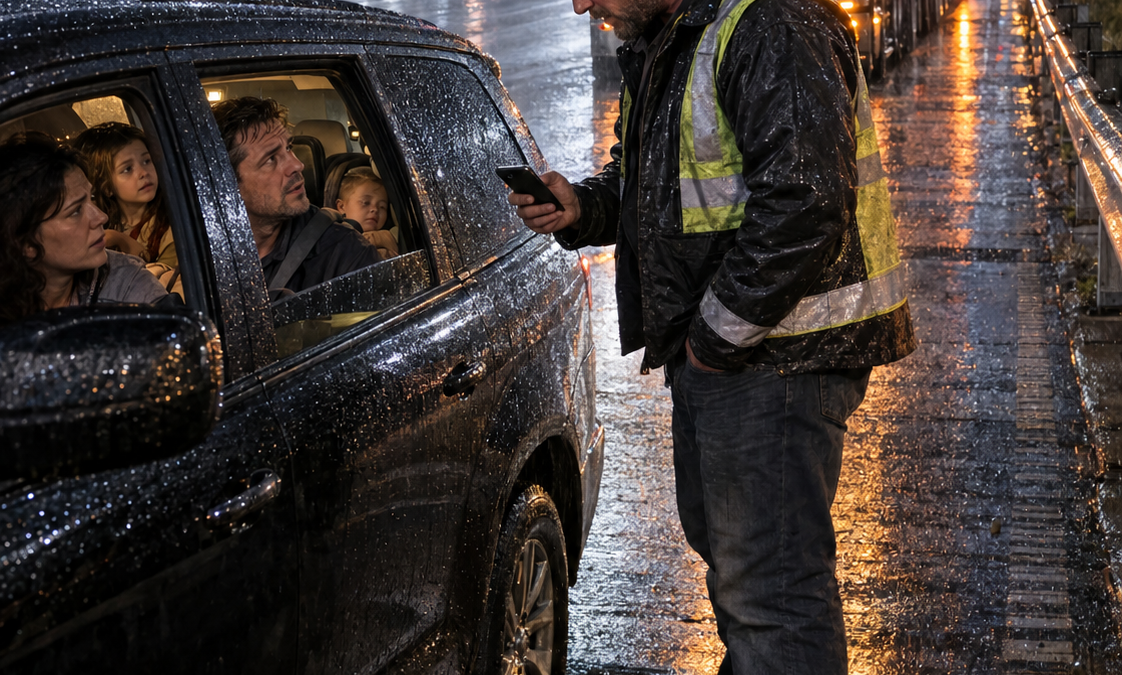
At 2:13 in the morning, I saw a man standing in the rain with both arms raised beside a dead SUV.
The storm had been building for almost three hours.
Not dramatic movie rain.
Worse.
The kind that settles over an interstate and slowly removes every useful reference point.
Lane paint disappeared beneath standing water.
Headlights reflected off the pavement until distance became hard to judge.
Every passing truck threw a sheet of dirty spray high enough to erase whatever was beside it.
I was hauling refrigerated medical equipment east toward Pittsburgh.
Seven o’clock delivery appointment.
Strict receiving window.
The kind of load dispatchers talk about as though the customer will personally die if a trailer arrives late.
My name is Marcus Thorne.
I was forty-three years old and had been driving commercially for seventeen years.
Long enough to stop romanticizing trucks.
Long enough to respect them.
Eighty thousand pounds does not care whether you are a good person.
Physics does not reward intention.
That night I had both hands tight around the steering wheel and my speed well below the posted limit.
My terminal manager, Victor Hale, had called before midnight.
“The customer complained about the last delivery.”
“That wasn’t my load.”
“I know. I’m telling you they’re already sensitive.”
“I’ll get there as safely as I can.”
“Just get there by seven.”
That was Victor.
Everything eventually became the clock.
I had worked under him three years.
He was not stupid.
He knew federal hours.
Knew weather policy.
Knew every sentence he was supposed to say in a meeting.
What he believed privately was simpler.
Good drivers solved problems without making them visible.
Traffic?
Make up time.
Weather?
Slow down a little, but not enough to miss the window.
Tired?
Coffee exists.
Dispatch culture can become dangerous without anyone ever explicitly saying, “Break the law.”
Pressure does the work.
The driver supplies the interpretation.
I had learned to separate pressure from judgment.
Mostly.
At 2:13, the SUV appeared out of the rain.
Hazards blinking.
Left side dangerously close to the fog line.
A man stood beside the rear quarter waving something reflective.
I lifted off the throttle.
Checked mirrors.
For a few seconds, I kept moving.
I wish I could tell you there was never a question.
There was.
Stopping a tractor-trailer on a narrow shoulder in heavy rain creates its own hazard.
I could not tow them.
Could not load four people into my cab legally.
Could not magically fix an SUV in a storm.
And I had a delivery appointment.
Then a truck passed the SUV in the left lane.
Its wake pushed a wall of water across the shoulder.
The man disappeared inside it.
I made the decision.
I moved ahead far enough to create space, eased right, hazards on, and stopped with my trailer visible well before approaching traffic reached the disabled vehicle.
I set the brakes.
Grabbed my reflective jacket.
By the time I reached the SUV, my jeans were soaked below the knees.
The man cracked his door.
“You okay?”
“My phone won’t connect.”
“Everybody inside?”
“My wife and kids.”
“Stay there.”
He looked toward my truck.
“You don’t need to stay.”
“I know.”
His name was Daniel Reyes.
His wife, Marisol, was in the passenger seat.
Their daughter Sofia was eight.
A toddler named Benji slept in a car seat.
They were driving home after visiting Marisol’s sister.
The SUV lost electrical power almost completely.
Daniel managed to get it partially onto the shoulder before steering became heavy.
There was no good place to push farther.
I returned to my truck.
My phone found one bar of signal.
I called the state patrol first.
Location.
Direction.
Nearest mile marker.
Disabled family vehicle close to live traffic.
Then I called a commercial roadside company I had used before.
The dispatcher warned me weather had backed up calls.
At least an hour.
Maybe more.
She needed a card authorization before dispatching.
I gave her mine.
Then I contacted our night dispatch line.
No answer.
I left a voicemail.
After that, I texted Victor directly.
Stopped MM 117 eastbound. Disabled SUV with family partially in travel hazard. State patrol requested. Tow dispatched. Remaining with cargo and will resume once scene secured.
Victor responded almost immediately.
You have 7 AM appointment. Keep moving.
I stared at it.
Typed:
Family vehicle is unsafe. Patrol ETA unknown. I’m positioned ahead with hazards for visibility.
Three dots appeared.
Missing the window is your problem.
I put my phone away.
There are moments when disobedience feels dramatic.
This one did not.
It felt wet.
Cold.
Annoying.
I checked on the family every fifteen minutes.
Daniel kept apologizing.
Marisol eventually told him:
“He knows. Stop apologizing.”
Sofia waved at me through the window.
I waved back.
State patrol arrived in thirty-seven minutes.
The trooper repositioned his vehicle behind the SUV and activated full emergency lighting.
That allowed me to move farther ahead.
The tow arrived shortly after three.
Daniel pulled out his wallet.
The driver said:
“Already authorized.”
Daniel looked at me.
“Marcus.”
“Get your family somewhere warm.”
“I can pay.”
“Later.”
“You mean it?”
“No.”
He laughed despite everything.
Then shook my hand.
The tow truck carried the SUV to a hotel near the next exit.
I waited until the trooper cleared me.
Then merged back onto the interstate.
My schedule was gone.
I knew that.
The strange thing was, once I accepted it, my driving became calmer.
No clock to chase.
No imaginary way to recover ninety minutes.
Just drive.
Arrive.
Protect the freight.
The medical equipment reached Pittsburgh at 8:26.
Eighty-six minutes late.
The receiving supervisor looked at the arrival time.
Then out at the rain.
“You’re doing better than most.”
“Appointment was seven.”
“Half our inbound schedule is wrecked.”
He checked the trailer temperature log.
Everything perfect.
They unloaded.
Signed without exception.
One dock worker told me a section of interstate farther west had closed after multiple crashes.
I thought about Daniel’s SUV.
Then about Victor’s text.
Keep moving.
I returned to our terminal that afternoon.
Victor was waiting.
“You stopped over an hour.”
“I notified dispatch.”
“I told you to continue.”
“There was a stranded family close to traffic.”
“You’re a freight driver.”
“Yes.”
“Not emergency services.”
“State patrol took over when they arrived.”
Victor slid a form across the desk.
Unauthorized route delay.
Failure to follow dispatch instruction.
Risk to scheduled customer appointment.
I read every line.
“I delivered intact.”
“Late.”
“Customer accepted it.”
“You don’t decide whether late matters.”
I signed acknowledgment.
Not agreement.
Then wrote beneath my signature that I had notified dispatch, called state patrol, arranged licensed towing assistance, remained with cargo, and departed once the scene was secure.
Victor leaned back.
“You always need the last word.”
“I like accurate records.”
He took the paper.
“Good.”
Then:
“You might want to get comfortable with paperwork.”
The following Monday, my schedule changed.
Thirty-six hours.
Normally I ran fifty to fifty-five.
I asked dispatch.
“Freight is light.”
It wasn’t.
Other drivers were running overtime.
The next week, thirty-two.
No disciplinary suspension.
No formal retaliation.
Just fewer loads.
Hard to prove.
Easy to feel.
Sarah and I sat at our kitchen table with a yellow legal pad.
My wife had worked as a respiratory therapist before our son was born.
Now she worked part time at an outpatient clinic.
Our son Aaron was fifteen.
Our daughter Paige was nineteen and starting community college locally.
We were not poor.
We were also not built for losing twenty hours of pay every week indefinitely.
Sarah looked at the numbers.
“We can pause the basement project.”
“That doesn’t cover much.”
“Paige can delay the tuition payment.”
“No.”
“She could.”
“No.”
Sarah looked at me.
“You’re doing the dad thing.”
“What dad thing?”
“Deciding everybody else is protected before we decide what we actually need.”
I hated when she was right.
I told her about Victor’s messages.
Showed her screenshots.
She read them twice.
“You kept these?”
“I keep everything.”
“Truck-driver romance.”
“I’m very exciting.”
She smiled.
Then:
“Would you stop again?”
“Yes.”
No hesitation.
“That isn’t the question you’re actually worried about.”
I looked at her.
“What is?”
“Whether doing the right thing is going to cost us enough that next time you hesitate longer.”
I did not answer.
Because it had already crossed my mind.
That frightened me.
Not Victor.
The possibility that pressure could train judgment out of me.
Exactly two weeks after the storm, Victor called me into his office.
Friday.
End of shift.
I expected either termination or another reduction.
Instead, two strangers were sitting there.
A woman in her fifties introduced herself as Karen Liu, corporate director of safety.
The man beside her was Evan Price from outside counsel.
Victor sat behind his desk with his arms crossed.
He looked furious.
Karen gestured toward a chair.
“Marcus, thank you for coming in.”
“You make it sound optional.”
She almost smiled.
Then opened a laptop.
“We’re reviewing dispatch communications from September eighteenth.”
The storm.
My stomach tightened.
“Why?”
She pulled up a thread.
Mine.
Exact text.
My notification.
Victor’s instruction.
My response.
His second instruction.
Missing the window is your problem.
Victor said:
“We’ve been through this.”
Karen ignored him.
Then opened another message thread.
Driver: Jamal Watkins.
I knew Jamal.
Forty-eight.
Two decades behind the wheel.
Worked nights mostly.
His message had been sent twenty-seven minutes after mine.
Visibility under 100 ft. Standing water. Requesting permission to pull off at next safe area.
Victor:
You’re already 40 min down. Keep rolling until fuel stop.
Jamal:
Road bad. Hydroplaning light.
Victor:
Every truck on that road is dealing with same weather. Keep moving.
I looked at Karen.
“What happened?”
Her voice changed.
“Jamal’s truck left the roadway seventeen miles later.”
I felt cold.
“Is he okay?”
“Broken collarbone. Concussion. No fatality.”
I breathed again.
“Load?”
“Damaged.”
Victor finally spoke.
“He made his own decision.”
Karen turned.
“Yes.”
A short answer.
Then:
“That’s why we’re reviewing whether management communications created unsafe pressure around those decisions.”
Victor looked toward me.
Angry.
As though my existence had caused the review.
It had not.
Jamal’s crash triggered a claims examination.
Telematics.
Weather data.
ELD records.
Dispatch records.
Several internal communications.
Then safety found my write-up.
A driver formally disciplined for stopping during the same storm.
That made my record relevant.
Karen asked me to walk through my night.
I did.
No embellishment.
No speech about heroism.
SUV.
Family.
State patrol.
Tow.
Messages.
Delivery.
Write-up.
Reduced hours.
Evan Price asked:
“When did your hours decrease?”
I told him.
“Were you given a business reason?”
“Light freight.”
Karen looked at Victor.
He said nothing.
They already had dispatch allocation reports.
The freight had not been light.
My assigned loads had been moved to other drivers.
Two days later, corporate interviewed Sarah.
Not because she worked there.
Because I had told her contemporaneously about the warning and reduced schedule.
They interviewed Jamal.
Other drivers.
Dispatch staff.
The picture became ugly.
Not illegal in one dramatic way.
Cultural.
Victor tracked on-time percentages obsessively.
He publicly ranked drivers in morning meetings.
Late deliveries affected preferred routes.
Drivers who pulled over for weather too often got labeled “nervous.”
Nobody had been ordered to violate hours-of-service limits.
Nothing so obvious.
Instead, every safer decision acquired a social and financial cost.
The drivers learned.
Jamal told investigators:
“I knew I could stop. I also knew what my paycheck would look like if Victor decided I wasn’t reliable.”
That sentence changed the investigation.
Because it described exactly what happened to me.
Corporate restored my normal schedule immediately.
They also removed the disciplinary write-up pending review.
Victor stayed on duty for another week.
Then he disappeared from the terminal.
No dramatic firing in front of us.
Karen later told me he had been placed on leave and eventually separated from the company after the investigation.
I did not celebrate.
Victor had a wife.
Kids.
Mortgage probably.
Consequences rarely land only on the person who earned them.
The company changed too.
That mattered more.
Weather-stop language was revised.
Drivers no longer requested “permission” to stop for unsafe weather.
We notified dispatch.
Not asked.
Safety reviewed any management complaint about a weather shutdown.
On-time metrics stopped including delays associated with documented severe conditions.
Drivers were still accountable.
You could not simply decide rain was scary and park at a casino for six hours.
But the incentives changed.
Stopping safely no longer automatically damaged your reliability score.
Jamal came back months later.
Light duty first.
Then driving.
His shoulder never fully stopped bothering him.
One morning we drank terrible terminal coffee.
He said:
“I saw your message thread.”
“Sorry.”
“For what?”
“That it took your crash for anybody to care.”
He nodded.
Then:
“I kept thinking I should’ve stopped.”
I said nothing.
“You know the stupid thing?”
“What?”
“I was scared Victor would cut my miles.”
He laughed once.
“Almost rolled eighty thousand pounds because I didn’t want to lose two loads next week.”
That is how safety systems fail.
Not always because workers do not know the rules.
Sometimes because they know exactly what the rule says and also know what the culture rewards.
Daniel Reyes called me a month after the investigation started.
The stranded father.
I had almost forgotten giving him my number when the tow driver handed over the receipt.
He wanted to repay me.
I said no.
He mailed the money anyway.
Inside the envelope was a drawing from Sofia.
A giant blue truck.
Four stick figures beside it.
One enormous stick figure apparently representing me.
She had written:
MARCUS STOPPED.
I kept the drawing.
Not because I think stopping made me heroic.
Because she understood the important part better than most adults.
I stopped.
Later, Daniel asked whether the trouble at work had anything to do with helping them.
I told him some of it.
He became angry.
“I’ll call your company.”
“No.”
“I’ll tell them what happened.”
“They already know.”
“You paid for our tow and they punished you?”
“Daniel.”
“What?”
“Your family was not the reason management had a safety problem.”
He went quiet.
“You were just where I noticed it.”
That distinction mattered to me.
I did not want a story where helping the right stranger magically solves your life.
Daniel was a warehouse supervisor.
Marisol taught third grade.
Normal people.
They did not own my trucking company.
They did not know the CEO.
Nobody walked into corporate headquarters and revealed himself as a billionaire.
They were simply a family who needed help on a dangerous road.
I happened to be there.
My job problems were solved because records existed.
Because Jamal survived.
Because safety finally examined a pattern.
Because people spoke honestly.
Not because kindness earned a reward.
Sarah liked that part least.
“You realize that makes the story less satisfying.”
“I’m not telling a story.”
“You tell the same story every Thanksgiving.”
“That’s different.”
Months later, our company held a safety meeting.
Karen Liu came to the terminal.
There were maybe forty drivers in folding chairs.
She presented the investigation without turning any driver into a mascot.
Then she showed one slide.
Two dispatch messages.
Names removed.
One driver reported a roadside emergency and stopped.
Another reported dangerous visibility and kept driving after pressure.
She asked:
“What is the difference?”
Somebody said:
“Outcome.”
Karen shook her head.
“Decision environment.”
I remember that phrase.
Decision environment.
Drivers make decisions.
Companies shape the conditions around them.
Families do too.
Bosses.
Schools.
Any system.
What do people learn will happen when they say, “This isn’t safe”?
Do they get supported?
Or punished quietly later?
After the meeting, Karen asked if I wanted to join a driver safety committee.
I almost said no.
Committees sounded terrible.
Then I said yes.
Not because I became passionate about corporate policy.
Because drivers listen differently to rules written by people who actually know what an interstate looks like at two in the morning.
I still drive.
Different routes now.
Mostly regional.
Better schedule.
Paige finished community college and transferred to a state university.
Aaron got his braces.
The basement project eventually happened, badly and over budget, because I tried to do too much of it myself.
Normal life resumed.
Victor never contacted me.
I sometimes wondered whether he believed he had done anything wrong.
Maybe not.
He could point out that every driver retained authority to stop.
That was technically true.
Sometimes technical truth is how organizations avoid examining practical reality.
Years later, I drove through the same section of interstate during rain.
Not that storm.
Ordinary rain.
I saw an SUV stopped on the shoulder.
Empty.
Already tagged by patrol.
Still, my hands tightened around the wheel.
Memory does that.
I thought about Daniel.
Sofia.
Jamal.
Victor.
The eighty-six-minute delay.
The weeks of reduced hours.
Then I thought about a question Sarah had asked me at our kitchen table.
Would the consequences make me hesitate longer next time?
I know the answer now.
Probably.
For a few seconds.
That is why culture matters.
People like to imagine moral decisions arrive cleanly.
You either stop or don’t.
You either care or don’t.
But real decisions arrive carrying mortgage payments, deadlines, supervisors, tired children, performance scores and fear.
Courage is not the absence of all those calculations.
Sometimes it is making the calculation and stopping anyway.
The night I met the Reyes family, I did not save anybody’s life.
Maybe another truck would have stopped.
Maybe the patrol would have reached them anyway.
Maybe nothing bad would have happened.
I will never know.
What I do know is that a family was scared beside a dangerous highway, and I had the ability to make the situation slightly safer.
So I did.
For a while, that cost me money.
Then it exposed a problem much larger than me.
I would like to say everything changed because the company suddenly learned that human beings matter more than delivery windows.
That would be too neat.
Customers still expect freight.
Managers still watch numbers.
Drivers still complain about dispatch.
Commerce did not discover a soul.
We simply changed one part of the decision environment.
Now when severe weather closes visibility and a driver says:
“I’m pulling off.”
Dispatch answers:
“Send location when safe.”
No permission.
No argument.
No reminder about the clock.
Sometimes that is what meaningful change looks like.
A different sentence at two in the morning.