For Three Years, My Husband Told Me His 18-Year-Old Daughter Could Barely Walk, Rarely Speak, and Could Never Be Left Alone—Then He Finally Trusted Me to Care for Her for Six Days, and the First Thing She Asked Was, “Can You Turn Off Dad’s Cameras?”
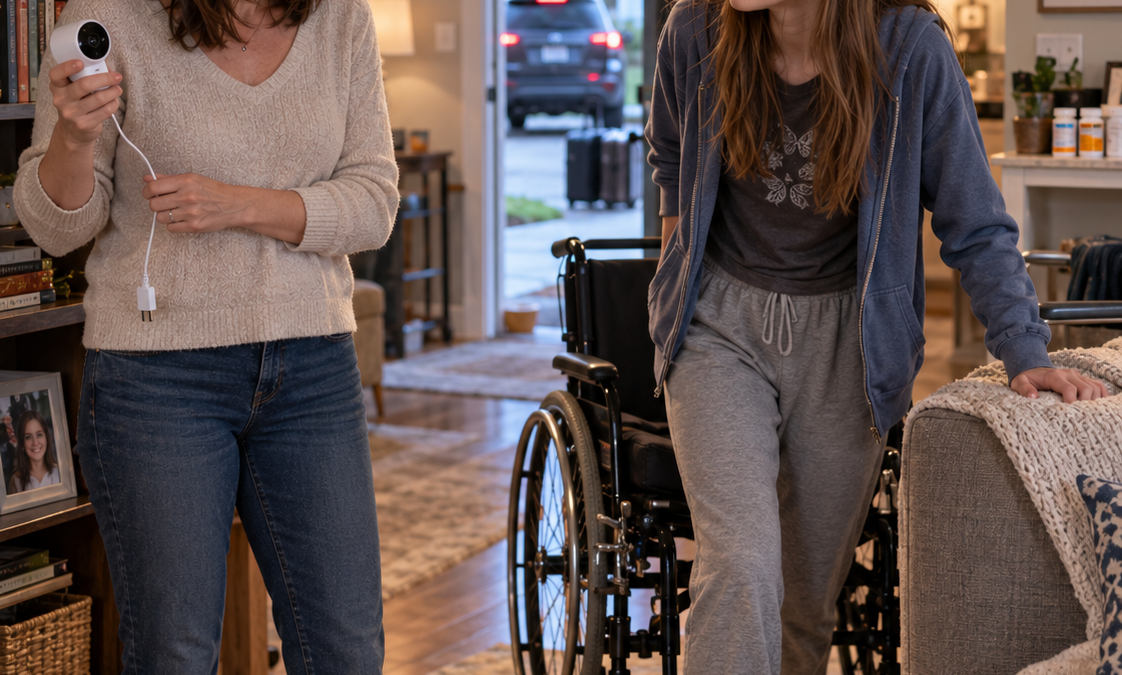
The first thing Lena asked after her father’s car disappeared was whether I would turn off the cameras.
Not whether breakfast was ready.
Not whether I remembered her medication.
Not whether I could help transfer her out of the wheelchair.
She looked past me toward the small black camera mounted above the living-room bookshelf.
“Can you turn that off?”
I thought I had misheard.
“What?”
“My dad checks it.”
The sentence itself was unusual.
Lena was eighteen, but in the three years I had known her, I rarely heard her speak more than a few words at a time.
My husband Daniel said talking exhausted her.
He told me that after the neurological complications from her bicycle accident, processing speech had become difficult.
Lena understood people, he said.
She simply couldn’t reliably respond.
That morning, her voice sounded quiet.
But clear.
I looked at the camera.
“Your dad said they need to stay on.”
“Please.”
Something in the way she said it made me walk over and unplug the cord.
Lena immediately glanced toward the kitchen.
There was another camera above the breakfast nook.
I unplugged that one too.
The third was in the hallway outside her downstairs bedroom.
Daniel had told me never to disable them.
Safety.
Falls.
Confusion.
Emergencies.
For three years, every explanation in that house eventually arrived at the same word.
Safety.
I turned off the hallway camera.
When I came back, Lena was sitting very still.
Daniel’s SUV had left the subdivision maybe five minutes earlier.
He and his mother, Patricia, were flying to Seattle for Daniel’s nephew’s college graduation.
Six days away.
The longest Daniel had ever left Lena since the accident.
I had volunteered to stay.
That sounds obvious because I lived there.
It wasn’t obvious to Daniel.
He had spent nearly a month deciding whether I could “handle the full routine.”
We had been married eighteen months.
I had helped him care for Lena every day.
Still, he treated the week as though I were applying for a specialized job.
Printed meal plan.
Medication checklist.
Emergency numbers.
Rules.
No shower without someone immediately outside the bathroom.
No cooking.
No stairs.
No walking even with assistance.
No friends in the house.
No deviations from the homeschooling schedule.
Do not turn off cameras.
He walked me through everything Friday night.
Again Saturday morning.
At one point I laughed.
“Daniel, I know.”
He did not laugh back.
“You’ve never been solely responsible for her.”
He was right.
Even when he worked, his mother usually stopped by.
One of them was almost always in the house.
That had once reassured me.
That morning, it suddenly looked different.
Lena put both hands on the arms of her wheelchair.
Then she stood.
I remember the exact feeling in my chest.
Not fear.
My brain simply rejected the image.
Lena’s legs trembled.
Her left hand reached for the table.
She was not pretending to be an athlete.
She was not moving like someone with no physical limitations.
She was a young woman working carefully inside a body that required concentration.
But she was standing without me.
Without Daniel.
Without Patricia.
“Lena.”
She looked at me.
“I can walk.”
Her voice was completely normal.
Not loud.
Not effortless.
Normal.
She moved toward the couch.
Six or seven steps.
One hand touched furniture twice.
Then she sat.
I remained standing.
“What is happening?”
She swallowed.
“I still use the chair.”
“Okay.”
“My legs get weak.”
“Okay.”
“Sometimes I get dizzy.”
I nodded.
All of that made sense.
She had never told me she had no condition.
Then she said:
“Dad tells people I can’t walk at all.”
I sat across from her.
“Does he know?”
“Yes.”
“How long have you been able to do that?”
“About sixteen months.”
Sixteen months.
I had married Daniel eighteen months earlier.
Almost my entire marriage.
“Why have I never seen you?”
“You have.”
I frowned.
She reminded me of small moments.
The water bottle I once saw her lunge toward.
A wheelchair I found inexplicably moved.
A sound upstairs when Daniel was supposedly the only person home capable of climbing the stairs.
I had noticed all three.
Daniel had explained all three.
Reflex.
Patricia moved the chair.
House settling.
I had accepted his answers because the alternative seemed absurd.
“Why do you pretend when he’s here?”
Lena looked toward the dead camera.
“I don’t pretend all the time.”
That distinction mattered.
“I really do have trouble.”
“I believe you.”
Her eyes lifted.
Something softened.
“I know.”
I waited.
“He gets angry when I do too much.”
“Why?”
“He says I’m going to hurt myself.”
“That could be because he’s scared.”
“I know.”
That surprised me.
She wasn’t describing him as a monster.
She understood him better than I did.
“When did this start?”
“After rehab.”
The bicycle accident happened when Lena was fifteen.
A driver failed to stop at an intersection.
Lena was thrown hard enough to require surgeries and months of rehabilitation.
Daniel told me she had developed lasting neurological problems afterward.
Mobility.
Fatigue.
Speech.
Balance.
Some of that was true.
That was what made the rest possible.
Lena spent nearly a year moving between hospital care, outpatient rehabilitation and home.
According to Daniel, she eventually plateaued.
Her mother Renee could not accept it.
Daniel’s version was that Renee pressured Lena constantly.
Walk farther.
Talk more.
Return to school.
Stop “acting sick.”
They fought.
Renee left.
Eventually she moved to another state.
“Your mother left because she thought you weren’t sick?”
Lena shook her head.
“She knew I was sick.”
“Then what happened?”
“She thought Dad was making me more dependent.”
I felt uncomfortable immediately.
Not because I disbelieved her.
Because I had judged Renee for years based entirely on Daniel’s story.
I had never met the woman.
Daniel said she abandoned her daughter.
I accepted that because I admired him.
When we met, his devotion to Lena was the first thing I noticed.
He had rebuilt his house around her needs.
Widened one doorway.
Installed grab bars.
Moved Lena’s room downstairs.
Changed jobs so he could work partly from home.
I thought:
This is what a good father looks like.
People told him that constantly.
I did too.
“What did your mother want?”
“For me to keep doing rehab.”
“And Dad?”
“At first, same.”
“What changed?”
Lena looked down.
“I fell.”
“When?”
“About a year and a half ago.”
She had been practicing walking in a rehabilitation gym.
She lost balance and fell.
No major injury.
But Daniel witnessed it.
After that, according to Lena, his fear became a set of rules.
The therapists wanted her to continue carefully.
Daniel wanted certainty.
No more falls.
No more risk.
He began telling Lena she was pushing too hard.
When she improved, he called the improvement temporary.
When she became tired, he used the fatigue as proof that the therapists had been wrong.
Renee fought him.
The fight became about custody.
Then about medical decisions.
Eventually, at seventeen, Lena refused to see her mother at all.
“Why?”
She cried then.
Quietly.
“Dad said she was going to take me somewhere and force me into rehab.”
“Was she?”
“I don’t know.”
That answer was important.
Lena did not have perfect knowledge either.
She had been a teenager between two angry parents.
“What do you know?”
“She kept sending me messages.”
“You could read them?”
“At first.”
Then Daniel changed her phone.
Parental restrictions.
New account.
He told me that was because strangers had been harassing Lena online after local fundraising events.
That too could have been partly true.
Eventually, Renee’s messages stopped reaching her.
“I thought she quit trying.”
“Did she?”
Lena looked at me.
“I found letters.”
“Where?”
“Dad’s office.”
My stomach tightened.
“How many?”
“Eleven.”
She had found them six months earlier while looking for insurance paperwork.
Unopened.
All addressed to her.
Daniel had put them inside a file drawer.
“What did they say?”
“I don’t know.”
“You didn’t open them?”
“They were gone the next day.”
I leaned back.
The story was getting larger than I wanted.
Not more dramatic.
More uncertain.
There was a version where Renee was unsafe.
A version where Daniel genuinely believed withholding contact protected Lena.
A version where both parents had used fear and conflict to damage her.
I needed facts.
So did Lena.
“Show me what you wanted to show me.”
She wheeled herself to her bedroom.
This time I watched differently.
She used the chair efficiently.
Not as a prop.
As mobility.
Inside her room, she opened a drawer beneath some notebooks.
A flat envelope.
Rehabilitation paperwork.
The report was fourteen months old.
I read slowly.
It described persistent neurological symptoms and variable fatigue.
It also described meaningful gains.
Independent standing.
Short-distance ambulation under certain conditions.
Ability to communicate verbally.
Recommendations for progressive independence.
Community mobility training.
A gradual return to in-person education.
Lena watched me.
“Dad says this report is outdated.”
“Maybe it is.”
Her face fell.
I held up one hand.
“I’m not saying he’s right.”
I looked at the date.
“But one report from fourteen months ago does not automatically tell us what you can safely do now.”
That was the first time she smiled.
Barely.
“Mom said the same thing.”
That surprised me.
“What did she say?”
“That I needed a new evaluation that wasn’t chosen by either of them.”
Smart.
“Did that happen?”
“No.”
“Why?”
“Dad canceled it.”
Again, Daniel could have had reasons.
Again, I needed facts.
Then Lena handed me another document.
A county probate court notice.
I recognized my own name halfway down the page.
“What is this?”
“He’s trying to become my guardian.”
Lena had turned eighteen six weeks earlier.
Daniel had told me he was working on “adult-care paperwork.”
I assumed insurance.
Disability benefits.
Medical authorization.
The petition argued Lena was unable to make major medical, educational and financial decisions independently.
It did not ask for limited assistance.
It asked for broad guardianship.
My stomach turned.
Then I saw an attachment list.
A caregiver affidavit.
Proposed witness:
Claire Whitman — stepmother and daily caregiver.
I looked at Lena.
“Has he asked me to sign anything?”
“He said he would after the trip.”
That explained Daniel’s strange insistence that I master the routine.
He had not only been testing whether I could care for Lena.
He was positioning me to describe her dependence.
Whether he consciously thought of it that way, I did not know.
“Do you want your father as guardian?”
“No.”
Immediate.
“Do you want anyone as guardian?”
“I don’t know.”
Better answer.
“What do you want?”
Lena stared at the floor.
“To be evaluated by somebody he doesn’t choose.”
That was reasonable.
“And I want to talk to my mom.”
I nodded.
“Okay.”
She looked startled.
“Okay?”
“Yes.”
“You’ll help?”
“I’ll help you find a safe way to do those things.”
“Without telling Dad?”
That question was harder.
I was her stepmother.
Daniel’s wife.
She was also eighteen.
An adult.
And she had just told me she believed the person I slept beside every night had prevented her from communicating honestly about her own abilities.
“I’m not going to call him right now.”
That was as far as I could promise.
The next morning, we started with her former rehabilitation center.
Not secretly.
Lena called.
I sat beside her only because she asked.
She gave her own name.
Date of birth.
Explained she wanted records and information about arranging a current independent evaluation.
The coordinator spoke to her.
Not me.
That distinction felt enormous.
They could not immediately schedule everything.
But they explained the process and sent records to an email address Lena created herself.
Next, Lena searched for her mother.
Renee was easier to find than either of us expected.
She was living in Richmond, Virginia.
Working as a dental hygienist.
Public social profile.
Nothing mysterious.
Lena stared at the screen for twenty minutes.
Then wrote:
Mom, it’s Lena. Is this still your number?
We waited.
Seven minutes later:
Yes.
Then:
Are you safe?
Lena began crying before she answered.
That call lasted almost three hours.
I did not sit beside her.
I went into the kitchen.
Made coffee.
Tried to understand what my marriage had become.
Afterward, Lena told me only what she wanted me to know.
Renee’s version did not make Daniel a cartoon villain.
That almost made things worse.
After the accident, Daniel and Renee had been terrified.
They disagreed about risk.
Renee pushed rehabilitation.
Daniel became more protective after the fall.
Arguments escalated.
Renee accused him of teaching Lena helplessness.
Daniel accused Renee of endangering her.
Their divorce lawyered every disagreement until each conversation sounded like evidence.
Renee eventually lost primary decision-making authority temporarily after Daniel produced records showing Lena experienced severe episodes after some visits.
Renee believed those episodes were related to stress and medication changes.
Daniel believed they proved the visits were harmful.
By the time Lena was seventeen, she told the court she did not want contact.
Renee stopped forcing it.
“I thought she was choosing him,” Renee told me later.
“She thought you abandoned her,” I said.
Renee closed her eyes.
“I know.”
There was no simple innocent parent.
There was a daughter who had spent years inside adult fear.
On Monday, Lena had an appointment with an independent physiatry clinic.
I drove.
The physician did not pronounce her magically recovered.
He listened.
Reviewed old records.
Recommended updated physical and neuropsychological assessments.
He also asked Lena questions without me in the room.
Good.
Tuesday, we met with a disability-rights attorney recommended by the clinic social worker.
Again, Lena spoke first.
The attorney explained that guardianship was not inevitable simply because someone had disabilities.
There were less restrictive supports.
Supported decision-making.
Medical proxies.
Financial assistance.
Limited arrangements when appropriate.
A formal independent assessment would matter.
I said almost nothing.
On Wednesday night, Daniel called.
“How’s everything?”
“Fine.”
I hated myself for using the word.
He asked whether Lena had followed the schedule.
I looked across the room.
She was making grilled cheese at the kitchen counter, seated on a high stool with her wheelchair nearby.
Mostly.
“She’s okay.”
“Did she have any episodes?”
“No.”
He relaxed.
“Good. See? Routine works.”
Lena looked at me.
I ended the call soon afterward.
Thursday, she received her first email directly from her old rehabilitation therapist.
Not medical conclusions.
A note.
I’m glad you reached out yourself.
Lena read it four times.
Friday evening, Daniel came home.
I had imagined confrontation all week.
None of my imagined versions happened.
He entered carrying luggage.
Patricia behind him.
Lena was in the living room.
In her wheelchair.
Not because she was performing.
She had been tired that afternoon and chose to use it.
Daniel kissed her forehead.
“Good week?”
“Yes.”
He stopped.
Her voice was stronger than he expected.
Then he looked at me.
Something in my expression must have changed.
“What happened?”
I did not answer in front of Patricia.
“Can we talk privately?”
His face tightened.
We went to the kitchen.
I put the guardianship packet on the island.
Daniel looked at it.
Then at me.
“You went through my office?”
“Lena showed me her copy.”
His entire body changed.
“What has she been telling you?”
Wrong question.
Not:
What did she show you?
Not:
Is she okay?
What has she been telling you?
“She wants an independent evaluation.”
“No.”
Immediate.
“She’s eighteen.”
“She doesn’t understand the consequences.”
“She understands the question.”
His jaw tightened.
“You have been alone with her for six days and suddenly you’re an expert?”
“No.”
“I have done this for three years.”
“I know.”
“Then trust me.”
I looked at the man I had married because his devotion to his daughter seemed limitless.
“I did.”
He went still.
That hurt him.
Good.
Not because I wanted pain.
Because he needed to hear the past tense.
Lena appeared in the kitchen doorway.
Daniel immediately looked toward her wheelchair.
“Go rest.”
“No.”
His eyes narrowed.
“Lena.”
She placed her hands on the armrests.
Then she stood.
Not dramatically.
Slowly.
Carefully.
Daniel closed his eyes.
That reaction told me more than surprise would have.
He knew.
“Sit down.”
“No.”
“You’re overtired.”
“I decide when I’m tired.”
Patricia stepped forward.
“Sweetheart, don’t upset yourself.”
Lena looked at her grandmother.
“I’m already upset.”
I had never heard her speak to Patricia like that.
Daniel turned on me.
“What did you do?”
I nearly laughed.
There it was.
Independence had to belong to someone else.
If Lena changed, another adult must have caused it.
“She did this.”
He looked toward his daughter.
“You don’t understand what Claire is encouraging.”
Lena’s hands shook.
Not weakness this time.
Anger.
“I talked to Mom.”
Daniel went completely still.
That was the real confrontation.
Not walking.
Renee.
“You what?”
“I called her.”
Daniel looked at me.
“You allowed that?”
“She doesn’t need my permission.”
His face became red.
“She absolutely needs—”
He stopped.
Lena finished the sentence for him.
“Yours?”
No one spoke.
Then she said:
“I’m not signing anything that says I want you as my guardian.”
Daniel’s expression changed.
Fear.
Real fear.
For one brief moment, I saw past the control.
Back to the father who watched a fifteen-year-old daughter get loaded into an ambulance after an accident.
The father who spent months terrified she would never recover.
Somewhere along the way, the fear had become identity.
If Lena became independent, what had all those years been?
Who was Daniel if she no longer needed him every minute?
He said quietly:
“You’re going to get hurt.”
“Maybe.”
“You don’t understand.”
“I might fall.”
“Yes.”
“I fell before.”
He swallowed.
“And I got back up.”
Daniel turned away.
The guardianship hearing was postponed after Lena obtained counsel and requested independent evaluations.
Then the process became boring.
Good.
Boring was healthy.
Assessments.
Meetings.
Paperwork.
Lena still had real limitations.
That remained true.
She fatigued easily.
She used the wheelchair outside frequently.
Some days she needed help.
Other days she walked around the house.
Her speech never disappeared simply because Daniel left.
It became obvious that “unable to communicate” had been an inaccurate description for a long time.
The court ultimately denied the broad guardianship petition.
Lena chose supported decision-making instead.
She signed a healthcare proxy naming Renee and me jointly for emergencies, with the ability to change it whenever she wanted.
Daniel was not included.
That devastated him.
I did not tell her to do it.
I also did not try to change her mind.
The first time she returned to an in-person classroom was not some triumphant university lecture.
It was one community-college course.
Introduction to Digital Design.
Two mornings a week.
She used campus disability services.
Sometimes the chair.
Sometimes forearm crutches.
Her life did not become magically easy.
It became hers.
My marriage did not survive.
Daniel said I betrayed him.
There was truth in that from his perspective.
I had made decisions while he was away.
Contacted professionals.
Supported Lena when she opposed him.
From mine, the marriage had already broken the moment I realized he had spent years asking me to care for a version of his daughter he helped construct.
We separated three months after the guardianship petition ended.
No police.
No dramatic criminal charges.
No public fundraiser scandal.
I did not discover Daniel had fabricated the original accident.
He hadn’t.
The tragedy was more ordinary.
Something terrible happened to his daughter.
Fear convinced him safety meant eliminating risk.
Then eliminating risk required eliminating autonomy.
Every improvement became dangerous because improvement meant letting go.
Eventually, protection and control became indistinguishable to him.
Patricia defended him for almost a year.
Then Lena invited her to lunch.
Alone.
I drove Lena there and waited nearby.
When she came out, her grandmother had been crying.
“What happened?”
“Grandma asked why I never told her.”
“What did you say?”
Lena looked through the windshield.
“I said I tried.”
That was all.
Renee returned slowly.
She did not become perfect because Daniel’s version had been incomplete.
Lena was angry with her too.
“For giving up.”
Renee accepted that.
“I thought respecting your no was the only thing left I could do.”
“Maybe you should’ve tried again.”
“Maybe.”
Not satisfying.
Honest.
Their relationship rebuilt in small pieces.
Text messages.
Lunch.
A movie.
One weekend visit.
No immediate mother-daughter reunion.
I remained in Lena’s life after the divorce because she asked me to.
Daniel hated that initially.
Then, eventually, stopped fighting it.
Two years later, Lena lived in an accessible apartment with a roommate.
Three blocks from campus.
She still had the wheelchair.
That detail matters to me.
People hearing the story often expect the wheelchair to vanish once “the truth” appears.
It didn’t.
The wheelchair was never the lie.
The lie was that needing it sometimes meant Lena could never decide anything for herself.
I visited one Saturday.
She opened the door standing.
A cane in one hand.
Wheelchair folded near the wall behind her.
“Show-off,” I said.
She smiled.
“Good day.”
“I can tell.”
Her kitchen was a mess.
There were three mugs in the sink.
Laundry on a chair.
A half-dead plant on the windowsill.
Her own ordinary chaos.
We ordered pizza.
Halfway through dinner, she said Daniel had called.
“How was it?”
“Awkward.”
“Progress.”
“He apologized.”
I looked at her.
“For what?”
“He said he made being my dad into a job he didn’t know how to quit.”
That sounded like Daniel.
“What did you say?”
“That I still need a dad.”
I waited.
“Just not a warden.”
I laughed.
“So?”
“He said he’d work on it.”
Maybe he would.
Maybe he wouldn’t.
I had stopped needing the story to end with everyone becoming the people they should have been from the beginning.
The week Daniel left me alone with Lena, I thought the shocking discovery was that she could stand.
It wasn’t.
Bodies are complicated.
Recovery is complicated.
Disability is complicated.
The real discovery was simpler.
For three years, nearly every adult around Lena had been describing her.
Answering for her.
Planning for her.
Protecting her.
Fighting over her.
Nobody was leaving enough silence for her to answer the questions herself.
The first useful thing I did was not help her walk.
It was unplug a camera and listen.