For Three Years, I Cut My Career to Part-Time So I Could Bathe, Feed, Drive, and Care for My Husband’s Mother Every Day—Then I Heard Him Tell His Sister That I Had “Chosen Not to Work” and That Once His Mother Moved Out, He Could Finally Stop Supporting a Wife Who “Contributed Nothing.”
For three years, I took care of my husband’s mother almost every day.
Then I overheard him tell his sister I had chosen not to work.
My name is Maren Ellis.
I was forty-four when the sentence finally made me understand what my marriage had become.
Before Evelyn moved in with us, I worked full-time as an events coordinator for the Allegheny County library system outside Pittsburgh.
I had been there almost twelve years.
It was not glamorous work.
Author talks.
Children’s programs.
Community workshops.
Grant applications.
Holiday events where somebody always forgot extension cords.
I loved it.
The year Evelyn had her stroke, I was being considered for an assistant branch manager position.
Then everything changed.
Evelyn was eighty at the time.
Widowed.
Proud.
Independent enough that she still complained when anyone carried groceries for her.
The stroke was not catastrophic, but it affected her left side and left her with balance problems that made living alone difficult.
Graham, my husband, was terrified.
His younger sister Paula was too.
For the first two weeks after the hospital, everybody had opinions.
Physical rehabilitation.
Home health.
Assisted living.
Moving Evelyn into our house.
Nobody wanted her in a facility.
Including me.
Our house had a first-floor den beside a full bathroom.
It seemed manageable.
“Six months,” Graham said.
“Maybe a year.”
I believed him.
For the first month, Graham was deeply involved.
He installed grab bars.
Bought a shower chair.
Rearranged the den.
Attended one physical-therapy session.
Paula came almost every weekend.
Then normal life resumed.
Graham ran regional sales for a building-supply company.
Paula had two teenagers and lived forty minutes away.
Somehow, the daily work settled onto me.
Not because anyone held a meeting and assigned it.
It simply happened.
I worked closest to home.
I had the more flexible supervisor.
I knew Evelyn’s medication schedule.
I cooked.
I was female.
Nobody said that last part.
Nobody needed to.
At first, I did it gladly.
Evelyn had always treated me kindly.
When Graham and I married, she gave me a recipe box and told me I was under no obligation to cook any of it.
When I once asked whether she minded that Graham and I did not want children, she said:
“Your marriage is not a public utility. Nobody else gets a vote.”
I loved her for that.
So when she needed help, I helped.
Morning medication.
Breakfast.
Bathing.
Laundry.
Physical therapy exercises.
Appointments.
Blood-pressure checks.
Pharmacy runs.
There was always something.
I tried to keep working full-time.
That lasted fourteen weeks.
One Tuesday, I left an event setup early because Evelyn became dizzy at home.
Thursday, I missed a staff meeting because her transport service canceled.
The following Monday, I fell asleep at my desk after being awake with her most of the night.
My supervisor, Lena, called me into her office.
“You can’t keep doing both like this.”
I expected a warning.
Instead she offered an alternative.
Two remote days.
One half-day onsite.
Temporary reduced schedule.
I nearly cried.
Graham called it perfect.
“Just until Mom gets stronger.”
My salary dropped.
My retirement contributions dropped.
The promotion disappeared.
I told myself that was the price of keeping Evelyn out of an institution she did not want.
Six months passed.
Then twelve.
Evelyn improved enough to walk short distances with a walker.
Not enough to live independently.
Graham stopped using the word temporary.
He also stopped noticing the work.
That happened gradually.
In the beginning, if I said I was tired, he thanked me.
Then he began saying:
“I’m tired too.”
Later:
“At least you’re home most days.”
Eventually:
“I wish I had your schedule.”
That was the one that always made me stare at him.
My schedule began at six thirty.
Breakfast.
Medication.
Help Evelyn dress.
Laundry.
Emails for work.
Exercises.
Lunch.
More work.
Appointments.
Dinner.
Cleaning.
If Evelyn had a difficult night, I slept badly.
Graham left at seven thirty and returned around six.
He worked hard.
I never denied that.
But he came home to a mother who had been fed, washed, medicated and monitored.
He began acting as though all those things simply occurred.
Paula was worse in a different way.
She praised me publicly.
“You’re an angel.”
“I don’t know how you do it.”
Then she would cancel Saturday visits because one of her children had soccer.
I eventually learned that praise is sometimes the cheapest way to avoid helping.
A year into the arrangement, Evelyn’s hospital social worker recommended a formal caregiver assessment.
Her pension and supplemental care plan allowed her to pay a family member for a limited number of documented caregiving hours.
I was uncomfortable.
“She’s family.”
The social worker looked at me.
“So are you.”
I still resisted.
Evelyn did not.
“I have money,” she said.
“You have a retirement account that is shrinking while you take care of me.”
“I’m fine.”
“You are forty-two.”
“I was forty-three.”
“Exactly. Old enough to know better.”
That was Evelyn.
The program required timesheets.
Care plans.
Periodic reviews.
The payroll administrator registered me under Maren Ellis, my legal name before marriage, because that remained the name tied to an old professional certification and one of my banking records.
I never changed it.
Every two weeks, I received a modest payment.
Not enough to replace my salary.
Enough to matter.
I put part into an IRA.
Used some for professional dues.
Bought my own clothes without asking whether our joint account could absorb them.
Occasionally I covered one of Evelyn’s personal items and reimbursed myself properly.
Everything documented.
Graham knew there was a caregiver payment.
He just did not know it was me.
The first statement arrived by mail.
He glanced at it.
“M. Ellis?”
I was standing at the stove.
I looked over.
“That’s the caregiver.”
He nodded.
“How often does she come?”
I should have corrected him.
Instead I said:
“Enough.”
He tossed the statement onto the counter.
“Good.”
That was it.
He did not ask to meet her.
Did not ask what hours she worked.
Did not wonder why he never saw a stranger entering the house.
The fact that his mother’s needs were being handled was enough.
At first, I found it almost funny.
Then instructive.
Graham did not really know what happened inside the house during the day.
He only knew the results.
His mother was clean.
Fed.
Stable.
Appointments attended.
Bills organized.
He assumed someone else did part of it because believing in an invisible worker was easier than acknowledging his wife had reorganized her life around his family.
So I stopped correcting the assumption.
I never wore a disguise.
Never invented a personality.
Never used a fake name.
I simply allowed him to keep not asking.
The payments continued.
So did the marriage.
By the third year, money became an argument more often.
Graham earned significantly more than I did.
That had never bothered me before.
Now he used it as authority.
When I wanted to replace my aging laptop:
“Can we wait? I’m carrying most of the household right now.”
When I renewed my professional membership:
“Do you really need that if you’re barely working?”
When I suggested we hire someone for one evening a week:
“That’s what Mom’s caregiver is for.”
I looked at him.
“You mean M. Ellis?”
“Whoever.”
He genuinely did not care.
I began to wonder whether he cared who was doing anything as long as it spared him.
Then came the afternoon I overheard him talking to Paula.
It was a Wednesday.
I remember because Evelyn’s physical therapist had canceled, which gave me an unexpected hour.
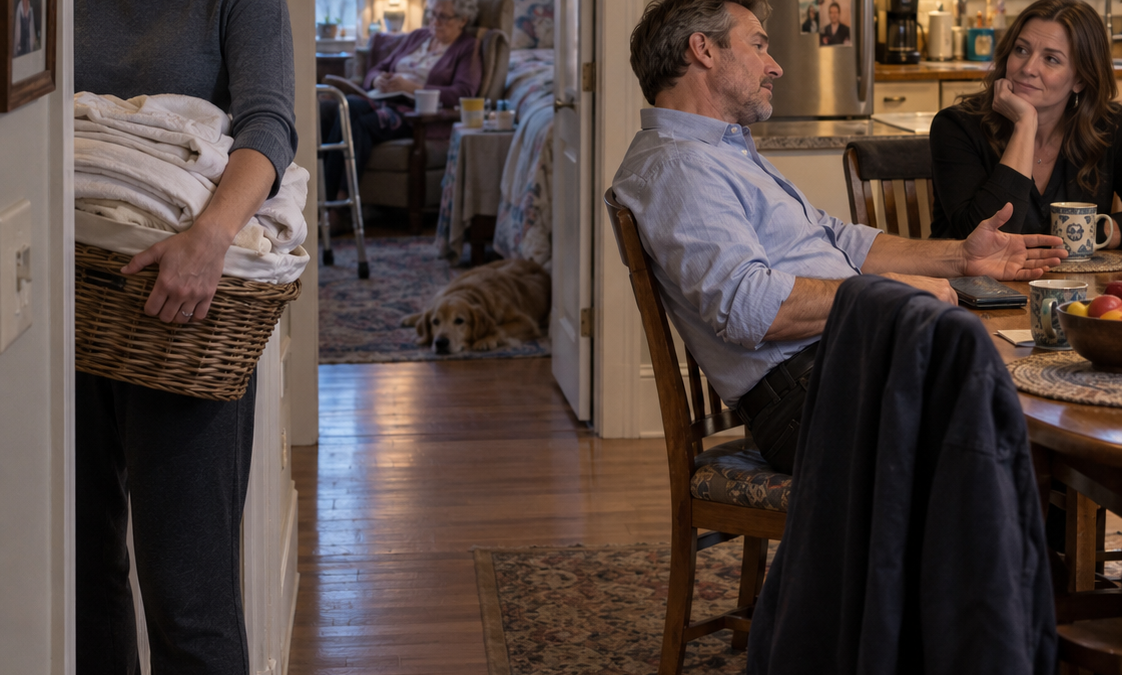
I washed her sheets.
Folded them.
Carried the basket down the hallway.
Graham had come home early.
Paula was in the kitchen.
I heard her laugh.
Then Graham said:
“Once Mom moves, I can finally deal with Maren.”
I stopped.
Paula said:
“Deal with her how?”
“I’m tired.”
“You’ve been tired for ten years.”
“I’m serious.”
He lowered his voice.
“Maren hasn’t worked a real job in three years.”
My hands tightened around the basket.
Paula said nothing.
Graham continued.
“She acts like taking Mom to appointments is some full-time career.”
Paula laughed quietly.
That sound hurt more than I expected.
“What are you going to do?”
“Mom’s name is on the waiting list at Hawthorne.”
Hawthorne was an assisted-living community fifteen minutes away.
I knew that.
Evelyn and I had toured it.
She liked it.
She was not ready to move yet.
“When they have an opening, she goes.”
Paula asked:
“And Maren?”
Graham paused.
Then:
“She won’t have an excuse anymore.”
I felt my stomach tighten.
“Excuse for what?”
Paula asked.
“Not pulling her weight.”
There are phrases you hear and instantly understand they have existed in someone’s mind much longer than they have existed in the room.
Pulling her weight.
Graham had decided I was a dependent.
Paula said:
“You mean you’d make her go back full-time?”
“I mean she can do whatever she wants.”
He laughed.
“If she wants to stay married, she can start contributing.”
I stood there holding his mother’s clean sheets.
A load I had washed.
Folded.
Was about to put on the bed where she slept because I had given up half my career to keep her safe.
I almost walked in.
I imagined dropping the basket on the kitchen floor.
I imagined listing every task.
Every appointment.
Every night.
Every hour.
Then I realized I had already spent three years explaining.
The problem was not lack of information.
Graham benefited from the version of reality he preferred.
I carried the sheets into Evelyn’s room.
She was reading.
She looked at my face.
“What happened?”
“Nothing.”
“Maren.”
I put the basket down.
“I heard Graham talking to Paula.”
Her expression sharpened.
“What did he say?”
I sat on the edge of the chair.
“I’m not ready to repeat it.”
Evelyn closed her book.
We sat quietly.
Then she opened the top drawer of her nightstand.
She pulled out a thick brown accordion folder.
“What is that?”
“My paperwork.”
“I keep your paperwork in the cabinet.”
“You keep the paperwork Graham knows about.”
I looked at her.
Evelyn set the folder on her lap.
“Three years ago, after you cut your hours, I started keeping copies.”
“Copies of what?”
“Everything.”
She opened it.
Timesheets.
Care assessments.
Bank statements.
Payroll records.
Appointment summaries.
Receipts.
Printed emails.
I stared.
“Why?”
“Because my husband taught me something.”
Her husband, Frank, had died seven years earlier.
“What?”
“Never allow another person to tell you your own work did not happen simply because they weren’t watching.”
I picked up one timesheet.
My name.
Maren Ellis.
Evelyn’s signature.
Hours.
Tasks.
Dates.
Three years.
“You kept all of this?”
“Every month.”
“Why?”
“Because Graham asked me last year how much I thought your ‘little part-time arrangement’ had cost him.”
I looked up.
“He said that?”
“Yes.”
“What did you tell him?”
“That he had no idea what anything cost.”
That sounded like her.
Then she gave me an envelope.
Inside was a letter from the care-plan administrator.
It showed the total amount Evelyn had paid me legally over the previous three years.
More than $41,000.
Not enormous.
Not enough to replace the salary I had lost.
But not nothing.
There were also summaries valuing the unpaid hours outside the reimbursed schedule.
Those numbers were much larger.
I felt embarrassed seeing them.
Evelyn noticed.
“Why are you making that face?”
“It looks ridiculous when you add everything.”
“No.”
“It looks like I’m charging you for being your daughter-in-law.”
“You are not.”
She tapped the folder.
“It looks like work.”
I started crying.
Not dramatically.
Just suddenly.
Evelyn let me.
Then she said:
“There’s more.”
I laughed through the tears.
“Please don’t tell me you have another folder.”
“I do.”
Of course she did.
That folder contained something I did not expect.
Emails from Graham.
Not secret criminal emails.
Not a scheme.
Something more revealing.
When the care plan had been established, the administrator had contacted Graham because he was Evelyn’s son and emergency contact.
They asked whether the family understood that Evelyn had chosen me as the paid family caregiver.
Graham replied:
Whatever arrangement keeps my mother at home is fine. Maren handles those details.
Another email months later asked him to attend a care conference.
He declined.
My wife manages the day-to-day. Please coordinate with her.
Another:
Maren is effectively Mom’s primary caregiver. I’m usually unavailable during business hours.
I stared at the screen.
“He knew.”
Evelyn shook her head.
“He knew when it was convenient.”
That distinction mattered.
Graham may not have remembered my payroll name.
He may genuinely have assumed another worker later.
But in writing, when professionals needed responsibility assigned, he described me accurately.
Primary caregiver.
Manager of day-to-day care.
When talking to Paula, when discussing our marriage, I had “chosen not to work.”
Same three years.
Two versions.
Whichever served him.
“What do you want to do?” Evelyn asked.
That question had become rare in my life.
I looked at the folders.
“I don’t know.”
“Good.”
“Good?”
“People make foolish decisions when they think they have to know immediately.”
For the next week, I said nothing to Graham.
I went to work.
Cared for Evelyn.
Completed my timesheets.
Then I made three appointments.
First, my supervisor Lena.
I asked whether there was a path back to full-time work.
She did not promise my old promotion.
Good.
Life had moved on while I was caregiving.
But a program manager position was opening in two months.
“You’d have to apply.”
“I know.”
“You’d be competing.”
“I know.”
“You want it?”
“Yes.”
I had not said that word about my career in years.
Yes.
Second, I met with a financial planner.
My own.
Not Graham’s.
I wanted to know exactly what three years of reduced income had done to my retirement trajectory.
The answer was uncomfortable.
Not catastrophic.
Repairable.
That mattered.
Third, I met with a family-law attorney.
Not to file for divorce.
To understand.
Our house.
Accounts.
Retirement.
What belonged to whom.
What would happen if I left.
What would happen if Graham filed.
I had spent years avoiding legal information because asking felt disloyal.
Information turned out not to be betrayal.
It was information.
Two weeks later, Hawthorne called.
A room would be available in six weeks.
Evelyn asked to see it again.
We toured.
She liked the garden.
Hated the dining-room curtains.
Approved of the physical-therapy space.
“I think I’m ready,” she said.
I stopped walking.
“You’re sure?”
“No.”
I smiled.
“That sounds more believable.”
She squeezed my hand.
“I’m ready enough.”
That evening, Evelyn told Graham.
He looked relieved.
Too relieved.
“That’s great, Mom.”
“I haven’t died.”
He laughed awkwardly.
“Nobody said you did.”
“I’m reminding you.”
He looked at me.
“Once she moves, maybe things can finally get back to normal.”
I asked:
“What does normal mean?”
He shrugged.
“You working again. Us having a life.”
I almost admired how easily he said it.
As though I had spent three years away on vacation.
“I am working.”
“You know what I mean.”
“Yes.”
I did.
“Graham, sit down.”
Something in my tone changed his face.
Evelyn stayed in the room.
That was her choice.
Paula was not there.
No audience.
No humiliation.
I placed the accordion folder on the table.
Graham frowned.
“What’s that?”
“Three years.”
He opened it.
The first page was a care summary.
Then timesheets.
Payroll records.
Appointment logs.
Receipts.
Emails.
He turned pages faster.
“What is this supposed to prove?”
“That depends.”
“On what?”
“On whether you still think I contributed nothing.”
His eyes lifted.
I watched recognition arrive slowly.
“M. Ellis.”
“Yes.”
He looked at Evelyn.
“You paid Maren?”
“I hired Maren.”
“That’s the same thing.”
“No.”
Evelyn’s voice stayed calm.
“I paid for some of the work she did because you were comfortable receiving all of it for free.”
Graham’s face reddened.
“That’s unfair.”
I almost laughed.
Instead I pulled out copies of his emails.
Primary caregiver.
Manages day-to-day.
Coordinate with her.
His own words.
“You knew when doctors asked.”
He stared.
“You knew when insurance asked.”
“Maren—”
“You knew when it meant you didn’t have to leave work.”
“That isn’t what I meant when I talked to Paula.”
“What did you mean?”
He had no answer ready.
For once, I did not help him find one.
Finally:
“I was frustrated.”
“You called my work an excuse.”
“I was venting.”
“You said if I wanted to stay married, I needed to start contributing.”
His face changed.
“You heard that?”
“Yes.”
He leaned back.
Evelyn spoke.
“Did you mean it?”
“Mom, stay out of this.”
She stared at him.
“I am the work.”
That shut him up.
I will remember that sentence forever.
Not because it was clever.
Because it was exact.
Evelyn was not a chore we had been arguing about.
She was a person.
Her body.
Her meals.
Her fear.
Her appointments.
Her life.
The work existed because she existed.
And she had heard her son reduce both of us to burdens.
Graham looked at me.
“What do you want?”
There it was.
Too late.
Still important.
“I’m applying for a full-time position.”
He nodded quickly.
“Good.”
“I’m also opening a separate checking account for my income.”
His face changed.
“Why?”
“Because I need one.”
“We’re married.”
“Yes.”
“And?”
“And marriage is not the same thing as financial blindness.”
He stood.
“So what is this? Punishment?”
“No.”
“Then what?”
“A correction.”
He slept in the guest room that night.
We did not explode.
No plates broke.
No one was thrown out.
The next six weeks were more difficult than any dramatic confrontation could have been.
Evelyn prepared to move.
I trained two aides at Hawthorne on her routines.
Packed clothing.
Labeled medication lists.
Sorted photographs.
Graham participated more than he had in years because suddenly there was no assumption that I would absorb every task.
He hated how much there was to do.
That was useful.
One evening he sat at the kitchen table with three forms.
“How did you keep track of all this?”
I looked at him.
He heard himself.
“I know.”
That was the first real apology.
Not the word sorry.
Recognition.
Evelyn moved in on a Tuesday.
She cried.
I cried.
Graham cried too.
Grief does not only happen when someone dies.
Sometimes it happens when a household shape ends.
I stayed with her until after dinner.
When I returned home, Graham had ordered takeout.
Two containers.
He handed me one.
“We need to decide what happens now.”
“Yes.”
“I don’t want a divorce.”
I sat down.
“I don’t know what I want yet.”
He closed his eyes.
“That bad?”
“Yes.”
He nodded.
No defense.
That was new too.
I got the program manager job.
Not because of the caregiving story.
Because I interviewed well.
Because I knew the library system.
Because I had spent three years solving complicated human problems with limited resources.
My first month back full-time was exhausting.
I had lost professional confidence.
Technology had changed.
People I once supervised had advanced.
I had to learn again.
That humility was healthy.
Graham and I started counseling.
He admitted something months later that I had suspected but never articulated.
My caregiving had made his life easier.
Then he resented me for the version of myself required to make his life easier.
“I wanted you available,” he said.
“And then I looked down on you for being available.”
That was the ugliest truth in the marriage.
Also the most useful.
I wish I could say understanding fixed everything.
It did not.
Some injuries become clearer before they become smaller.
I could forgive exhaustion.
Fear.
Avoidance.
What I struggled to forgive was contempt.
The little jokes about my income.
The implication that I lived on his generosity.
The way he could accurately describe my work to professionals and dismiss it privately.
We stayed in counseling for nine months.
Eventually, I moved into a small apartment fifteen minutes from Evelyn.
Not because Graham threw me out.
Not because I discovered a secret fortune.
Because I needed to learn whether I wanted the marriage when I was no longer organized around his needs.
We separated.
Evelyn was furious with him.
I asked her not to choose between us.
“Maren, I am eighty-one years old.”
She pointed her cane at me.
“I choose whatever I want.”
Fair enough.
Still, she continued seeing Graham.
That mattered.
He needed to be her son without using me as the bridge.
He began visiting twice a week.
Then three.
He learned her medication list.
Attended meetings.
Took her to lunch.
Once he called me.
“What does she mean when she says her left shoe feels wrong?”
I almost answered automatically.
Then stopped.
“Ask the physical therapist.”
Silence.
“Right.”
Small boundary.
Huge feeling.
Our separation lasted a year.
We did not reconcile.
By then, something had changed in both of us, just not in a way that rebuilt marriage.
Graham became more involved with Evelyn.
I became more involved with myself.
We divorced without turning Evelyn into property.
That sounds like a strange sentence.
It shouldn’t.
Her money remained hers.
Her decisions remained hers.
Her care plan remained hers.
The caregiver payments ended when she moved to Hawthorne.
The separate account in my name contained a little over twelve thousand dollars after taxes and retirement contributions.
Not a secret fortune.
Enough for a security deposit, furniture and several months of breathing room.
Money I had earned.
Two years later, Evelyn was still at Hawthorne.
Still complaining about the curtains.
Still insisting the soup needed salt.
I visited every Thursday.
Graham usually came Sundays.
Sometimes our visits overlapped.
We became polite.
Not close.
That was enough.
One afternoon Evelyn handed me the brown accordion folder.
“What am I supposed to do with this?”
“Keep it.”
“Why?”
“Because one day you’ll start telling yourself those years weren’t real.”
I laughed.
“I won’t.”
“You will.”
She tapped the folder.
“Women are very talented at shrinking their own work after it is over.”
I took it.
She was right.
Sometimes I remembered only the marriage ending.
The argument.
The humiliation.
Then I opened that folder.
Three years of dates.
Hours.
Meals.
Appointments.
Exercises.
Transportation.
Medication.
Laundry.
Night care.
A life held together in ordinary tasks.
The most important thing in those pages was not what Graham had failed to see.
It was what I had finally learned to see myself.
Care was work.
Love was not supposed to make that work invisible.
And sacrifice stopped being generous the moment somebody else decided you owed it.