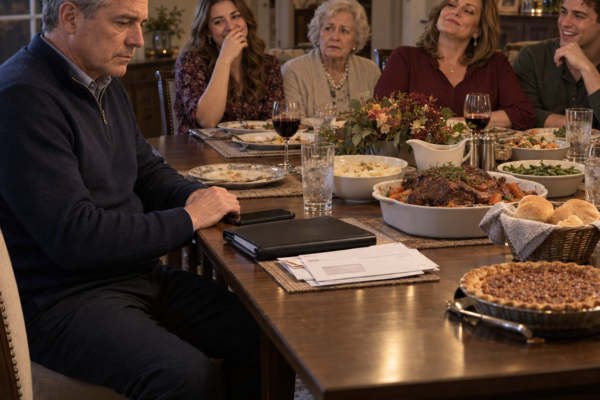
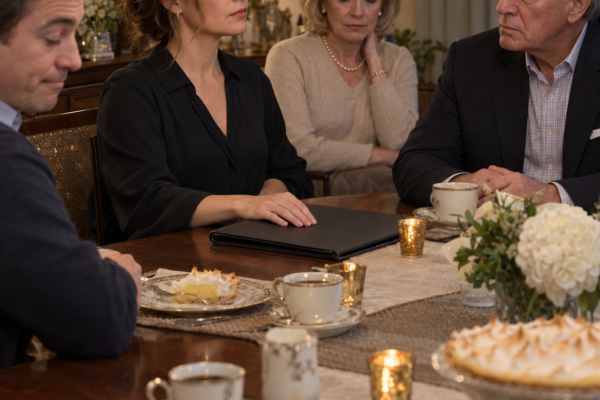
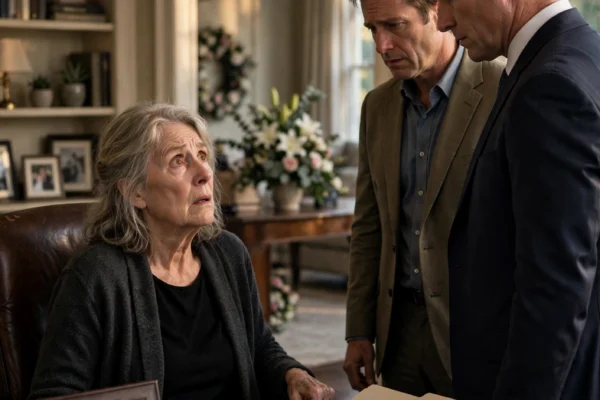
At My 70th Birthday Lunch, My Son Slid a Realtor Packet Across the Table and Said My Paid-Off House Was “Too Much for One Person”—Then My Daughter Started Dividing the Sale Money Between His Business Debt and Her Home Renovation Before Either of Them Had Even Asked Whether I Planned to Move.
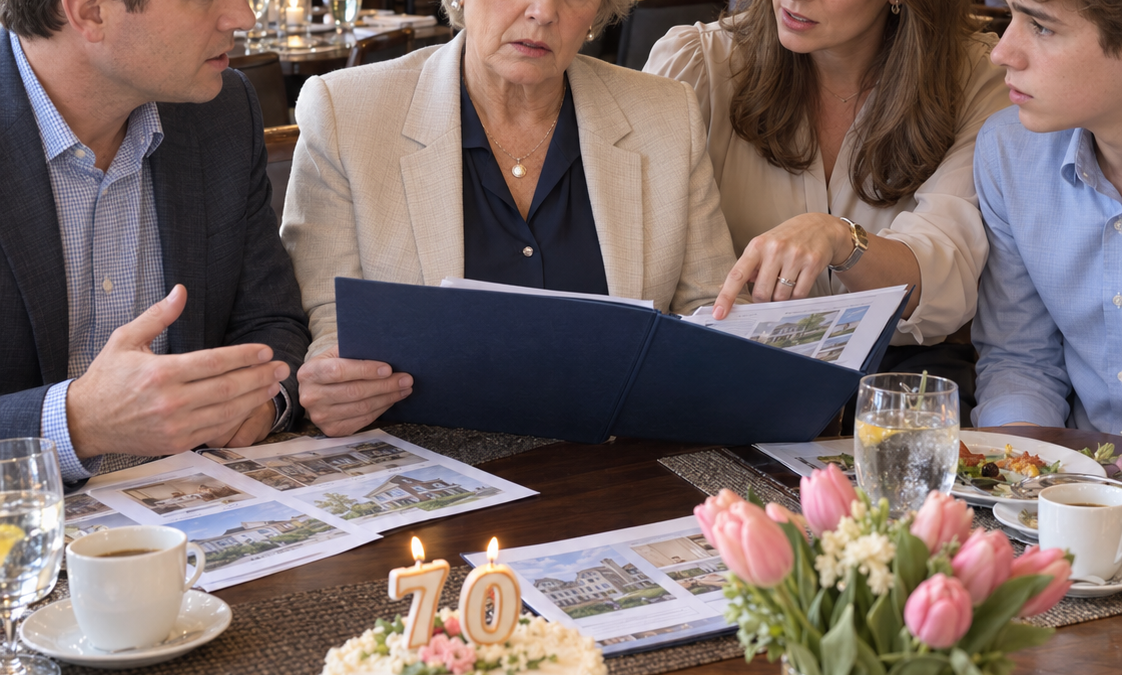
My children tried to sell my house at my seventieth birthday lunch.
I should clarify that sentence.
They did not forge my signature.
They did not hire movers behind my back.
They did not commit some elaborate crime that would end with police cars outside a suburban restaurant.
What they did was quieter.
They planned my next stage of life without asking whether I wanted it.
Then they arrived at my birthday expecting gratitude.
My name is Marian Brooks.
I turned seventy on a rainy Saturday in April.
For twenty-three years, I had lived in a brick two-story house outside Raleigh, North Carolina.
I bought it when I was forty-seven, newly divorced and more frightened than I ever admitted to my children.
Derek was seventeen.
Allison was fourteen.
Their father moved to Florida less than a year later.
He did not vanish from their lives, but he became the sort of parent who knew birthdays and graduation dates better than ordinary Tuesdays.
The ordinary Tuesdays were mine.
I worked at the county public library.
Not as a librarian at first.
Circulation desk.
Then administration.
Eventually branch operations.
Nobody ever got rich managing overdue notices and summer-reading budgets.
But I was good at living within what I had.
The house was my most reckless purchase.
Three bedrooms.
Backyard.
Small screened porch.
A mortgage that kept me awake for the first two years.
My sister thought I should rent.
My mother thought I should buy something smaller.
I wanted my children to keep at least one place that felt permanent.
So I bought it.
Derek built pantry shelves in high school as part of a shop-class project.
They were slightly crooked.
I kept them.
Allison painted her bedroom lavender and later denied ever liking purple.
I kept one small patch inside the closet.
Years later, when Allison had children, we began marking their heights on the mudroom doorway every Thanksgiving.
The house was not an investment to me.
It became one, of course.
Raleigh grew.
Neighborhood prices climbed.
I refinanced once.
Paid extra whenever I received a raise.
By sixty-four, I owned it outright.
When the bank mailed the final mortgage release, I bought a bottle of champagne.
I drank one glass on the screened porch.
Then I put the document in a fireproof box.
That was my celebration.
My children knew how hard I had worked for it.
At least, I assumed they did.
Derek was forty-four when I turned seventy.
He owned a neighborhood restaurant called Field & Vine.
Good food.
Thin margins.
He had always been charming enough to make people believe trouble was temporary.
A broken freezer.
A slow winter.
A supplier increase.
A divorce.
There was always one difficult season between Derek and stability.
Allison was forty-one.
She and her husband, Matt, had two children and a perfectly respectable house fifteen minutes from mine.
Allison was organized in every area except money.
She could plan a family vacation eighteen months in advance and somehow still need to put part of it on a credit card.
I helped them both.
Not constantly.
That distinction mattered to me for years.
I was not paying mortgages every month.
I was not handing them allowances.
I simply stepped in when something significant happened.
Derek needed $8,000 toward a commercial refrigerator after his equipment financing fell through.
I gave it to him.
Allison needed a deposit for her daughter Sophie’s semester abroad before scholarship funds arrived.
I covered it.
A storm damaged Allison’s fence.
Derek needed legal fees during his divorce.
My grandchildren needed orthodontic work.
There was always a reasonable explanation.
And I could afford to help.
That was the sentence I used.
I can afford it.
Nobody forced me.
That was also true.
What I failed to notice was that gratitude had gradually been replaced by expectation.
The first sign was language.
Derek stopped saying:
“Could you help?”
He started saying:
“I’m going to need around five thousand.”
Allison stopped explaining the entire situation.
She would text:
Can you float this until next month?
I still usually said yes.
I liked being useful.
There is something dangerous about being the reliable person in a family.
People admire you.
Then they organize themselves around you.
Eventually they forget your reliability costs anything.
My seventieth birthday lunch was supposed to be simple.
Derek chose a restaurant near downtown because he said turning seventy justified tablecloths.
Allison brought pink tulips.
My grandson Ben wore a blue button-down shirt he clearly hated.
Sophie was away at college and called before lunch.
For the first hour, everything was normal.
Derek told a story about a customer who tried to send back a steak after eating almost all of it.
Allison complained about contractors.
Ben ate enough bread for a family of six.
Then the cake arrived.
The waiter placed two number candles on top.
Seven.
Zero.
Everyone took pictures.
Derek raised his glass.
“To Mom.”
I smiled.
He added:
“And to making the next decade easier.”
That should have sounded strange.
I assumed he meant retirement.
Then he reached beside his chair and lifted a large blue folder.
“Happy birthday.”
I opened it.
The first page showed a condominium.
Two bedrooms.
New construction.
Elevator.
Balcony.
Twenty minutes from my neighborhood.
I looked at Derek.
“What is this?”
Allison smiled.
“We’ve been doing some research.”
“On condos?”
“On options.”
“For who?”
Neither answered immediately.
I turned another page.
Another condo.
Then another.
One near a shopping center.
One beside a greenway.
One in a development advertised for active adults.
“What am I looking at?”
Derek leaned forward.
“Mom, you have a four-bedroom house.”
“Three.”
“You turned the office into a bedroom.”
“That does not cause architecture to change.”
Ben smiled into his water glass.
Derek ignored him.
“You’re one person in almost twenty-four hundred square feet.”
“So?”
“So the stairs aren’t going to get easier.”
“My knees are fine.”
“The yard.”
“I pay someone eighty dollars twice a month.”
“The roof is old.”
“The roof is twelve.”
Allison stepped in.
“We’re not saying you have to do anything tomorrow.”
That was when I noticed the spreadsheet.
Printed.
Color-coded.
I pulled it forward.
At the top:
Brooks House — Simplification Scenario
My daughter had labeled my home like a corporate efficiency project.
Estimated sale price: $730,000.
Estimated closing and preparation costs.
Projected condominium purchase: $265,000.
Moving.
Furniture.
Reserve.
Then:
Available balance after transition: approximately $392,000.
I stared at the number.
“Why are you calculating what I would have left?”
Derek shifted.
“Because otherwise there’s no point downsizing.”
“There are plenty of reasons to downsize that do not involve creating a pile of cash.”
He sighed.
“Mom.”
That tone.
Patient.
Almost parental.
“You have most of your wealth sitting in a building.”
“It’s called a house.”
“You know what I mean.”
“No. Explain it.”
Allison put one hand over the spreadsheet.
“We just thought there might be a smarter way to use it.”
“We?”
Silence.
I looked at Derek.
He rubbed his jaw.
“My restaurant note resets in September.”
There it was.
“How much?”
“One hundred and twenty thousand.”
“You owe one hundred and twenty thousand?”
“It’s business debt.”
“That was not my question.”
He stiffened.
Allison jumped in.
“Nobody is asking you to pay all of it.”
“All of what?”
“Anything.”
I looked at her.
“Then why are you in the conversation?”
She stared at me for half a second too long.
“Our addition.”
I nearly laughed.
“What addition?”
“The downstairs bedroom and bath.”
“For Matt’s mother?”
“No. She’s staying where she is.”
“Then why?”
Allison lowered her voice.
“We need more space.”
They already had four bedrooms.
I looked again at the spreadsheet.
That was when I saw smaller text beneath the available balance.
Someone had created possible allocations.
Derek business stabilization: $150,000.
Allison addition: $90,000.
Grandchildren education: $75,000.
Marian reserve: $77,000.
I read the last line twice.
My reserve.
From my house.
From my money.
After everyone else’s categories.
Ben spoke.
“Grandma?”
“Yes?”
“Do you want to move?”
No one had asked me that.
Not once.
I looked at him.
“No.”
He nodded.
Derek leaned back.
“This is why we wanted to talk instead of springing it on you.”
I looked down at the folder.
“You brought property listings and divided the proceeds.”
“They’re examples.”
Then I saw a clipped appointment sheet.
Monday.
Ten in the morning.
A realtor’s name.
My address.
I held it up.
“What is this?”
Allison went pale.
“It’s only a consultation.”
“At my house.”
“You didn’t have to keep it.”
“You booked someone to come price my home before asking if I wanted to sell?”
Derek said:
“Mom, you’re making it sound worse than it is.”
I closed the folder.
I had heard that sentence in different forms for years.
It is just until next month.
It is just a temporary shortfall.
It is just a deposit.
It is just family helping family.
Now:
It is just a consultation.
I looked at both my children.
Then at Ben.
The poor boy looked like he wanted to crawl under the table.
I hated that.
This was not his burden.
I smiled at him.
“You didn’t do anything wrong.”
Allison said:
“Nobody said he did.”
“I know.”
I turned back to her.
“If I sell my house, move into your condo, pay Derek’s debt and build your addition, what exactly did I receive for my birthday?”
Neither answered.
I asked for a box for the cake.
Then I took the blue folder home.
I did not call either child that evening.
Instead, I made tea and read every page.
That was when anger finally arrived.
Not loud anger.
Useful anger.
The kind that makes you take notes.
There were three realtor printouts.
Estimated moving costs.
A handwritten list of furniture they thought would not fit in a condo.
My dining table was marked:
Derek?
The grandfather clock my father gave me was marked:
Allison storage maybe.
A second spreadsheet estimated what could be sold.
Someone had even written:
Mom probably won’t need riding mower.
I did not own a riding mower.
That almost made me laugh.
Then I found the part that hurt.
At the bottom of one page, in Allison’s handwriting:
Better to help everyone now instead of waiting for inheritance later.
I sat at my kitchen table for a long time.
There it was.
No villain speech.
No one wishing me dead.
Something more ordinary.
They had stopped seeing a clean boundary between what belonged to me now and what might someday belong to them.
My house had become future family money.
The only uncertain part, apparently, was timing.
Monday morning, I called the realtor.
Her name was Denise Harper.
“Mrs. Brooks?”
“Yes.”
“I was actually about to confirm our ten o’clock.”
“We don’t have a ten o’clock.”
She paused.
“I spoke with your daughter.”
“I’m sure you did.”
Silence.
“I was told you were considering downsizing.”
“I am not.”
“I’m very sorry.”
I believed her.
She canceled immediately.
Then I made another call.
Not to an attorney.
Not yet.
To my financial adviser, Simone Keller.
Simone had been telling me for years to create clearer rules around family gifts.
I had always smiled.
Changed the subject.
At her office, I placed the blue folder on the table.
She read quietly.
When she reached the allocation sheet, she removed her glasses.
“Did you agree to any of this?”
“No.”
“Do they have access to your accounts?”
“No.”
“Power of attorney?”
“No.”
“House title?”
“Mine.”
She put her glasses back on.
“Good.”
I exhaled.
Apparently I had been worried about something I had not admitted.
“What do I do?”
Simone surprised me.
She did not tell me to disinherit anyone.
She did not tell me to sell.
She did not tell me to punish them.
She asked:
“What do you want?”
The same question Ben had asked.
“I want to stay in my house.”
“For how long?”
“As long as it makes sense.”
“What would make it stop making sense?”
That was better.
We made a list.
Physical health.
Maintenance.
Affordability.
Isolation.
Transportation.
Actual reasons.
Not Derek’s loan.
Not Allison’s addition.
Simone suggested I pay for an independent home assessment focused on aging in place.
So I did.
A contractor inspected the stairs.
Bathrooms.
Exterior.
Electrical.
Roof.
Lighting.
He found several improvements worth making.
Better railing on the basement stairs.
Brighter hallway lighting.
A walk-in shower instead of the tub in the primary bathroom.
Lever handles.
Some exterior drainage work.
The roof probably had another five years.
Not emergency.
Not perfect.
My house was not too much for me.
It simply needed planning.
That cost money.
My money.
I approved the work.
The estimate came to just under $42,000.
The first person to notice was Allison.
She stopped by unexpectedly one afternoon and saw samples spread across the kitchen counter.
“What are these?”
“Bathroom tile.”
“Are you renovating?”
“Partly.”
Her face changed.
“How much are you spending?”
I looked at her.
Something in me finally clicked.
Not anger.
Clarity.
“I’m not discussing that with you.”
She blinked.
“I’m your daughter.”
“Yes.”
“Why are you being secretive?”
“I’m not. You know I’m renovating.”
“You know what I mean.”
I smiled.
The family phrase.
“What you mean is you want the number.”
She folded her arms.
“After that birthday disaster, I think we have a right to know what you’re planning.”
“We?”
“Derek and me.”
“No.”
She stared.
I continued.
“You have a right to know whether I’m healthy, safe and making decisions freely. You do not have a right to my balance sheet.”
“We were trying to help.”
“I believe you thought that.”
“Thought?”
“You also assigned ninety thousand dollars of my hypothetical sale to your house.”
Her cheeks reddened.
“That was an example.”
“Good. Then you won’t miss it.”
She left angry.
Derek called that evening.
“You’re spending forty grand on that house?”
I laughed.
“Allison works fast.”
“Mom, this is ridiculous.”
“What is?”
“If you’re going to spend that kind of money, you might as well move.”
“Why?”
“Because every dollar you put into that place is locked up.”
There was that phrase again.
Locked up.
“My money is not imprisoned because you can’t use it.”
Silence.
Then:
“That’s a cheap shot.”
“No. It’s arithmetic.”
He hung up.
I cried afterward.
That is the part stories like this often skip.
Boundaries can feel wonderful in retrospect.
In the moment, they can make you sick.
I loved Derek.
I loved Allison.
I wanted them happy.
I wanted to call back and smooth everything over.
I wanted to offer Derek twenty thousand instead of one hundred and fifty.
I wanted to tell Allison maybe I could help with the bathroom portion of the addition.
Not because they had persuaded me.
Because making them happy had become a reflex.
I sat in my kitchen and let the urge pass.
Then I called Ben.
Not his mother.
Ben.
“How was your chemistry test?”
He groaned.
Normal conversation.
Exactly what I needed.
Over the next few months, things changed.
Derek stopped calling as often.
When he did, the conversations were stiff.
His restaurant refinanced the debt through a regional lender at worse terms than he wanted.
He survived.
That mattered.
Not comfortably.
Not magically.
But he solved his own problem.
Allison postponed the addition.
She and Matt converted the existing office instead.
Apparently their house had contained more usable space than ninety thousand dollars suggested.
I did not point that out.
The grandchildren continued visiting.
I made sure of that.
When Allison tried to cancel Ben’s Saturday visit after one of our arguments, I said:
“You and I can be angry without recruiting him.”
She did not like hearing it.
She brought him anyway.
My renovations finished in August.
The new shower was wonderful.
The handrail was boring.
The drainage work was expensive and completely invisible.
I loved all of it.
For the first time in years, I had spent a large amount of money on something purely because it improved my own future.
That realization embarrassed me.
Why had I needed permission?
In September, Simone and I reviewed my estate documents.
This time, I did make changes.
Not as revenge.
I kept Derek and Allison as beneficiaries.
But I changed how several things worked.
Money designated for my grandchildren would go directly into educational trusts rather than through their parents.
I named my sister as alternate financial power of attorney instead of automatically choosing one of my children.
I left instructions that no one was to assume my house would be sold if I became temporarily ill.
My wishes came first.
Care needs second.
Inheritance last.
That ordering should not have felt revolutionary.
It did.
I told Derek and Allison the broad outline.
No surprises.
No dramatic reading of a will after my death.
Derek reacted badly.
“You don’t trust us.”
“I trust you to be my son.”
“That’s not an answer.”
“It is the answer.”
Allison asked why my sister had financial authority instead of her.
“Because Gail does not need my money.”
That ended the conversation.
For several weeks, neither child visited.
I had been prepared for it.
That did not make the house less quiet.
One Saturday, I almost drove to Allison’s with a check.
Not because she had asked.
Because I missed everyone.
I put my purse down.
Called a woman named Ruth from my old library branch instead.
We went to a matinee.
That small choice changed more than I expected.
I began rebuilding a life I had allowed to become too narrow.
Book club.
Water aerobics.
Lunch with former colleagues.
Volunteer reading sessions at the library.
Not a triumphant senior-citizen montage.
Some weeks I stayed home and watched television.
Some mornings my knees hurt.
Some nights I missed the years when my children needed me for things as simple as lunch money and rides to practice.
But loneliness stopped being something only Derek and Allison could cure.
That mattered.
Thanksgiving came.
I did not automatically offer to host.
Allison called two weeks before.
“What are you doing?”
“Ruth invited me to her sister’s.”
Silence.
“You’re not cooking?”
“No.”
“But we always come to your house.”
I nearly laughed.
A year earlier, I would have heard obligation.
Now I heard possibility.
“Would you like to?”
“What?”
“Come here.”
Another silence.
“Yes.”
“Then ask.”
She exhaled.
“Mom, can we all come for Thanksgiving?”
“Yes.”
Different sentence.
Different relationship.
Derek came too.
The day was not magical.
He was still reserved.
Allison overcompensated with compliments.
Matt stayed wisely neutral.
The grandchildren filled the gaps.
After dinner, Derek stood beside the new stair railing.
“You really like all this?”
“The railing?”
“The house.”
“Yes.”
He looked around.
“I thought you were holding onto it because of us.”
That surprised me.
“No.”
“You always talked about keeping the family home.”
“I meant keeping a home where family could come.”
I looked at him.
“That does not mean preserving an asset for you.”
He nodded slowly.
Then he said:
“My restaurant is okay.”
“I’m glad.”
“I had to sell my boat.”
I did not know he owned a boat.
That almost ruined the moment.
I managed:
“I’m sorry.”
He laughed.
“No, you’re not.”
“No.”
For the first time since my birthday, we both laughed.
It did not fix everything.
It opened a door.
Allison took longer.
Her turning point came because of Ben.
The following spring, he received an acceptance to a summer engineering program.
Allison immediately called me.
“The deposit is eighteen hundred dollars.”
I waited.
She went quiet.
Then:
“I’m not asking you to pay it.”
“Okay.”
“I just wanted you to know.”
Another pause.
“We can cover it.”
“Good.”
Then I said:
“I would like to give Ben five hundred as his birthday gift if he wants to put it toward the program.”
Allison was silent.
“That’s different,” I said.
“I know.”
And I think she finally did.
A gift chosen freely is not the same thing as a resource someone budgets before asking.
I turned seventy-one almost exactly a year after the blue-folder lunch.
This time, I hosted dinner at my house.
My choice.
Not because everyone had fully repaired things.
Derek came.
Allison came.
Matt.
Ben.
Sophie was home from college.
My sister Gail drove down.
Ruth came too, which confused Derek because he had not realized I possessed friends outside the family.
We ate on the screened porch.
No expensive restaurant.
No presentation.
No financial planning disguised as a birthday gift.
Ben handed me a small wrapped box.
Inside was a brass plaque.
I raised an eyebrow.
“Am I being memorialized?”
“Read it.”
Three words:
MARIAN’S HOUSE. ASK FIRST.
I laughed hard enough to embarrass him.
Allison closed her eyes.
“Ben.”
“What? It’s funny.”
“It is,” I said.
Derek pointed toward the mudroom.
“Put it above the height marks.”
I looked at him.
He shrugged.
“Seems appropriate.”
We mounted it two weeks later.
The plaque was ridiculous.
I loved it.
My children did not become villains when they saw dollar signs in my home.
That would make the story easier.
They became adults who had grown too accustomed to my help.
I became a mother who had mistaken solving their problems for maintaining closeness.
Both things could be true.
The birthday folder forced us to see where that arrangement eventually led.
They were planning what my money could do for them before asking what I wanted my life to do for me.
That was the boundary I could no longer ignore.
The house is still mine.
Maybe someday I will sell it.
Maybe my knees will change.
Maybe I will want a condo near the greenway.
Maybe I will wake up one morning and decide three bedrooms are ridiculous.
If that happens, I will call a realtor.
I may even ask Allison to help me choose a place.
But the decision will begin with a question no spreadsheet at my seventieth birthday bothered to include.
What do I want?
For now, I want the crooked pantry shelves.
The screened porch.
The roses.
Ben’s height marks.
The absurd brass plaque.
And the freedom to live inside everything I spent decades building without anyone treating my continued presence as a delay in their financial plans.