After I Left My Cheating Husband With Our Three Children, My Father Refused to Let Us Spend Even One Night in His House—He Told Me to “Go Home and Try Again,” While My Brother Laughed and My Sister Called Me Selfish for Breaking Up the Family
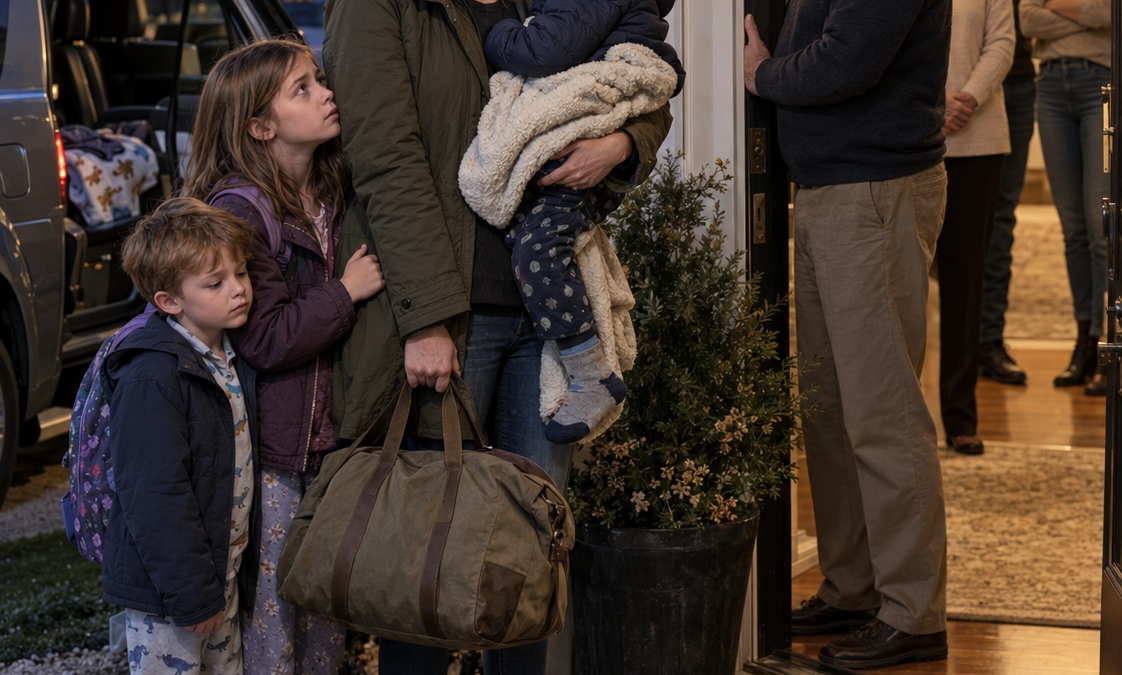
My father closed the door while my three children were still standing on his porch.
That is the detail I remember most.
Not what he said.
Not my brother laughing.
Not my sister calling me selfish.
The door.
Oak.
Dark stain.
Brass handle my mother polished before every holiday.
For thirty-seven years, that door had meant home.
At 9:43 on a Thursday night, it meant something else.
My name is Rebecca Nolan.
At the time, I was thirty-seven years old and had been married to Mark for eleven years.
We lived in a comfortable suburb northwest of Chicago with our three children.
Chloe was nine.
Liam was six.
Noah was three.
From the outside, our life looked so ordinary it was almost invisible.
Mark worked in commercial insurance downtown.
I handled payroll and scheduling three days a week for a dental practice.
We had a mortgage.
Two aging cars.
Soccer on Saturdays.
School lunches nobody remembered to unpack.
Laundry that seemed capable of reproducing without human involvement.
We argued sometimes.
Mostly about normal things.
Money.
Chores.
My mother.
His hours.
Whether one of us had promised Chloe she could get her ears pierced at ten.
I did not think our marriage was perfect.
I thought it was real.
Then Chloe needed Mark’s tablet for a school assignment.
I picked it up from the kitchen counter.
A notification appeared.
I miss waking up next to you.
The contact was saved as Dan Office.
I knew most of Mark’s coworkers.
There was no Dan.
I opened the conversation.
I wish I could say I read one message and stopped.
I didn’t.
There were hundreds.
Months of them.
Hotel reservations.
Lunch plans.
Photographs.
Arguments.
Apologies.
A woman named Valerie.
I learned the affair had lasted almost eleven months.
Mark had missed Liam’s birthday dinner because of a “client problem.”
He had spent that evening at a hotel near O’Hare.
He had once left family Christmas early because the office was “melting down.”
Valerie had been waiting in the city.
There are discoveries so large the mind becomes interested in tiny details instead.
I remember the blue ring around my coffee cup.
A banana going brown in the fruit bowl.
The dishwasher beeping because the cycle had finished.
My entire marriage had cracked open, and I was irritated by the dishwasher.
Mark came home shortly after six.
I placed the tablet on the kitchen island.
He looked at it.
Then at me.
For a second, fear crossed his face.
Then defensiveness replaced it.
“You went through my messages?”
That was the first sentence.
Not:
I’m sorry.
Not:
Let me explain.
The violation he wanted to discuss was mine.
“Who is Valerie?”
He rubbed his forehead.
“Rebecca.”
“How long?”
“It’s complicated.”
“How long?”
He eventually admitted it.
Eleven months.
He insisted he never intended to leave the children.
That was apparently supposed to reassure me.
He talked about our marriage.
How tired I had been after Noah.
How rarely we went out.
How much attention the children took.
How his commute drained him.
Every explanation included me.
Finally I said:
“You could have told me you were unhappy.”
“I tried.”
“No. You complained about dishes and sex and weekends. You never said you were going to sleep with someone else.”
“That’s not fair.”
I laughed.
That ended the conversation.
I packed a canvas duffel upstairs.
Not because I had a long-term plan.
Because I could not sleep beside him that night.
Mark followed me.
“You’re taking the kids?”
“Yes.”
“You can’t just do that.”
“I’m taking them to my parents for one night.”
He relaxed slightly.
That should have bothered me.
At the time, I assumed he believed Dad would calm me down.
He was right about one thing.
Dad tried.
I drove thirty-five minutes with the kids.
Noah fell asleep.
Liam asked three times whether Dad was coming later.
Chloe said nothing.
My parents lived in the same house where I had grown up.
When Mom opened the door, I expected her to pull me inside.
Instead, she looked over my shoulder toward the driveway.
“Where’s Mark?”
That was my first warning.
I said:
“I need to stay here tonight.”
Dad appeared from the living room.
My older brother Eric was visiting.
My younger sister Natalie too.
It should have felt lucky.
Everyone together.
Instead, it felt like walking into a meeting I didn’t know had been scheduled.
Dad asked:
“What happened?”
“Mark has been having an affair.”
Mom closed her eyes.
Eric made a strange sound that became a laugh.
I stared at him.
“Sorry,” he said.
He was not sorry yet.
Natalie folded her arms.
“For how long?”
“Almost a year.”
She winced.
Then said:
“But you have the kids with you.”
“Yes.”
“You took them out of the house?”
“Yes.”
“That seems extreme.”
I looked at her.
“Extreme?”
“They were asleep.”
That was Natalie.
Always more concerned with whether a response looked orderly than whether the thing causing it was wrong.
Dad told the kids to sit in the living room.
Chloe refused.
She stood beside me holding the bag.
“I’m not asking for advice tonight,” I said. “I need somewhere for us to sleep.”
Dad shook his head.
“No.”
I thought I misheard.
“What?”
“Go home.”
Mom whispered:
“Tom.”
He ignored her.
“You’re upset. Understandably. But you don’t move three children out of their home in the middle of the night because your husband made a mistake.”
“A mistake?”
“Call it whatever you want.”
Natalie said:
“You’re making them part of this.”
“They already are part of our marriage.”
Eric leaned against the hallway wall.
“Rebecca finally found something she can’t organize her way out of.”
He laughed.
I looked at him.
His expression changed immediately.
That laugh would bother him later.
Dad continued.
“Go back tonight. Sleep separately if you need to. Talk tomorrow.”
“Can the kids stay here?”
“No.”
Mom finally spoke.
“Maybe just the children.”
Dad turned toward her.
“If the children stay, Rebecca stays away. Then this becomes permanent before anyone thinks clearly.”
I stared at him.
“You think refusing three kids a bed will force me back to Mark?”
“I think you need to stop acting emotionally.”
Chloe heard that.
I saw her face.
That ended my willingness to argue.
I picked up Noah.
Took the bag from Chloe.
Then left.
Dad called after me that I was making things harder than necessary.
Maybe he believed that.
The children and I ended up at a motel off the interstate.
The woman at the desk gave me an extra blanket after seeing Noah asleep against my shoulder.
She did not ask questions.
That small kindness nearly undid me more than Dad’s refusal.
Inside the room, Chloe helped her brothers settle.
Then she asked:
“Grandpa doesn’t want us?”
I sat beside her.
“Grandpa wants me to make a choice he agrees with.”
“Are we going home?”
“Not tonight.”
“Ever?”
I had no answer.
“I don’t know.”
Children know when adults lie.
So I didn’t.
After they fell asleep, I checked my phone.
Mark had sent:
Please come home.
Then:
Your dad agrees this is getting out of hand.
That sentence made me sit up.
My father had already spoken to him?
Mom wrote:
Please don’t punish the children.
Natalie:
You need to calm down before you blow up your whole life.
Eric sent:
I shouldn’t have laughed.
Then:
There’s something Dad didn’t tell you.
I waited until the room was quiet and called.
Eric answered.
His voice was different.
Ashamed.
“Rebecca, Dad knew about Mark.”
I said nothing.
“Months ago.”
“What do you mean knew?”
Eric told me Mark had called Dad in May.
Five months earlier.
Not to confess exactly.
To ask advice.
Mark apparently said he had become involved with someone from a client company.
He claimed he wanted to end it.
Dad told him to stop seeing her, recommit to his family and never tell me.
My mother knew too.
“How do you know this?”
“I was at Dad’s when Mark came over once.”
“Mark came over?”
“Yeah.”
I sat on the closed toilet lid.
The bathroom fan hummed overhead.
Eric continued.
“Dad said telling you would destroy the family over something Mark could fix.”
My throat tightened.
“What did you say?”
“Nothing.”
That was the second betrayal.
Different size.
Still betrayal.
“You knew too?”
“One night. I knew something had happened. I didn’t know it was still going.”
“You knew enough.”
“Yes.”
He did not defend himself.
That mattered later.
At the time, I hung up.
I spent the rest of the night understanding that I had not driven to my parents for shelter after discovering a family crisis.
I had driven into a room where nearly everyone already had more information than I did.
Dad had not been shocked on the porch.
He had been managing a problem he thought he had already contained.
Me.
By morning, I knew I was not going back simply because everyone wanted the situation quiet.
I also knew three children could not live in a motel indefinitely.
I called my supervisor, Helen.
I told her I was dealing with a family emergency.
She surprised me.
“Do you need the furnished apartment?”
Our dental practice owned a small apartment above a detached garage behind the office.
The dentist had used it during a renovation and now rented it occasionally to visiting hygienists.
I had completely forgotten it existed.
“It’s tiny,” Helen said. “But empty for six weeks.”
“How much?”
“Talk to Dr. Patel. I think he’ll work something out.”
By noon, I had keys.
Not charity.
I paid rent.
Reduced rent, but rent.
Two bedrooms.
Tiny kitchen.
A living room where Liam’s feet touched the coffee table when he sat on the sofa.
It was ours for six weeks.
The first thing I bought was cereal.
Then toothbrushes.
Then three cheap plastic laundry baskets.
Normal things.
Normality became precious.
Mark called constantly.
I agreed to speak with him without the children.
We met at a coffee shop.
He looked terrible.
Part of me wanted that.
Another part still knew exactly how he took his coffee.
That is what betrayal does.
It doesn’t erase intimacy on schedule.
“I ended it,” he said.
“When?”
“Yesterday.”
I laughed.
“You slept with her for almost a year and ended it yesterday because I found out.”
“I’m trying.”
“No. You’re responding.”
He asked me to come home.
I said no.
Then he said:
“Your dad thinks we should work through this.”
That was when I told him I knew about May.
His face changed.
Not guilt.
Recognition.
“You talked to Eric.”
“Dad knew for five months.”
Mark looked down.
“He was trying to help.”
“Who?”
“Our family.”
“No. He was helping you avoid consequences.”
Mark became defensive.
“He said telling you would traumatize the kids.”
“The affair did that. The truth just arrived later.”
He had no answer.
I did not decide on divorce that day.
That surprised everyone.
Including me.
I needed time.
I needed income.
I needed to understand what life looked like outside panic.
For several weeks, Mark and I attended counseling.
Not because my parents demanded reconciliation.
Because I wanted to know whether anything remained that I could rebuild without betraying myself.
The answer became clear slowly.
Mark wanted forgiveness.
He wanted normality.
He wanted to be allowed to say the affair happened because our marriage had been weak.
What he did not want was to sit fully inside the fact that he had chosen deception repeatedly.
He kept trying to spread responsibility.
I stopped helping him.
Two months after I left, I told him I wanted a divorce.
He cried.
I cried too.
I still loved parts of him.
That did not obligate me to stay married to all of him.
The children adjusted unevenly.
Chloe became protective.
Too protective.
I had to remind her repeatedly that she was a child, not my assistant parent.
Liam became angry over small things.
Noah asked whether Dad was coming home every time a car pulled into the lot.
Mark remained involved.
He loved the kids.
We eventually developed a shared-parenting schedule with professional mediation because direct negotiations between us turned every practical detail into emotional archaeology.
I did not try to remove him from their lives.
He had betrayed me.
Not them.
But I also stopped pretending our choices affected only adults.
The children needed consistency more than they needed a fake picture of an intact marriage.
My parents were another problem.
Mom called every few days.
At first she defended Dad.
“He thought Mark would end it.”
“He didn’t.”
“We believed he had.”
“You believed what made life easiest for you.”
“That is unfair.”
“No. It’s exactly what happened.”
Dad did not call for almost a month.
Then he appeared outside the dental office.
He did not come inside.
I found him beside my car.
“We need to talk.”
“I’m working.”
“Five minutes.”
I almost walked away.
Then stayed.
Dad began by telling me he had wanted to protect the children.
I asked:
“From what?”
“Their father making one terrible choice.”
“Eleven months.”
“He told me he was ending it.”
“And when he didn’t?”
Dad looked away.
“You knew he was still seeing her?”
“I suspected.”
“So why didn’t you tell me?”
“Because every family has difficult seasons.”
That answer ended something between us.
“You let me sit at Thanksgiving, birthdays and Sunday dinners with a man you knew was lying to me.”
“I was trying to preserve your marriage.”
“No.”
I shook my head.
“You were trying to preserve the appearance of it.”
Dad became angry.
“You think divorce is easy on children?”
“No.”
“You think your life will be easier?”
“No.”
“You think some judge and apartment and custody calendar are better than giving a marriage another chance?”
There was the real issue.
Dad could only recognize a decision as good if it preserved the structure he respected.
Marriage.
House.
Family photographs.
He did not know what to do with a daughter choosing uncertainty over a familiar humiliation.
“You don’t have to agree,” I said.
“I’m your father.”
“Yes.”
“That should matter.”
“It did. That’s why the door hurt.”
He went silent.
I got into my car.
Dad knocked once on the window before I pulled away.
I did not lower it.
Eric apologized next.
Properly.
He came to the apartment with pizza for the children.
After they ate, he stood by the tiny sink and said:
“I laughed because I was uncomfortable.”
“I know.”
“That doesn’t excuse it.”
“No.”
“I knew Dad had talked to Mark. I convinced myself it wasn’t my place.”
“It was your place to tell your sister something that affected her life.”
“Yes.”
He looked at me.
“I’m sorry.”
I accepted it.
Not immediately in my heart.
Out loud.
The rest took time.
Natalie was harder.
She believed divorce was selfish because her own marriage had survived several ugly years.
She treated staying as proof of strength.
I finally told her:
“You keep describing endurance as if it is automatically virtue.”
She stopped speaking to me for two months.
Fine.
I had spent enough years treating access to me as a reward people received regardless of how they behaved.
The biggest surprise came from Mom.
She arrived one Saturday with two grocery bags.
I almost did not let her in.
She stood outside.
“I brought things for the kids.”
“I can buy groceries.”
“I know.”
She looked exhausted.
“Can I come in?”
That question mattered because nobody in my family had been asking permission lately.
I let her in.
The children were with Mark.
We sat at the small kitchen table.
Mom stared at the apartment.
“You’re really doing this.”
“Yes.”
“I kept thinking you’d go home.”
“I am home.”
That bothered her.
Good.
Then she said something I had not expected.
“Your father knew first.”
“I know.”
“He told me after Mark came to him.”
“You still knew.”
“Yes.”
Her eyes filled.
“I wanted to tell you.”
“But?”
“He said we’d be the reason the marriage ended.”
I laughed softly.
“The affair didn’t qualify?”
“I know how it sounds.”
“No. I think you know how it is.”
She nodded.
Then told me something that made my anger more complicated.
When she was thirty-one, she discovered Dad had kissed another woman during a business conference.
One night.
According to him.
Mom never knew whether that was the entire truth.
Her mother told her to stay.
She did.
Their marriage survived.
Dad eventually became a better husband.
That history had become family doctrine.
Mom believed she was giving me the advice that saved her own marriage.
“I thought you’d thank me eventually.”
I stared at her.
“For letting me live inside a lie?”
She started crying.
“No.”
She wiped her face.
“For giving Mark time to become better.”
That was the most honest answer she had given.
“Mom, maybe he becomes better.”
I paused.
“He doesn’t need me to stay married to him while he does it.”
She looked at me for a long time.
Then nodded.
We were not repaired.
But something moved.
The divorce took almost a year.
The house was sold.
Neither Mark nor I could afford to keep it comfortably alone.
I cried the day we handed over the keys.
Not because leaving was wrong.
Because a home can contain good memories even when the marriage inside it ends badly.
I rented a three-bedroom townhouse ten minutes from the children’s school.
No granite countertops.
No finished basement.
But Chloe picked her wall color.
Liam hung soccer medals above his desk.
Noah chose dinosaur sheets.
The first night there, we ate takeout on the floor because the dining table had not arrived.
Chloe looked around and said:
“This feels more like home than the motel.”
I smiled.
“That’s a low bar.”
She laughed.
That laugh told me we were going to be okay.
Not unchanged.
Okay.
My parents did not see the children much that first year.
That was partly my choice.
Not revenge.
Trust had become a practical issue.
If Chloe told Grandpa something about the divorce, would he repeat it to Mark?
Would Dad pressure her to wish her parents back together?
Would Mom tell them I was making a mistake?
Children should not carry adults’ agendas.
So visits happened with me present.
Dad hated that.
He called it punishment.
I called it supervision.
Eventually he learned not to discuss the marriage with Chloe.
Then I relaxed the boundary.
Consequences do not have to be permanent to be real.
Mark and I became better co-parents after we stopped trying to be spouses.
That sentence would have offended my father once.
It became simply true.
Mark married Valerie two years later.
That hurt more than I expected.
Not because I wanted him back.
Because it confirmed the relationship had not been a meaningless mistake.
I allowed myself to be angry.
Then moved forward.
The children attended their wedding.
I did not.
Everyone survived.
Five years after the night on my parents’ porch, Chloe turned fourteen.
Dad came to her birthday barbecue at my townhouse.
He was older.
Slower.
Still opinionated.
He helped Liam assemble a basketball hoop without once claiming he knew better than the instructions.
A miracle.
After dinner, he found me in the kitchen.
“I think about that night.”
I knew which one.
“So do I.”
“I should’ve opened the door.”
“Yes.”
He nodded.
No excuse.
No speech about marriage.
Just:
“I should’ve opened the door.”
It was the apology I had wanted years earlier.
Five words.
Late.
Still meaningful.
I said:
“Yes, you should have.”
He looked at me.
Then I added:
“Thank you for saying it.”
Mom apologized too.
Natalie eventually did.
Eric had long since become the sibling I trusted most.
Families do not always split neatly into villains and allies.
People fail you in different ways.
Some learn.
Some don’t.
Some repair.
Some relationships remain thinner afterward because that is the honest shape they can hold.
I never became wealthy.
There was no secret inheritance.
No hidden house waiting for me.
No dramatic courtroom victory.
For a while, I worked five days a week instead of three.
I budgeted.
I used secondhand furniture.
I learned which grocery store discounted meat on Wednesdays.
It was hard.
That matters.
Leaving was not instantly empowering.
It was expensive.
Exhausting.
Lonely.
Some nights I lay awake wondering whether Dad had been right about one thing:
Would staying have been easier?
Probably.
That did not mean it would have been better.
There are choices that make life harder because they remove something false that was making it convenient.
My marriage had been one of those things.
So had my relationship with my parents.
The most important night was not the night I discovered Mark’s messages.
It was the night Dad closed the door.
Because until then, some part of me still believed safety was a place other people could grant me.
Parents.
Husband.
House.
Marriage.
That night stripped the illusion away.
I hated it.
Then I built something more reliable.
Not independence from everyone.
That is another trap.
I built the ability to know who was actually standing beside me and who simply liked me better when I made choices that kept their world comfortable.
Chloe is sixteen now.
Liam is thirteen.
Noah is ten.
A few weeks ago, Chloe asked me about that night for the first time in years.
“Were you scared?”
“Yes.”
“Did you know what you were going to do?”
“Not even slightly.”
She smiled.
“You looked like you did.”
That surprised me.
“What do you remember?”
She thought.
“Grandpa closing the door.”
I waited.
Then she said:
“And you walking back to the car like we were still going somewhere.”
That was all.
Not some revenge speech.
Not a brilliant plan.
I simply kept walking.
Sometimes that is the first thing strength looks like.
Not knowing what comes next.
Only knowing which door you will not knock on again that night.